


1. Introduction
In physics, work is said to be done when a force applied to an object causes displacement in the direction of that force.
Work links the concepts of force and energy — it is the mechanism by which energy is transferred to or from a body.
If a constant force [F] acts on a body and displaces it by [s] in the direction making an angle [θ] with the displacement vector, then the work done [W] is defined as:
[W = F s \cosθ]
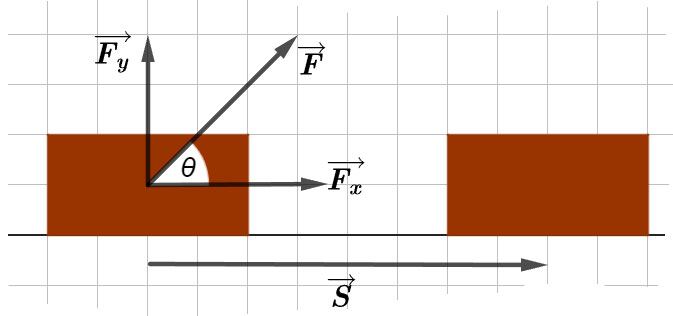
2. Mathematical Expression
- If force and displacement are in the same direction:
[W = F s] - If force and displacement are perpendicular:
[W = 0]
(Example: A person carrying a load while walking horizontally — no work is done on the load.) - If force and displacement are in opposite directions:
[W = -F s]
(Example: Friction acting opposite to motion.)

3. Unit and Dimensions
- SI Unit: Joule (J)
1 Joule = Work done when a force of 1 newton displaces a body by 1 metre in the direction of force.
[1 J = 1 N \times 1 m = 1 kg·m^2·s^{-2}] - CGS Unit: Erg
[1, J = 10^7 erg]
4. Positive, Negative and Zero Work
- Positive Work:
When the angle [θ < 90°]; force has a component in the direction of displacement.
(e.g., force applied to move an object forward)- When an object falls freely due to gravity, the work done by the gravitational force is positive.
- When a horse pulls a cart on a flat surface, the resulting work is positive.
- Negative Work:
When [θ > 90°]; force opposes the motion.
(e.g., frictional force or air resistance)- When an object is pushed across a rough surface, the work done by friction (opposing force) is negative.
- When a positive charge is moved towards another positive charge, the work done by the repulsive electrostatic force is negative.
- Zero Work:
When [θ = 90°]; force and displacement are perpendicular.
(e.g., centripetal force in uniform circular motion)- When a porter walks along a platform carrying a load on his head, the work done by him is zero.
- When an object is moved along a circular path by a string, the tension in the string does no work.
- When a person holds a heavy object without moving, no work is done.
5. Work Done by Variable Force
If force varies with displacement, the work done is the area under the F–x graph:
[W = \int_{x_1}^{x_2} F(x), dx]
Thus, graphical interpretation connects to integration from mathematics.
6. Work Done by a Force in Vector Form
Work is the dot product of force and displacement vectors:
[W = \vec{F} \cdot \vec{s}]
Hence, it is a scalar quantity (though derived from vectors).
7. Work Done by Gravitational Force
For a body of mass [m] raised to height [h]:
[W = mgh]
Here, the work done against gravity is stored as potential energy.
8. Work Done by a Spring Force
From Hooke’s Law: [F = -kx]
Work done in stretching or compressing a spring by displacement [x]:
[W = \int_{0}^{x} F,dx = -\frac{1}{2}kx^2]
(The negative sign shows the restoring nature of spring force.)
9. Graphical Interpretation
The area under the Force–Displacement (F–x) graph gives the work done.
- For constant force: area = rectangle = [F × s]
- For variable force: area = region under curve = [∫F(x)dx]
11. Practical Examples
Example 1: A man weighing 80 kgf carries a stone of weight 20 kgf to the top of the building 30 m high. Calculate the work done by him. Given $ \displaystyle g=9.8m/{{s}^{2}}$.
Solution:
Here weight of the man = 80 kgf, weight of stone = 20 kgf
Force applied to carry the total weight up,
$ \displaystyle \begin{array}{l}F=80+20=100\text{ kgf}\\=100\times 9.8=980\text{ N}\end{array}$
Height through which weight is carried, $ \displaystyle S=30\text{ m}$
Therefore work done is given by,
$ \displaystyle W=FS=980\times 30=29400J$
Example 2: A body constrained to move along z-axis of a co-ordinate system is subject to a constant force
$ \displaystyle \overrightarrow{F}=-\widehat{i}+2\widehat{j}+3\widehat{k}\text{ N}$,
where $ \displaystyle \widehat{i},\widehat{j},\widehat{k}$ are unit vectors along the X, Y, and Z-axis of the system respectively. What is the work done by this force in moving the body a distance of 4 m along the Z-axis?
Solution:
Here, $ \displaystyle \overrightarrow{F}=-\widehat{i}+2\widehat{j}+3\widehat{k}\text{ N}$
Since, body moves a distance of 4 m along Z-axis, $ \displaystyle \overrightarrow{S}=4\widehat{k}\text{ m}$
Now,
$ \displaystyle \begin{array}{l}W=\overrightarrow{F}\cdot \overrightarrow{S}\\=\left( {-\widehat{i}+2\widehat{j}+3\widehat{k}\text{ N}} \right)\cdot \left( {4\widehat{k}} \right)\\=-4\left( 0 \right)+8\left( 0 \right)+12\left( 1 \right)=12\text{ J}\end{array}$
Example 3: Calculate the amount of work done in raising a glass of water weighing 0.5 kg through a height of 20 cm. Take $g = 10 \, \text{ms}^{-2}$.
Solution:
Here, $m = 0.5 \, \text{kg}$
$$
h = 20 \, \text{cm} = \frac{20}{100} = 0.2 \, \text{m}
$$
$$
g = 10 \, \text{ms}^{-2}
$$
Work done $= \text{force} \times \text{distance}$
$ \displaystyle W=mg\times h$
$ \displaystyle =0.5\times 10\times \frac{1}{5}=1\text{J}$
10. Conceptual Questions
1. When is work said to be done in physics?
When a force causes displacement in the direction of force.
2. Why does a person carrying a heavy load on the head while walking horizontally do no work on the load?
Because the displacement is perpendicular to the force (weight), hence [W = F s cos90° = 0].
3. Why is work done against gravity considered positive?
Because the displacement is in the direction of applied force (upward), opposite to gravitational force.
4. What kind of work is done by friction?
Friction usually does negative work since it opposes motion.
5. Can a force do zero work on a moving object?
Yes, when the force is perpendicular to the direction of motion.
6. Why is work a scalar quantity?
Because it results from the dot product of two vectors — force and displacement — yielding a scalar.
7. What does a negative area under the F–x graph signify?
It indicates that the work done is negative, i.e., force opposes motion.
8. Does work depend on path?
For constant forces, work depends only on the displacement, not on the path taken.
9. Why is gravitational work path independent?
Because gravitational force is a conservative force.
10. Is work done in uniform circular motion?
No, because the force (centripetal) is always perpendicular to the displacement.
11. Why does work done by friction depend on path?
Because friction is a non-conservative force.
12. What is the work done when lifting a 10 kg object by 2 m?
[W = mgh = 10 × 9.8 × 2 = 196 J].
13. When is total work done on a system zero?
When the net force on the system is zero or displacement is zero.
14. Can work done be fractional or negative?
Yes, depending on the direction of force relative to displacement.
15. What is the physical meaning of one Joule?
It is the work done when a 1 N force moves an object by 1 m in its direction.
11. FAQs / Common Misconceptions
1. Is work always positive when a body moves?
No, work can be positive, negative, or zero depending on the angle between force and displacement.
2. Is “no work done” equivalent to “no force acting”?
No, even if a force acts, work may be zero if displacement is perpendicular to force.
3. Can displacement be non-zero and work be zero?
Yes, if the force is perpendicular to displacement.
4. Why is work not a vector?
Because it’s defined by the dot product of vectors, which gives a scalar result.
5. Does the sign of work depend on direction of motion?
Yes, positive if force aids motion, negative if it resists motion.
 Continue with Google