


1. Introduction
When a force acts on a body, it can produce two kinds of motion:
- Translational motion – movement in a straight line.
- Rotational motion – turning about a fixed point or axis.
The rotational effect of a force is measured by a physical quantity called Torque (also called moment of force).
2. Definition
The torque of a force about a point (or axis) is the product of the magnitude of the force and the perpendicular distance of the line of action of the force from that point.
[\tau = F \times r_\perp]
where
- [\tau] = torque (or moment of force)
- [F] = magnitude of force applied
- [r_\perp] = perpendicular distance from the axis of rotation to the line of action of force
3. Vector Form
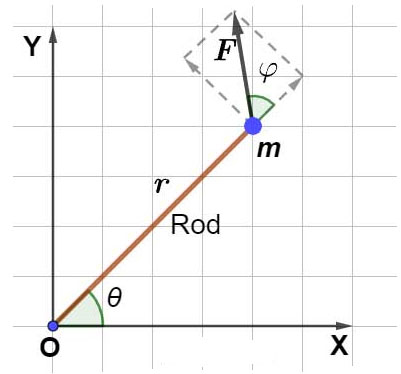
If [\vec{r}] is the position vector of the point of application of the force from the axis and [\vec{F}] is the force applied, then:
[\vec{\tau} = \vec{r} \times \vec{F}]
The direction of [\vec{\tau}] is perpendicular to the plane formed by [\vec{r}] and [\vec{F}] and is given by the right-hand rule.
4. Magnitude of Torque
[\tau = r F \sin\theta]
where [\theta] is the angle between [\vec{r}] and [\vec{F}].
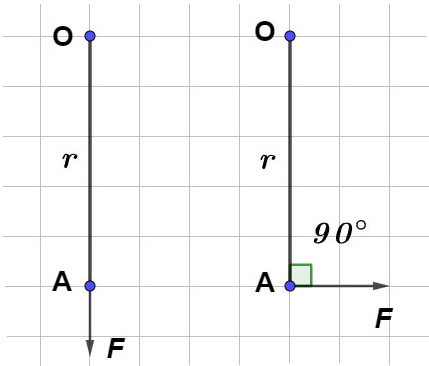
- If [\theta = 0°] or [180°], then [\sin\theta = 0] ⇒ [\tau = 0]
→ Force produces no rotation. - If [\theta = 90°], then [\tau = rF]
→ Force produces maximum rotation.
5. Unit and Dimensions
- SI Unit: [N·m] (newton meter)
- CGS Unit: [dyne·cm]
- Dimensional Formula: [M L² T⁻²]
6. Direction of Torque
- Torque is a vector quantity.
- Direction is given by right-hand rule:
- Curl the fingers of your right hand from [\vec{r}] to [\vec{F}].
- The thumb gives the direction of torque.
If torque tends to rotate the body anticlockwise, it is positive;
if clockwise, it is negative.
7. Conditions of Rotational Equilibrium
A body is in rotational equilibrium if the net torque acting on it is zero:
[\sum \vec{\tau} = 0]
This means the body does not experience angular acceleration.
8. Relation to Linear Motion (Integrated Concept)
| Linear Motion | Rotational Motion |
|---|---|
| Force [F] produces linear acceleration [a] | Torque [\tau] produces angular acceleration [\alpha] |
| [F = m a] | [\tau = I \alpha] |
| [p = m v] | [L = I \omega] |
Related Concept- Force, Moment of Inertia
9. Example Problems
Example 1
A force of [10 N] acts at the end of a spanner of length [0.25 m] at right angles.
Find the torque about the nut.
[\tau = rF\sin\theta] [= 0.25 \times 10 \times \sin 90° = 2.5\ N·m]
Example 2
A door 1.2 m wide requires a minimum force of 20 N to open it.
If the force is applied at 60° to the door surface, calculate the torque.
[\tau = r F \sin\theta] [= 1.2 \times 20 \times \sin 60° = 20.8\ N·m]
10. Practical Applications
- Opening a door (force at handle gives more torque).
- Using a wrench or spanner.
- Tightening or loosening bolts.
- Steering a car with a wheel (larger radius → larger torque).
- Balancing seesaws and levers.
11. Conceptual Questions
1. What does torque physically represent?
Torque measures the rotational effect of a force about an axis.
2. Why is torque maximum when force acts at 90°?
Because [\sin\theta] is maximum (1) at 90°, giving maximum moment arm.
3. Why does pushing near the hinges of a door make it harder to open?
The perpendicular distance (moment arm) [r] is small, so torque is small.
4. What is the torque when the force passes through the axis of rotation?
Zero, since [r_\perp = 0].
5. Can torque be negative?
Yes. Clockwise torque is taken as negative, anticlockwise as positive.
6. Is torque a scalar or a vector?
It is a vector, directed perpendicular to the plane of rotation.
7. Does greater force always mean greater torque?
Not necessarily — torque also depends on the lever arm and angle.
8. What happens to torque if the line of action of force passes through the pivot?
Torque becomes zero because [r_\perp = 0].
9. How can torque be increased without increasing force?
By increasing the lever arm (distance from pivot).
10. Why is torque important in engines?
It determines the rotational power output, affecting acceleration and load-handling.
12. FAQs / Common Misconceptions
1. Is torque the same as work?
No. Torque causes rotation, while work is energy transfer due to displacement.
2. Can torque exist without rotation?
Yes, in equilibrium conditions — equal and opposite torques can balance each other.
3. If torque is zero, does that mean force is zero?
Not necessarily. Force may exist, but if it passes through the axis, torque = 0.
4. Why is torque measured in N·m and not in Joules?
Though dimensions are same, torque represents rotational effect, not energy.
5. What is the significance of the right-hand rule in torque?
It helps determine the direction of the torque vector.
 Continue with Google