


1. Introduction
In rotational dynamics, the radius of gyration provides a simplified way of expressing how mass is distributed about an axis of rotation.
It converts a complex distribution of mass into an equivalent single-distance measure.
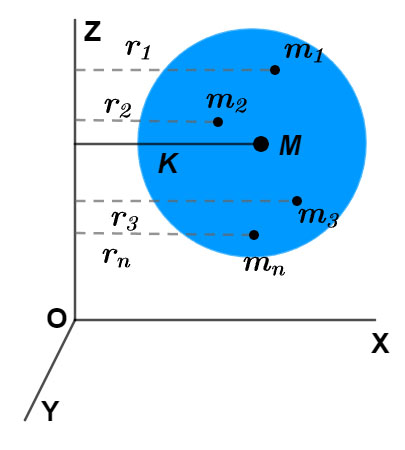
The radius of gyration ([ k ]) is defined such that if the entire mass ([ M ]) of the body were concentrated at a distance [ k ] from the axis, it would produce the same moment of inertia ([ I ]) as the actual distribution of mass.
2. Definition and Formula
Mathematically, the moment of inertia of a rigid body is given by:
[ I = \sum m_i r_i^2 ]
If all the mass were imagined to be at a distance [ k ] from the axis:
[ I = M k^2 ]
Hence, the radius of gyration is:
[ k = \sqrt{\dfrac{I}{M}} ]
3. Units and Dimensions
- SI Unit: metre [m]
- Dimensional Formula: [ L ]
(It represents a length — the equivalent distance of mass from the axis.)
4. Physical Meaning
- The radius of gyration gives an idea of how spread out the mass is around the axis.
- A larger [ k ] means the mass is farther from the axis → larger moment of inertia → harder to rotate.
- A smaller [ k ] means the mass is closer to the axis → smaller moment of inertia → easier to rotate.
5. Relation Between [ I ], [ M ], and [ k ]
[ I = M k^2 ]
This relationship helps compare different bodies easily, since the ratio [ k = \sqrt{I/M} ] directly reflects how mass distribution affects rotational inertia.
6. Example Values of [ k ] for Common Bodies
| Body | Axis of Rotation | Moment of Inertia [ I ] | Radius of Gyration [ k ] |
|---|---|---|---|
| Thin Rod (about center) | Perpendicular to length | [ \dfrac{1}{12} M L^2 ] | [ \dfrac{L}{2\sqrt{3}} ] |
| Thin Rod (about one end) | Perpendicular to length | [ \dfrac{1}{3} M L^2 ] | [ \dfrac{L}{\sqrt{3}} ] |
| Ring (about central axis) | Perpendicular to plane | [ M R^2 ] | [ R ] |
| Solid Disc (about central axis) | Perpendicular to plane | [ \dfrac{1}{2} M R^2 ] | [ \dfrac{R}{\sqrt{2}} ] |
| Solid Sphere (about diameter) | Through center | [ \dfrac{2}{5} M R^2 ] | [ \sqrt{\dfrac{2}{5}} R ] |
7. Relation Between Two Axes (Using Parallel Axis Theorem)
If the radius of gyration about an axis through the center of mass is [ k_c ],
and another parallel axis is at a distance [ d ] away, then:
[ I = I_c + M d^2 ]
Substituting [ I = M k^2 ] and [ I_c = M k_c^2 ]:
[ M k^2 = M k_c^2 + M d^2 ]
or,
[ k^2 = k_c^2 + d^2 ]
8. Conceptual Questions
1. What does the radius of gyration represent physically?
It represents the equivalent distance from the axis where the entire mass could be concentrated to produce the same moment of inertia.
2. How is the radius of gyration related to the moment of inertia?
They are related by [ I = M k^2 ], or [ k = √(I / M) ].
3. Does a larger radius of gyration mean a larger moment of inertia?
Yes, because [ I ∝ k^2 ]. A larger [ k ] implies mass is farther from the axis, increasing rotational inertia.
4. For two bodies of equal mass, what does a greater radius of gyration indicate?
It indicates that the body’s mass is distributed farther from the axis of rotation.
5. Can two bodies have the same radius of gyration but different masses?
Yes. The radius of gyration depends on the distribution of mass, not its total value.
6. How is the radius of gyration useful in comparing rotational properties?
It provides a single length-based measure to compare how easily different shapes can rotate about a given axis.
7. What happens to the radius of gyration if the axis is shifted away from the center?
It increases according to [ k^2 = k_c^2 + d^2 ].
8. Does the radius of gyration depend on angular velocity?
No, it depends only on mass distribution and axis location, not on rotation speed.
9. Between a solid and a hollow sphere of equal radius, which has greater radius of gyration?
The hollow sphere, because its mass lies farther from the axis.
10. How can radius of gyration simplify rotational calculations?
It allows you to replace the distributed mass with an equivalent point mass at distance [ k ], simplifying moment of inertia calculations.
11. What does a small value of [ k ] imply about a body’s rotation?
The body’s mass is concentrated near the axis, so it’s easier to rotate.
12. For a rod, how does [ k ] change when the axis is moved from the center to one end?
[ k ] increases because the average distance of mass elements from the new axis increases.
13. Why is the radius of gyration always positive?
Because [ k = √(I/M) ] and both [ I ] and [ M ] are positive quantities.
14. Is the radius of gyration the same for all axes of the same body?
No, it depends on the chosen axis since [ I ] varies with axis orientation.
15. How does the radius of gyration relate to structural engineering applications?
It helps determine a structure’s resistance to bending or buckling, as it reflects how mass or area is distributed about an axis.
9. FAQ / Common Misconceptions
1. Is the radius of gyration a physical radius?
No. It’s an equivalent length that represents mass distribution, not a physical boundary of the body.
2. Does a higher mass always mean a greater radius of gyration?
Not necessarily — [ k ] depends on how the mass is distributed, not its amount.
3. Can the radius of gyration be zero?
Only in theory if all mass is located exactly on the axis of rotation, which is not physically possible for a finite-sized body.
4. Does radius of gyration depend on the shape of the object?
Yes, different shapes distribute mass differently, so even for equal mass and size, [ k ] varies.
5. Is radius of gyration useful only in rotational motion?
No — it is also used in structural mechanics to analyze stiffness and stability of columns and beams.
 Continue with Google