


1. Introduction
The moment of inertia (M.I.) of a uniform thin circular ring depends on the axis of rotation.
In this case, the rotation axis is a tangent to the ring and is perpendicular to the plane of the ring.
We can determine its moment of inertia using the theorems of perpendicular and parallel axes.
2. Given Data
- Mass of the ring = [ M ]
- Radius of the ring = [ R ]
- Axis of rotation: Tangent to the ring and perpendicular to its plane.
3. Conceptual Understanding
A tangent perpendicular to the plane of the ring is parallel to the diameter of the ring.
Thus, to find the moment of inertia about this tangent, we can apply both:
- The Perpendicular Axis Theorem, and
- The Parallel Axis Theorem.
4. Step-by-Step Derivation
Step 1: Moment of Inertia about the center (C) and perpendicular to the plane
For a circular ring,
[
I_Z = MR^2
]
where [ I_Z ] is the M.I. about an axis perpendicular to the plane and passing through the center.
Step 2: Moment of Inertia about any diameter (in the plane of the ring)
By the Perpendicular Axis Theorem,
[
I_Z = I_X + I_Y
]
Since the ring is symmetrical,
[
I_X = I_Y = \dfrac{1}{2}I_Z = \dfrac{1}{2}MR^2
]
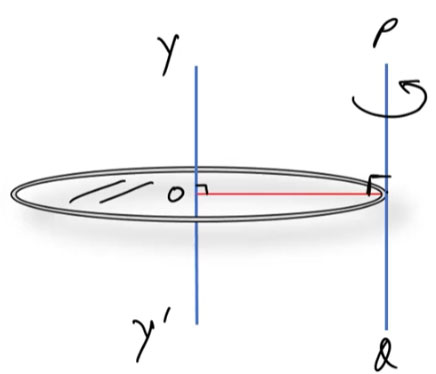
Step 3: Moment of Inertia about a tangent perpendicular to the plane
The tangent is parallel to the Z-axis and at a distance R from it.
Hence, using the Parallel Axis Theorem:
[
I = I_Z + MR^2
]
Substituting [ I_Z = MR^2 ],
[
I = MR^2 + MR^2 = 2MR^2
]
Final Result
[
\boxed{I = 2MR^2}
]
Thus, the moment of inertia of a uniform thin circular ring about a tangent perpendicular to the plane of the ring is [ 2MR^2 ].
5. Key Features
- This result is derived using both theorems (Perpendicular and Parallel Axis).
- The axis is outside the plane but parallel to the central axis.
- The ring’s symmetry simplifies the calculations.
- This M.I. is twice that about its central perpendicular axis.
6. Important Formulas to Remember
| Quantity | Formula | Description |
|---|---|---|
| M.I. about axis perpendicular to plane through center | [ I_Z = MR^2 ] | For ring |
| M.I. about any diameter in the plane | [ I_X = I_Y = \dfrac{1}{2}MR^2 ] | From Perpendicular Axis Theorem |
| Parallel Axis Theorem | [ I = I_{CM} + Mh^2 ] | Shifted axis |
| M.I. about tangent ⟂ to plane | [ I = 2MR^2 ] | Final result |
Conceptual Questions
1. What is the axis of rotation in this case?
A tangent to the ring that is perpendicular to the plane of the ring.
2. Which two theorems are used to find the moment of inertia here?
The **Perpendicular Axis Theorem** and the **Parallel Axis Theorem**.
3. What is the M.I. of the ring about an axis perpendicular to its plane and through its center?
[ I_Z = MR^2 ].
4. What is the M.I. about any diameter of the ring?
[ I_X = \dfrac{1}{2}MR^2 ].
5. Why is the M.I. about the tangent greater than about the center?
Because the tangent axis is farther from the mass distribution, increasing [ I ] by [ MR^2 ].
6. What does the term [ MR^2 ] in the parallel axis theorem represent?
The additional moment of inertia due to the shift of the axis by distance [ R ].
7. How are [ I_Z ] and [ I_X ] related in a circular ring?
[ I_Z = 2I_X ].
8. Is this result valid for a solid disc?
No, this derivation specifically applies to a **thin ring**, not a disc.
9. What would happen if the tangent were in the plane of the ring?
The value of M.I. would be different; the perpendicular axis theorem would not directly apply.
10. Why is this concept important?
It helps analyze rotational motion of ring-like objects when rotating about external axes.
FAQ / Common Misconceptions
1. Is the tangent axis through the center of mass?
No, it’s parallel to the central axis but displaced by [ R ].
2. Can the same expression be used for a disc?
No, because a disc has a different mass distribution and M.I. values.
3. Why can we apply both perpendicular and parallel axis theorems here?
Because the axis in question can be related geometrically to the ring’s central and planar axes.
4. Does the result depend on the mass density of the ring?
Only through total mass [ M ]; the ring must be uniform for this relation.
5. Is [ I = 2MR^2 ] an approximate or exact result?
It is an exact analytical result derived from fundamental theorems.
 Continue with Google