


1. Concept Overview
A uniform thin circular ring has its entire mass distributed uniformly along its circumference. The moment of inertia (M.I.) of this ring depends on the axis of rotation.
Here, we find the M.I. of the ring about a tangent lying in the plane of the ring.
2. Derivation
Let:
- Mass of the ring = [ M ]
- Radius of the ring = [ R ]
We already know:
- M.I. about a diameter of the ring (in its plane) = [ I_{D} = \dfrac{1}{2} M R^2 ]
- M.I. about an axis perpendicular to the plane of the ring and passing through its center = [ I_{C} = M R^2 ]
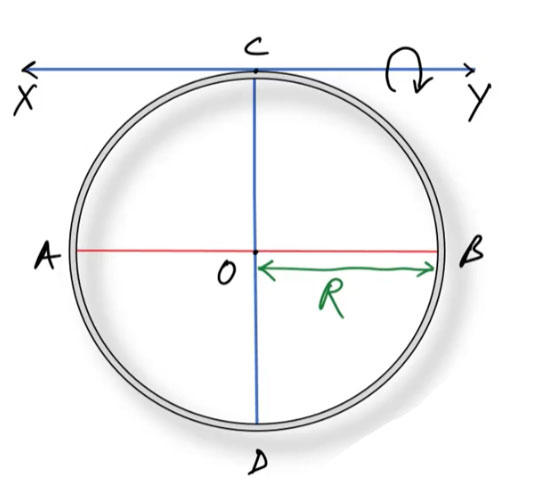
Now, using the Parallel Axis Theorem,
If the new axis is tangent to the ring and lies in the plane of the ring, then:
[
I_{T} = I_{D} + M R^2
]
Substitute [ I_{D} = \dfrac{1}{2} M R^2 ]:
[
I_{T} = \dfrac{1}{2} M R^2 + M R^2 = \dfrac{3}{2} M R^2
]
Hence,
[
\boxed{I_{T} = \dfrac{3}{2} M R^2}
]
3. Physical Significance
This shows that the moment of inertia of a ring about a tangent in the plane of the ring is 1.5 times the M.I. about a diameter of the ring.
It reflects that the resistance to rotational motion is greater when the axis is moved away from the center due to the parallel axis effect.
4. Key Features
- The axis is tangent and lies in the plane of the ring.
- The derivation uses the Parallel Axis Theorem.
- The M.I. increases because the distance between the tangent and the center adds a term [ M R^2 ] to the moment of inertia.
- The final expression: [ I_{T} = \dfrac{3}{2} M R^2 ]
Important Formulas to Remember
| Quantity | Formula | Description |
|---|---|---|
| M.I. about a diameter (in-plane) | [ I_{D} = \dfrac{1}{2} M R^2 ] | Axis passes through center, in-plane |
| M.I. about tangent in plane | [ I_{T} = \dfrac{3}{2} M R^2 ] | Axis tangent and in-plane |
| M.I. about axis perpendicular to plane (through center) | [ I_{C} = M R^2 ] | Axis through center, perpendicular to plane |
| Relation used | [ I_{T} = I_{D} + M R^2 ] | Parallel Axis Theorem |
Conceptual Questions
1. What is the moment of inertia of a ring about a tangent in its plane?
[ I_{T} = \dfrac{3}{2} M R^2 ]
2. Which theorem is used to derive this relation?
The Parallel Axis Theorem is used.
3. What is the M.I. about the diameter of the ring in its plane?
[ I_{D} = \dfrac{1}{2} M R^2 ]
4. How is the M.I. about the tangent in plane related to that about the diameter?
[ I_{T} = I_{D} + M R^2 = \dfrac{3}{2} M R^2 ]
5. Why is the M.I. about the tangent greater than that about the diameter?
Because the tangent is farther from the center, adding [ M R^2 ] as per the Parallel Axis Theorem.
6. What happens to the M.I. if the radius is doubled?
It becomes four times, since [ I \propto R^2 ].
7. Does the M.I. depend on the thickness of the ring?
No, as long as the ring is thin and mass is uniformly distributed.
8. What will happen to M.I. if mass is doubled?
The M.I. also doubles because [ I \propto M ].
9. What is the physical meaning of M.I.?
It measures the resistance of a body to rotational motion about a given axis.
10. Is this result valid for a disc?
No, because the mass distribution of a disc is different from that of a ring.
11. Can the Parallel Axis Theorem be applied to any axis?
Yes, provided the new axis is parallel to an axis through the center of mass.
12. Which has a larger M.I.—a tangent in plane or tangent perpendicular to plane?
The tangent **perpendicular to plane** has a larger M.I. because its base M.I. is [ M R^2 ] instead of [ \dfrac{1}{2} M R^2 ].
13. How is this concept used in rotational mechanics?
It helps calculate rotational kinetic energy and angular acceleration for rings.
14. Does the M.I. change if the ring is rotated about its tangent vertically?
No, because M.I. depends only on the geometry and mass distribution, not on orientation.
15. What is the ratio of M.I. about tangent in plane to diameter in plane?
[ \dfrac{I_{T}}{I_{D}} = \dfrac{\dfrac{3}{2} M R^2}{\dfrac{1}{2} M R^2} = 3 ]
FAQ / Common Misconceptions
1. Is the tangent axis through the center of the ring?
No, it is parallel to the diameter but touches the ring at one point.
2. Do we use the Perpendicular Axis Theorem here?
No, we use the **Parallel Axis Theorem** because the new axis is parallel to one through the center.
3. Why is the M.I. greater for tangent in plane than diameter?
Because the tangent is farther from the center, increasing the M.I. by [ M R^2 ].
4. Can this result be applied to non-circular objects?
No, it is specific to circular rings due to their uniform curvature.
5. Is the factor 3/2 universal for all ring axes?
No, it only applies for a tangent **in the plane of the ring**.
 Continue with Google