


1. Concept Overview
The moment of inertia (M.I.) of a body depends on how its mass is distributed relative to the chosen axis of rotation.
For a thin uniform rod, the M.I. about an axis perpendicular to its length and passing through one edge (end) is greater than that through its center, because more mass lies farther from the axis.
This case is fundamental in understanding the dynamics of pendulums, rotating rods, and mechanical linkages.
2. Derivation
Let:
- Mass of the rod = [ M ]
- Length of the rod = [ L ]
- Linear mass density = [ \lambda = \dfrac{M}{L} ]
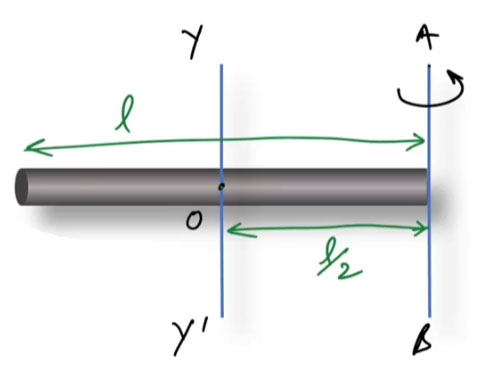
Consider a small element of length [ dx ] at a distance [ x ] from the axis at one end.
The mass of this element is:
[
dm = \lambda , dx
]
Moment of inertia of this element about the axis is:
[
dI = x^2 , dm = \lambda x^2 , dx
]
Integrating over the whole length of the rod (from [ 0 ] to [ L ]):
$ \displaystyle I = \int_{0}^{L} \lambda x^2 dx$ $ \displaystyle = \lambda \left[\dfrac{x^3}{3}\right]_0^L = \lambda \dfrac{L^3}{3}$
Substitute [ \lambda = \dfrac{M}{L} ]:
[
I = \dfrac{M}{L} \cdot \dfrac{L^3}{3} = \boxed{I = \dfrac{1}{3} M L^2}
]
3. Alternate Verification using the Parallel Axis Theorem
Moment of inertia of the rod about an axis through its center (perpendicular to the length):
[
I_{center} = \dfrac{1}{12} M L^2
]
By the Parallel Axis Theorem:
[I_{edge} = I_{center} + M\left(\dfrac{L}{2}\right)^2] [= \dfrac{1}{12} M L^2 + \dfrac{1}{4} M L^2 = \dfrac{1}{3} M L^2]
Thus, both methods give the same result.
4. Physical Significance
- The M.I. about an end is larger than that about the center.
- The reason: most of the rod’s mass lies away from the rotation axis.
- It quantifies the rotational resistance of a rod hinged or supported at one end.
- Commonly used in systems like physical pendulums or cantilever rods.
5. Key Features
- Axis: Perpendicular to length, passes through one edge (end).
- Distribution: Uniform mass along a straight line.
- Direct integration or Parallel Axis Theorem yields the same result.
- Formula: [ I_{edge} = \dfrac{1}{3} M L^2 ].
6. Important Formulas to Remember
| Axis of Rotation | Moment of Inertia | Formula | Remarks |
|---|---|---|---|
| Through center (⊥ to length) | [ I_{center} ] | [ \dfrac{1}{12} M L^2 ] | Axis passes through midpoint |
| Through one edge (⊥ to length) | [ I_{edge} ] | [ \dfrac{1}{3} M L^2 ] | Axis passes through one end |
| Relation between both | [ I_{edge} = I_{center} + M\left(\dfrac{L}{2}\right)^2 ] | From Parallel Axis Theorem |
7. Conceptual Questions
1. What is the M.I. of a uniform rod about an axis through one end and perpendicular to its length?
[ I_{edge} = \dfrac{1}{3} M L^2 ]
2. How is M.I. about the end related to that about the center?
[ I_{edge} = I_{center} + M\left(\dfrac{L}{2}\right)^2 ]
3. What theorem connects these two moments of inertia?
The **Parallel Axis Theorem**.
4. Which has a greater M.I.—about the center or about one end?
The M.I. about one end is greater.
5. Why is the M.I. greater when the axis passes through one end?
Because the average distance of mass elements from the axis is greater.
6. What is the ratio of M.I. about the end to that about the center?
[ \dfrac{I_{edge}}{I_{center}} = \dfrac{(1/3)}{(1/12)} = 4 ]
7. How does the M.I. depend on the length of the rod?
[ I \propto L^2 ]
8. What is the unit of M.I. in the SI system?
[ \text{kg·m}^2 ]
9. Does the M.I. depend on the orientation of the rod?
Yes, changing the axis changes the M.I.
10. If the mass of the rod is doubled, how does M.I. change?
It doubles, since [ I \propto M ].
11. What happens to the M.I. if the length is doubled?
It becomes four times, since [ I \propto L^2 ].
12. Why is M.I. a scalar quantity?
It depends only on magnitude of mass and distance, not on direction.
13. Can the same formula be used for a non-uniform rod?
No, because mass distribution would vary along the length.
14. What physical motion corresponds to this M.I.?
Rotation about a fixed end, such as in a **simple pendulum** or **beam**.
15. Why is the Parallel Axis Theorem essential here?
It relates the M.I. about any axis to one through the center of mass.
8. FAQ / Common Misconceptions
1. Is the axis through the center and the end the same?
No, they are **parallel** but not coincident; one passes through the midpoint, the other through one end.
2. Does the M.I. remain same for horizontal and vertical rods?
Yes, orientation doesn’t affect M.I. — only the position of the axis matters.
3. Does the M.I. depend on the thickness of the rod?
No, for a **thin** rod, thickness is negligible.
4. Can M.I. ever be zero for this rod?
No, because all mass elements are at some distance from the axis.
5. Is [ \dfrac{1}{3} M L^2 ] applicable to any shape?
No, it’s specific to a **thin uniform rod** rotating about an end.
 Continue with Google