


1. Concept Overview / Statement of the Law
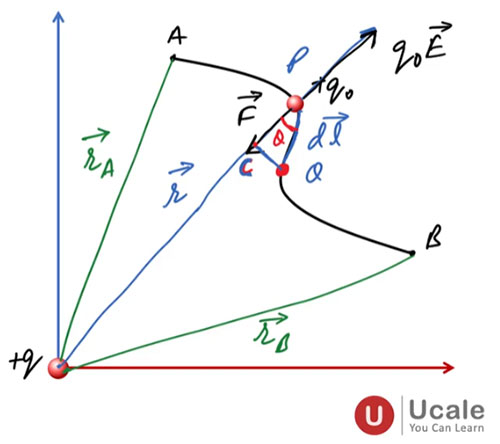
The line integral of an electrostatic field along a path from point A to point B is defined as:
[W_{AB} = \int_A^B \vec{E} \cdot d\vec{l}]
It gives the work done by the electric field in moving a test charge from point A to B.
For electrostatic fields, which are conservative, this line integral depends only on the end points, not the path.
2. Explanation and Mathematical Derivation
Consider an electrostatic field (\vec{E}) and a small displacement (d\vec{l}).
The work done by the field in moving a test charge (dq) is:
[
dW = dq, \vec{E} \cdot d\vec{l}
]
For unit positive test charge [(dq = 1)]:
[
dW = \vec{E} \cdot d\vec{l}
]
Total work done from A to B:
[
W_{AB} = \int_A^B \vec{E} \cdot d\vec{l}
]
Relation With Electrostatic Potential
The electrostatic potential difference is defined as:
[V_B – V_A] = [- \int_A^B \vec{E} \cdot d\vec{l}]
Thus,
[
\vec{E} = -\nabla V
]
Electrostatic field is irrotational, i.e.,
[
\nabla \times \vec{E} = 0
]
This is the fundamental reason why electrostatic fields are conservative, and therefore the line integral is path independent.
3. Dimensions and Units
| Quantity | Dimensions | SI Unit |
|---|---|---|
| Electric field, [E] | [[M L T^{-3} A^{-1}]] | N/C or V/m |
| Potential difference, [V] | [[M L^2 T^{-3} A^{-1}]] | volt (V) |
| Work, [W] | [[M L^2 T^{-2}]] | joule (J) |
4. Key Features
- The line integral measures work done by the field.
- Electrostatic field is conservative → path-independent integral.
- The line integral determines potential difference between two points.
- Negative sign indicates work done against the field increases potential.
- For closed path:[
\oint \vec{E} \cdot d\vec{l} = 0
] - The concept is used to define electrical potential, work-energy relations, and capacitor theory.
5. Important Formulas to Remember
| Concept | Formula |
|---|---|
| Line integral of electrostatic field | [W_{AB}] [= \int_A^B \vec{E} \cdot d\vec{l}] |
| Potential difference | [V_B – V_A] [= -\int_A^B \vec{E} \cdot d\vec{l}] |
| E in terms of potential | [\vec{E} = -\nabla V] |
| Closed loop integral | [\oint \vec{E} \cdot d\vec{l} = 0] |
6. Conceptual Questions with Solutions
1. Why is the electrostatic field conservative?
Because charges are at rest and electric field originates from stationary charges, giving [\nabla \times \vec{E} = 0]. Thus the field has zero curl, making it conservative.
2. What does the line integral physically represent?
The work done by the electric field in moving a unit positive test charge from point A to point B.
3. Why is the line integral path independent?
Because electrostatic field is conservative; work depends only on the initial and final points, not on how the path is taken.
4. Why is there a negative sign in the potential formula?
It shows that potential decreases in the direction of electric field; work done by the field is negative of work done against the field.
5. Does the closed loop integral of electrostatic field always vanish?
Yes, for electrostatic fields: [\oint \vec{E} \cdot d\vec{l} = 0].
6. Can the line integral be zero even if field is non-zero?
Yes, if the net contribution along the path cancels out geometrically or due to symmetry.
7. Does the line integral depend on the magnitude of test charge?
No. It is defined for unit test charge.
8. What happens if field is not electrostatic?
For time-varying fields, [\nabla \times \vec{E} \neq 0], line integral becomes path dependent.
9. How does symmetry help in evaluating the line integral?
It simplifies the dot product [\vec{E} \cdot d\vec{l}], often reducing integration to a single variable.
10. Is potential difference equal to work done by the field?
No. It is negative of that work: [V_B – V_A = -W_{AB}].
11. Why is electric field equal to negative gradient of potential?
Because potential decreases most rapidly along the direction of electric field.
12. Can electric field be zero but potential non-zero?
Yes. Inside a conductor, [E=0] but [V] is constant and may not be zero.
13. How does the line integral change sign when reversing limits?
[\int_A^B = – \int_B^A]. This reflects opposite direction of displacement.
14. Is potential defined even for non-conservative fields?
Not globally; potential exists only for conservative fields.
15. Why is the integral evaluated using dot product?
Because only the component of field along displacement contributes to work.
7. FAQ / Common Misconceptions
1. Misconception: Line integral gives total energy stored.
No. It gives work done in moving a test charge between two points.
2. Misconception: Electrostatic line integral is always positive.
No. It depends on direction; can be positive, negative, or zero.
3. Misconception: Potential always increases when moving in a field.
It only increases when moving against the field.
4. Misconception: Path always matters in work done.
Not for electrostatics. Path matters only for non-conservative fields.
5. Misconception: Zero line integral implies zero field.
False. Net work may cancel while field is present.
6. Misconception: Line integral always increases with distance.
Depends on orientation with field and path taken.
7. Misconception: Potential difference is a vector.
No. It is a scalar quantity.
8. Misconception: Electrostatic potential is zero at infinity by definition.
Only for isolated charges; it’s a chosen convention, not physical law.
9. Misconception: Line integral cannot be negative.
It can be negative when displacement is along electric field.
10. Misconception: Only straight paths are useful for line integrals.
Any path works; result is path independent.
8. Practice Questions (With Step-by-Step Solutions)
Q1. Calculate the work done by an electric field [\vec{E} = 10\hat{i}] in moving a unit test charge from [x = 0] to [x = 5].
Step 1: Use definition
[
W = \int_A^B \vec{E} \cdot d\vec{l}
]
[
d\vec{l} = dx,\hat{i}
]
[
\vec{E} \cdot d\vec{l} = 10, dx
]
Step 2: Integrate
[
W = \int_0^5 10, dx = 50,\text{J}
]
Answer:
[
W = 50\text{ J}
]
Q2. If [\vec{E} = \dfrac{kq}{r^2}\hat{r}], find the work done in moving a test charge from [r_1] to [r_2] radially.
Solution:
[
W = \int_{r_1}^{r_2} \dfrac{kq}{r^2} dr
]
[W = kq \left(-\dfrac{1}{r}\right)_{r_1}^{r_2}]
[
W = kq \left(\dfrac{1}{r_1} – \dfrac{1}{r_2}\right)
]
Q3. The electric field is tangential to the path everywhere. What is the line integral?
[
W = \int E, dl
]
Because [\vec{E} \parallel d\vec{l}]:
[
\vec{E} \cdot d\vec{l} = E,dl
]
Q4. The electric field is perpendicular to the path. What is the line integral?
Since:
[
\vec{E} \cdot d\vec{l} = 0
]
[
W = 0
]
Q5. Evaluate (\int_A^B \vec{E} \cdot d\vec{l}) around a closed loop for electrostatic field.
[
\oint \vec{E} \cdot d\vec{l} = 0
]
 Continue with Google