


1. Statement of the Concept
A liquid in equilibrium is a liquid at rest in a container such that every part of the liquid and the container experiences balanced forces.
In equilibrium, the force exerted by the liquid on the container walls and bottom is always perpendicular (normal) to the surface of contact.
2. Clear Explanation
Let’s consider a liquid at rest in a container (like water in a glass).
- Every particle of the liquid experiences gravitational force downward, and
- A reaction force (due to pressure from surrounding molecules and the container walls) acts upward or perpendicular to the surfaces.
If the liquid is stationary, these forces must balance at every point — i.e., there is no net force or motion.
Forces on the Container:
- Force on the Bottom:
- Molecules of liquid exert pressure on the base.
- The total force on the bottom is
[
F_b = p_b A_b
]
where [p_b] is pressure at the bottom and [A_b] is base area.
Since [p_b = p_0 + \rho g h],
[
F_b = (p_0 + \rho g h) A_b
]
This force acts vertically upward, balancing the weight of the liquid.
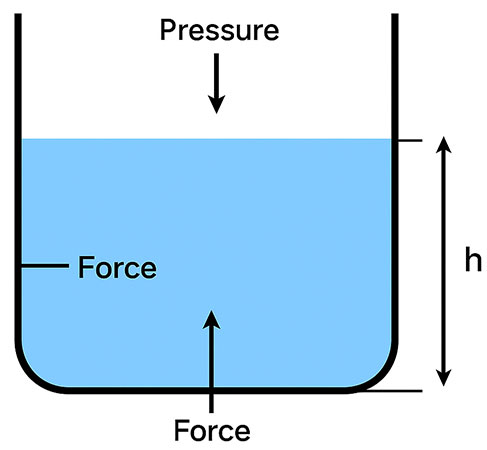
- Force on the Side Walls:
- Each point on the wall experiences pressure normal to the wall’s surface.
- The forces from opposite walls cancel each other horizontally when the liquid is at rest.
- Hence, the net horizontal force is zero, maintaining equilibrium.
- Force on the Free Surface:
- The air above exerts atmospheric pressure p₀ on the liquid surface.
- This ensures continuity of pressure from air to liquid and balances the force distribution.
Condition for Equilibrium:
For a small liquid element inside the fluid:
[\text{Sum of Forces in each direction}] [= 0]
- Vertically: Weight of the element is balanced by the pressure difference.
- Horizontally: Equal pressures from both sides cancel.
Thus, the liquid remains at rest.
3. Dimensions and Units
| Quantity | Symbol | Dimensions | SI Unit |
|---|---|---|---|
| Pressure | [p] | [M L^{-1} T^{-2}] | Pascal (Pa) |
| Force | [F] | [M L T^{-2}] | Newton (N) |
| Area | [A] | [L²] | m² |
| Density | [ρ] | [M L^{-3}] | kg/m³ |
4. Key Features
- Pressure acts normally on any surface in contact with a liquid.
- Bottom of the container experiences upward force equal to the weight of the liquid above it.
- Forces on opposite walls balance, so there’s no horizontal motion.
- The liquid remains in static equilibrium when all such forces are balanced.
- The free surface of a liquid at rest is horizontal (perpendicular to gravity).
5. Important Formulas to Remember
| Formula | Description |
|---|---|
| [p = p_0 + \rho g h] | Pressure at depth h in a liquid |
| [F = pA] | Force exerted by liquid on surface |
| [F_b = (p_0 + \rho g h)A] | Force on the bottom |
| [\text{Weight of liquid}] [= \rho g h A] | Balancing force on base in equilibrium |
6. Conceptual Questions with Solutions
1. Why is the force exerted by a liquid on the walls always perpendicular to the surface?
Because liquid molecules can move freely and cannot resist shear stress — any tangential component would cause motion, so equilibrium requires only **normal (perpendicular)** forces.
2. Why does the bottom of a container experience greater force than the sides?
Because pressure increases with depth, so the **bottom surface**, being deepest, experiences maximum pressure and hence maximum force.
3. What prevents the liquid from falling through the bottom of the container?
The **upward normal reaction** from the container base balances the **downward weight** of the liquid.
4. Why does a liquid not exert a net horizontal force on the container walls?
Because pressures on opposite sides are equal and opposite, cancelling out any net horizontal component.
5. Why is the free surface of a liquid at rest always horizontal?
If it were tilted, pressure at the same depth would not be equal, causing flow until it becomes horizontal — the equilibrium state.
7. FAQ / Common Misconceptions
1. Does the liquid push downward only on the bottom?
No, it also pushes **sideways and upward**, exerting pressure on all surfaces in contact.
2. Why doesn’t the liquid fall out sideways?
Because the container walls exert **equal and opposite normal forces**, keeping the liquid in place.
3. Is the pressure on vertical and horizontal surfaces the same?
At the same depth, yes — pressure depends on **depth only**, not on orientation.
4. Does liquid pressure act tangentially on the surface?
No, it acts **perpendicularly (normal)** to the surface at all points.
5. Can a liquid at rest exert shear force?
No. The appearance of shear force implies motion, destroying equilibrium.
8. Practice Questions (with Step-by-Step Solutions)
Q1. A container has a flat base of area [0.02 , m²] and holds water to a height of [0.5 m]. Find the force exerted by the water on the base.
[p] [= p_0 + \rho g h] [= 1.01 \times 10^5 + 1000 \times 9.8 \times 0.5]
[p] [= 1.06 \times 10^5 ,\text{Pa}]
[F] [= pA] [= 1.06 \times 10^5 \times 0.02] [= 2120 ,\text{N}]
Q2. Why does the liquid not move even though pressure acts on all sides?
Because pressures on opposite sides are equal and opposite — hence, no resultant force, ensuring equilibrium.
Q3. The force on the bottom of a container equals the weight of the liquid above. Prove it.
[F_b] [= (p_0 + \rho g h)A], [\quad] [W = \rho g h A]
The upward force due to liquid pressure plus atmospheric force balances weight.
[(p_0 A + \rho g h A)] [= p_0 A + W] [\implies \text{Equilibrium holds.}]
Q4. Why does the side force not contribute to the support of the liquid?
Because it acts horizontally, and its components cancel — only the vertical bottom force supports the liquid’s weight.
Q5. Explain how a liquid at rest in a container is in equilibrium.
The downward gravitational force is balanced by upward pressure forces on the bottom and normal reaction from the walls, resulting in no net motion.
 Continue with Google