


1. Statement of the Concept
When a liquid exerts a force on any surface in contact with it, that force is called thrust.
The thrust per unit area of the surface is known as pressure.
Thus,
[\text{Pressure}] [= \dfrac{\text{Thrust}}{\text{Area}}]
or simply,
[
p = \dfrac{F}{A}
]
2. Clear Explanation
Every liquid exerts a force on the surfaces it touches — the walls and bottom of its container.
This force is always perpendicular (normal) to the surface.
The total normal force on the surface in contact with the liquid is called thrust (F), and the pressure (p) at a point is defined as thrust per unit area.
[
p = \dfrac{F}{A}
]
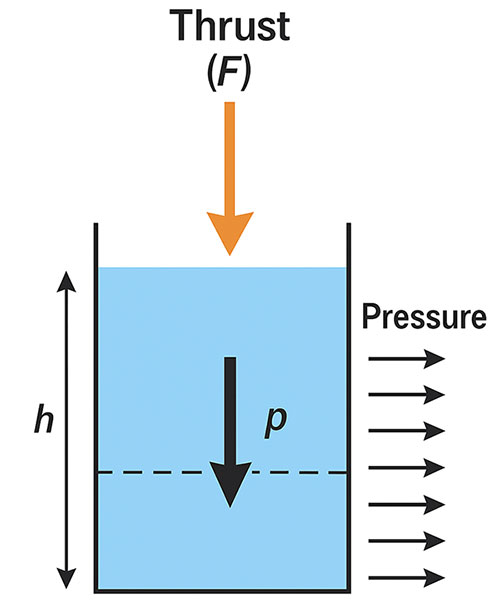
Pressure at a Depth h in a Liquid
Consider a small area [A] at depth [h] below the free surface of a liquid of density [ρ].
Weight of the liquid column above this area is:
[W = \rho g h A]
This weight exerts a downward force on the area [A], hence:
[p = \dfrac{F}{A} = \dfrac{W}{A} = \rho g h]
Therefore,
[\boxed{p = \rho g h}]
This is known as Hydrostatic Pressure — pressure at a depth [h] in a stationary liquid.
Observations:
- Pressure increases with depth ([h]).
- Pressure is independent of shape or area of the container.
- Pressure acts equally in all directions at a given depth.
3. Dimensions and Units
| Quantity | Symbol | Dimensions | SI Unit |
|---|---|---|---|
| Thrust | [F] | [M L T^{-2}] | Newton (N) |
| Pressure | [p] | [M L^{-1} T^{-2}] | Pascal (Pa) |
| Density | [ρ] | [M L^{-3}] | kg/m³ |
| Depth | [h] | [L] | m |
| Acceleration due to gravity | [g] | [L T^{-2}] | m/s² |
4. Key Features
- Thrust is the total normal force exerted by a liquid on a surface.
- Pressure is thrust per unit area.
- Pressure increases linearly with depth: [p ∝ h].
- At a given depth, pressure acts equally in all directions.
- Pressure does not depend on the shape of the container — only on depth, density, and gravity.
5. Important Formulas to Remember
| Formula | Description |
|---|---|
| [p = \dfrac{F}{A}] | Definition of pressure |
| [p = \rho g h] | Pressure at depth h |
| [F = pA] | Thrust on a surface |
| [F = \rho g h A] | Force due to a liquid column |
| [\Delta p = \rho g \Delta h] | Change in pressure with depth |
6. Conceptual Questions with Solutions
1. What is the difference between thrust and pressure?
**Thrust** is the total force exerted by a liquid on a surface, while **pressure** is the thrust per unit area.
2. Why does pressure increase with depth?
Because the **weight of the liquid column** above the point increases as depth increases, resulting in greater pressure.
3. Does pressure depend on the shape of the container?
No, at a given depth, pressure depends only on **density**, **gravity**, and **depth**, not on container shape.
4. Why do dams have thicker walls at the bottom?
Since pressure increases with depth ([p = ρgh]), greater depth requires stronger (thicker) walls to withstand greater pressure.
5. At the same depth, is pressure the same in all directions?
Yes, pressure at a point in a liquid acts **equally in all directions** — this is the principle of **isotropic pressure**.
7. FAQ / Common Misconceptions
1. Does pressure depend on the volume of liquid?
No, it depends on **depth**, not on total volume or amount of liquid.
2. Is pressure at the top of the liquid zero?
No, even at the free surface, there’s **atmospheric pressure p₀** acting downward.
3. Why does pressure not act tangentially?
Because liquids at rest cannot sustain **shear stress**; they exert only **normal (perpendicular)** pressure.
4. Does liquid pressure depend on the area of the surface?
No. **Pressure is independent of area**, but **thrust** increases with area.
5. Can two containers with different shapes but same depth have same pressure at the bottom?
Yes, because **p = ρgh** depends only on **h**, not on the shape.
8. Practice Questions (with Step-by-Step Solutions)
Q1. A liquid of density [1000 , kg/m³] exerts pressure at a depth of [2 , m]. Find the pressure.
[p] [= \rho g h] [= 1000 \times 9.8 \times 2] [= 1.96 \times 10^4 \,Pa]
Q2. Find the thrust on a surface of area [0.25 , m²] placed [3 , m] deep in water.
[p] [= \rho g h] [= 1000 \times 9.8 \times 3] [= 2.94 \times 10^4 \,Pa]
[F = pA] [= 2.94 \times 10^4 \times 0.25] [= 7350 \,N]
Q3. Does the pressure at depth [5 , m] depend on whether the container is narrow or wide?
No. Since [p = ρgh], it depends only on depth, not on shape or volume.
Q4. Two points in a liquid are 10 cm apart vertically. What is the pressure difference between them if [ρ = 1000 , kg/m³]?
[\Delta p] [= \rho g \Delta h] [= 1000 \times 9.8 \times 0.1] [= 980 \,Pa]
Q5. Why does a small nail sink in water but a large iron ship floats?
Because pressure = F/A — for the same thrust, smaller area gives higher pressure, so nails sink; ships have large area, reducing pressure on water.
 Continue with Google