


1. Statement of the Law
Pascal’s Law states that:
“The pressure applied to an enclosed fluid is transmitted undiminished to every part of the fluid and to the walls of its container.”
Mathematically,
[ P = \dfrac{F}{A} ]
where:
- [P] = pressure,
- [F] = applied force,
- [A] = area of the surface on which force acts.
2. Explanation and Mathematical Derivation
Consider a closed vessel filled with an incompressible fluid. When an external force is applied on a piston of area [A₁] with pressure [P₁], the pressure is transmitted equally throughout the fluid.
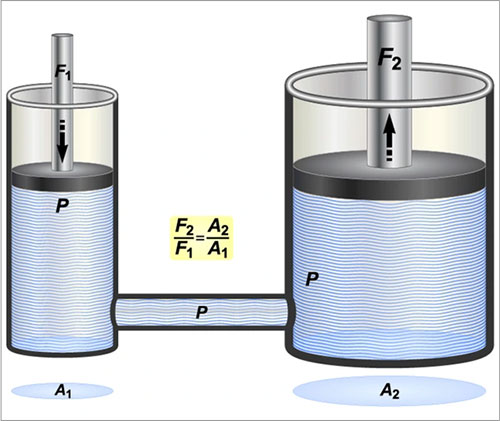
If another piston of area [A₂] is fitted at another point in the system, then the force exerted on it is:
[ F₂ = P₁ \times A₂ ]
Since [P₁ = P₂],
[
\dfrac{F₁}{A₁} = \dfrac{F₂}{A₂}
]
Thus, a small force [F₁] applied on a small area [A₁] can produce a large force [F₂] on a large area [A₂]. This principle is the basis of hydraulic machines such as hydraulic presses, lifts, and brakes.
3. Dimensions and Units
| Quantity | Symbol | Dimensions | SI Unit |
|---|---|---|---|
| Pressure | P | [M¹ L⁻¹ T⁻²] | Pascal (Pa) = N/m² |
| Force | F | [M¹ L¹ T⁻²] | Newton (N) |
| Area | A | [L²] | m² |
4. Key Features
- Pressure applied at one point is transmitted equally in all directions.
- The law is applicable only to enclosed fluids at rest.
- The transmission of pressure does not depend on the shape or size of the container.
- Hydraulic systems work on the principle of Pascal’s Law.
5. Important Formulas to Remember
| Concept | Formula | Description |
|---|---|---|
| Pressure | [P = \dfrac{F}{A}] | Pressure due to applied force |
| Hydraulic System | [\dfrac{F₁}{A₁} = \dfrac{F₂}{A₂}] | Force ratio in a hydraulic press |
| Mechanical Advantage | [\dfrac{F₂}{F₁} = \dfrac{A₂}{A₁}] | Ratio of output to input force |
6. Conceptual Questions with Solutions
1. Why does pressure in a liquid increase with depth?
Because the weight of the liquid column above increases with depth, exerting greater force per unit area.
2. How does Pascal’s Law explain the working of a hydraulic press?
In a hydraulic press, a small force applied on a smaller piston transmits equal pressure to a larger piston, producing a large output force.
3. Does the shape of the container affect pressure transmission?
No, the shape does not affect it; pressure is transmitted equally in all directions.
4. Why must the fluid be incompressible for Pascal’s Law to hold?
Because if the fluid compresses, part of the applied pressure is used to compress it rather than transmitting pressure uniformly.
5. What happens if the system has a gas instead of a liquid?
Gases are compressible, so Pascal’s Law applies approximately but not perfectly.
7. FAQ / Common Misconceptions
1. Does Pascal’s Law apply to moving fluids?
No, it applies only to fluids at rest (in static equilibrium).
2. Is pressure the same at all points in a liquid at rest?
Yes, at the same horizontal level and depth, pressure remains equal.
3. Can Pascal’s Law be applied to gases?
Only approximately, since gases are compressible.
4. Does height affect the pressure transmitted?
No, pressure transmission is independent of height but total pressure depends on depth.
5. Why does a hydraulic lift multiply force but not energy?
Because although the force increases, the displacement of the large piston is smaller, keeping the total work constant.
8. Practice Questions (with Step-by-Step Solutions)
Q1. A force of [200 N] is applied on a piston of area [0.02 m²]. Find the pressure transmitted in the fluid.
Solution:
[P] [= \dfrac{F}{A}] [= \dfrac{200}{0.02}] [= 10,000 \text{ Pa}]
Q2. In a hydraulic press, a small piston of area [0.01 m²] supports a large piston of area [0.5 m²]. If a force of [100 N] is applied on the small piston, find the output force on the large piston.
Solution:
[\dfrac{F₁}{A₁} = \dfrac{F₂}{A₂}]
[F₂] [= \dfrac{A₂}{A₁} \times F₁] [= \dfrac{0.5}{0.01} \times 100] [= 5000 \text{ N}]
Q3. Why is Pascal’s Law important in engineering?
Answer:
It forms the basis of hydraulic machines such as car brakes, lifts, and presses.
 Continue with Google