


1. Concept Overview
Surface tension is the property of a liquid surface that makes it behave like a stretched elastic membrane. It arises due to the cohesive forces between liquid molecules.
At the surface, molecules experience a net inward force because there are no molecules above them to balance the attraction, resulting in surface energy.
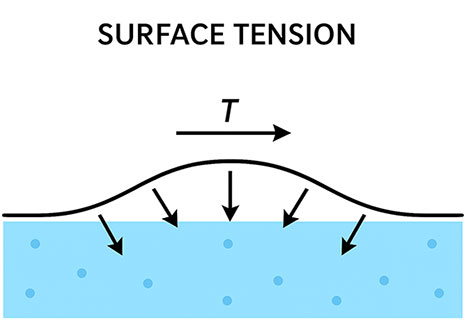
2. Explanation and Mathematical Derivation
Consider a liquid film stretched on a rectangular frame of length [l] and breadth [b], with a movable wire on one side.
If the wire is pulled slightly outward by applying a small force [F] to increase the surface area, then:

[
\text{Work done} = F \ dx
]
This work increases the surface energy of the liquid.
If the film has two surfaces (upper and lower), the total increase in surface area is:
[
\Delta A = 2l \ dx
]
Hence,
[T] = [\dfrac{\text{Work done}}{\text{Increase in surface area}}] [= \dfrac{F\ dx}{2l\ dx} = \dfrac{F}{2l}]
where
T = Surface tension of the liquid.
3. Dimensions and Units
| Quantity | Symbol | Formula | Dimensions | SI Unit |
|---|---|---|---|---|
| Surface Tension | T | [\dfrac{F}{2l}] | [M T⁻²] | N/m |
| Force | F | — | [M L T⁻²] | Newton (N) |
| Length | l | — | [L] | m |
4. Key Features
- Arises due to cohesive forces among liquid molecules.
- Makes liquid surfaces behave as if under tension.
- Responsible for droplet formation, capillarity, and meniscus shape.
- Decreases with increase in temperature.
- Disappears at critical temperature (where liquid turns into vapor).
5. Important Formulas to Remember
| Formula | Description |
|---|---|
| [T = \dfrac{F}{2l}] | Surface tension formula (film method) |
| [W = T \Delta A] | Work done to increase surface area |
| [T = \dfrac{F}{l}] | For single-surface film |
| [P = \dfrac{2T}{r}] | Excess pressure inside a soap bubble |
| [P = \dfrac{T}{r}] | Excess pressure inside a liquid drop |
6. Conceptual Questions with Solutions
1. What causes surface tension?
Unequal molecular forces at the surface cause molecules to experience a net inward pull, creating tension on the surface.
2. Why does a liquid surface behave like a stretched membrane?
Because surface molecules are pulled inward, reducing surface area and behaving like an elastic film.
3. How does temperature affect surface tension?
It decreases with temperature because cohesive forces weaken as molecular kinetic energy increases.
4. Why do raindrops form spherical shapes?
A sphere has the minimum surface area for a given volume, minimizing surface energy.
5. What is the unit of surface tension?
Newton per metre (N/m).
6. Why does a steel needle float on water?
Surface tension creates a stretched film that supports light objects if not wetting the surface.
7. What is the effect of adding detergent to water?
It reduces surface tension, allowing better spreading and cleaning action.
8. What happens to surface tension at the critical temperature?
It becomes zero as liquid and vapor phases become indistinguishable.
9. Why does warm water spread faster on a surface?
Lower surface tension at higher temperature allows easier spreading.
10. How is surface energy related to surface tension?
Surface tension equals surface energy per unit area.
11. Can surface tension exist in solids or gases?
No, it is specific to liquid surfaces in contact with another medium.
12. Why does mercury form a convex meniscus?
Cohesive forces in mercury are stronger than adhesive forces with glass.
13. Why does water rise in a capillary tube?
Adhesive forces between water and glass exceed cohesive forces within water, pulling the surface upward.
14. How can you experimentally determine surface tension?
By using capillary rise or the soap film method.
15. What happens to surface tension when impurities are added?
Generally decreases, as impurities weaken cohesive forces at the surface.
7. FAQ / Common Misconceptions
1. Does surface tension increase with temperature?
No, it decreases as cohesive forces weaken.
2. Is surface tension same for all liquids?
No, it varies depending on molecular composition and temperature.
3. Does surface tension depend on surface area?
No, it’s independent of surface area — it’s a property of the liquid.
4. Can gases have surface tension?
No, only liquids exhibit measurable surface tension.
5. Does soap increase surface tension?
No, soap decreases it.
6. Is surface energy the same as potential energy?
No, surface energy refers to the energy associated with surface creation, not gravitational potential energy.
7. Do all liquids wet solid surfaces?
No, it depends on the balance of adhesive and cohesive forces.
8. Does a smaller droplet have higher or lower pressure inside?
Higher, because [P = \dfrac{2T}{r}].
9. Is the surface tension direction tangential or normal?
Tangential to the liquid surface and perpendicular to the line of contact.
10. Is surface tension affected by gravity?
Negligibly — it’s a molecular-level effect, independent of gravity.
8. Practice Questions (with Step-by-Step Solutions)
Q1. A force of 0.03 N is required to move a wire of length 0.15 m on a soap film. Calculate the surface tension.
Solution:
[T] [= \dfrac{F}{2l}] [= \dfrac{0.03}{2 \times 0.15}] [= 0.1 \, N/m]
Q2. Find the excess pressure inside a soap bubble of radius 2 mm if surface tension is 0.07 N/m.
Solution:
[P] [= \dfrac{4T}{r}] [= \dfrac{4 \times 0.07}{2 \times 10^{-3}}] [= 140 , \text{N/m²}]
Q3. Determine excess pressure inside a liquid drop of radius 1 mm, surface tension = 0.05 N/m.
Solution:
[P] [= \dfrac{2T}{r}] [= \dfrac{2 \times 0.05}{1 \times 10^{-3}}] [= 100 \text{N/m²}]
Q4. What is the work done in increasing the surface area of a soap film from 20 cm² to 50 cm² if T = 0.04 N/m?
Solution:
[W] [= T \times \Delta A] [= 0.04 \times (2 \times (50 – 20) \times 10^{-4})] [= 0.04 \times 0.006] [= 2.4 \times 10^{-4} J]
Q5. A bubble of radius 0.5 mm has an internal pressure of 101330 Pa, while external pressure is 101325 Pa. Find surface tension.
Solution:
[P] [= \dfrac{4T}{r} \Rightarrow T] [= \dfrac{P r}{4}] [= \dfrac{(5)(0.5 \times 10^{-3})}{4}] [= 6.25 \times 10^{-4} ,\ N/m]
 Continue with Google