


1. Statement of the Concept
Viscosity is the property of a fluid that opposes the relative motion between its different layers. It is a measure of the internal friction between fluid layers moving at different velocities.
In simple words, viscosity is the resistance to flow.
For example, honey is more viscous than water because it flows more slowly.
2. Clear Explanation and Mathematical Derivation
Consider a liquid flowing steadily between two horizontal parallel plates separated by a distance d.
- The lower plate is stationary.
- The upper plate moves with a uniform velocity v.
- A velocity gradient exists between the plates — the layer in contact with the stationary plate has zero velocity, and the layer in contact with the moving plate has maximum velocity v.
Let the area of each plate be A.
To keep the upper plate moving at constant velocity v, a tangential force F must be applied to overcome the viscous resistance of the fluid.
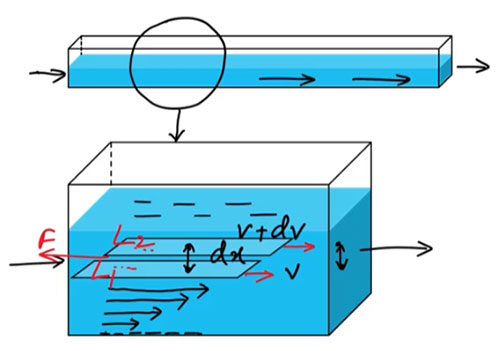
From experiment, Newton’s Law of Viscosity states that:
[ F ∝ A \dfrac{dv}{dx} ]
or
[ F = η A \dfrac{dv}{dx} ]
where:
- [ η ] = coefficient of viscosity (viscosity of the fluid),
- [ \dfrac{dv}{dx} ] = velocity gradient (rate of change of velocity with distance between layers),
- [ F ] = tangential force applied,
- [ A ] = area of the plate.
Hence,
[ η = \dfrac{F}{A(\dfrac{dv}{dx})} ]
3. Dimensions and Units
| Quantity | Symbol | SI Unit | CGS Unit | Dimensions |
|---|---|---|---|---|
| Coefficient of Viscosity | [η] | [N·s·m⁻²] or [Pa·s] | [poise] | [M¹L⁻¹T⁻¹] |
1 poise = 0.1 N·s·m⁻²
4. Key Features
- Viscosity depends on temperature — it decreases with increasing temperature in liquids and increases with increasing temperature in gases.
- It is a measure of internal friction in fluids.
- For an ideal fluid, viscosity is zero.
- It affects the flow rate and energy dissipation in pipelines and machinery.
- Units like centipoise (cP) are often used for practical measurements.
5. Important Formulas to Remember
| Formula | Description |
|---|---|
| [ F = ηA\dfrac{dv}{dx} ] | Newton’s law of viscosity |
| [ η = \dfrac{F}{A(\dfrac{dv}{dx})} ] | Coefficient of viscosity |
| [ \text{Velocity gradient}] [= \dfrac{v}{d} ] | For flow between two plates |
| [ F = ηA\dfrac{v}{d} ] | Simplified expression for viscous force |
6. Conceptual Questions with Solutions
1. What is viscosity in simple terms?
It is the resistance offered by a liquid or gas to the relative motion between its layers.
2. Why does honey flow more slowly than water?
Because honey has a higher viscosity, meaning stronger intermolecular forces resist flow.
3. What happens to the viscosity of liquids when temperature increases?
It decreases, as intermolecular forces weaken and layers move more freely.
4. What is an ideal fluid?
A hypothetical fluid with zero viscosity and no internal friction.
5. Why does viscosity increase in gases with temperature?
Because molecular collisions become more frequent, increasing internal momentum transfer.
6. How is viscous force related to area?
It is directly proportional — larger area leads to greater viscous force.
7. What are the dimensions of viscosity?
[M¹L⁻¹T⁻¹]
8. Give an example of a fluid with low viscosity.
Air or water have low viscosity compared to honey or glycerin.
9. What does the velocity gradient represent?
The rate of change of velocity between two adjacent layers of fluid.
10. If velocity gradient doubles, what happens to viscous force?
It also doubles, since viscous force is directly proportional to velocity gradient.
11. What is the SI unit of coefficient of viscosity?
Pascal-second (Pa·s).
12. What is 1 poise in SI units?
1 poise = 0.1 N·s·m⁻².
13. What happens to viscosity if fluid density increases?
Generally, higher density increases viscosity in liquids.
14. Which type of fluid flow is dominated by viscosity?
Laminar flow.
15. Can viscosity ever be negative?
No, viscosity is always positive as it represents resistance to motion.
7. FAQ / Common Misconceptions
1. Is viscosity only present in liquids?
No, gases also exhibit viscosity due to molecular momentum exchange.
2. Does viscosity always resist motion?
Yes, viscous forces always oppose relative motion between layers.
3. Do all liquids have the same viscosity?
No, viscosity varies with the type of liquid and temperature.
4. Is viscosity the same as density?
No, viscosity is resistance to flow; density is mass per unit volume.
5. Does a liquid stop flowing if viscosity is high?
No, it flows slowly but still flows.
6. Is water a viscous fluid?
It is slightly viscous but comparatively low among liquids.
7. What happens to viscosity in vacuum?
It becomes zero, as there are no particles to exert resistance.
8. Are viscosity and friction the same?
No, viscosity is internal fluid friction; friction acts between solid surfaces.
9. Can viscosity be used to identify liquids?
Yes, because each liquid has a characteristic viscosity at a given temperature.
10. Is the viscosity of gases higher at lower temperatures?
No, it decreases at lower temperatures.
8. Practice Questions (with Step-by-Step Solutions)
Q1. A liquid is flowing between two parallel plates separated by 2 mm. The upper plate moves at 0.1 m/s while the lower plate is stationary. If the viscosity of the liquid is [ 0.02 , \text{N·s·m}^{-2} ], calculate the force per unit area.
Solution:
[ \text{Velocity gradient}] [= \dfrac{dv}{dx}] [= \dfrac{0.1}{0.002}] [= 50 \text{s}^{-1} ]
[ F/A] [= η\dfrac{dv}{dx}] [= 0.02 \times 50] [= 1 \text{N·m}^{-2} ]
Q2. The viscosity of glycerin is higher than that of water. Explain why.
Solution: Glycerin molecules experience stronger intermolecular attractions, leading to greater internal friction, hence higher viscosity.
Q3. A fluid requires a tangential force of 0.3 N to move a plate of area 0.02 m² at a constant speed of 0.02 m/s. The gap between plates is 0.001 m. Find the coefficient of viscosity.
[ η] [= \dfrac{F d}{A v}] [= \dfrac{0.3 \times 0.001}{0.02 \times 0.02}] [= 0.75 \text{N·s·m}^{-2} ]
Q4. State two factors affecting the viscosity of a liquid.
Solution: Temperature and nature of liquid (molecular structure).
Q5. What is the significance of viscosity in engineering applications?
Solution: It helps design lubricants, hydraulic systems, and predict fluid flow resistance in pipelines.
 Continue with Google