


1. Statement of the Law / Concept Overview
Bernoulli’s Theorem states:
For a non-viscous, incompressible fluid flowing steadily along a streamline, the sum of pressure energy, potential energy, and kinetic energy per unit volume remains constant.
Mathematically,
[P + \rho gh + \dfrac{1}{2}\rho v^{2}] [= \text{constant}]
It represents the conservation of mechanical energy in fluid flow.
2. Clear Explanation and Mathematical Derivation
Consider a streamline flow of an incompressible fluid between two cross-sections of a tube:
- Pressure: [P_{1}], [P_{2}]
- Height: [h_{1}], [h_{2}]
- Velocity: [v_{1}], [v_{2}]
- Density: [\rho]
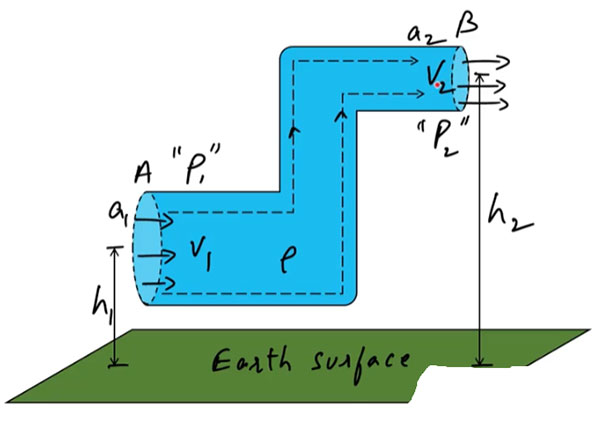
When a fluid element moves from section 1 to 2:
(a) Pressure Work Done on the Fluid
Work done by pressure forces:
[P_{1}A_{1}x_{1} – P_{2}A_{2}x_{2}]
Since [A_{1}x_{1} = A_{2}x_{2} = V]:
$P_{1}V – P_{2}V$ $= (P_{1} – P_{2})V$
(b) Change in Potential Energy
[\rho V g(h_{2} – h_{1})]
(c) Change in Kinetic Energy
[\dfrac{1}{2}\rho V(v_{2}^{2} – v_{1}^{2})]
Applying the Work–Energy Theorem
Work done = Change in KE + Change in PE:
[(P_{1} – P_{2})V] [= \rho V g(h_{2} – h_{1})] [+ \dfrac{1}{2}\rho V(v_{2}^{2} – v_{1}^{2})]
Divide by (V), rearrange:
[P_{1} + \rho gh_{1} + \dfrac{1}{2}\rho v_{1}^{2}] [= P_{2} + \rho gh_{2} + \dfrac{1}{2}\rho v_{2}^{2}]
Thus:
[P + \rho gh + \dfrac{1}{2}\rho v^{2}] [= \text{constant}]
This is Bernoulli’s Equation.
3. Dimensions and Units
All terms:
[P], $\quad [\rho gh],$ $\quad \left[\dfrac{1}{2}\rho v^{2}\right]$
have dimensions:
[ML^{-1}T^{-2}]
and SI unit:
[
\text{Pascal} = \text{N/m}^{2}
]
(When expressed per unit volume)
4. Key Features
- Derived from conservation of energy.
- Valid only for steady, incompressible, non-viscous, and irrotational flow.
- Explains:
- Why pressure decreases when velocity increases.
- Why the airplane wing generates lift.
- Why carburetors, atomizers, venturimeters work.
- Shows conversion between:
- Pressure Energy ↔ Kinetic Energy ↔ Potential Energy.
5. Important Formulas to Remember
| Description | Formula |
|---|---|
| Bernoulli’s equation (per unit volume) | [P + \rho gh + \dfrac{1}{2}\rho v^{2}] [= \text{constant}] |
| Bernoulli’s equation (per unit mass) | [\dfrac{P}{\rho} + gh + \dfrac{1}{2}v^{2}] [= \text{constant}] |
| Kinetic energy term | [\dfrac{1}{2}\rho v^{2}] |
| Potential energy term | [\rho gh] |
| Pressure energy term | [P] |
6. Conceptual Questions with Solutions
1. Why does pressure decrease when velocity increases?
Because total energy must remain constant. If velocity increases (more kinetic energy), pressure energy decreases to compensate.
2. What happens to velocity when a fluid enters a narrow pipe?
Velocity increases inside the narrow section. By Bernoulli, pressure decreases.
3. Why does water come out faster from a leaking tank at the bottom?
At the bottom, the height of water column is maximum → higher pressure → more conversion into kinetic energy → faster outflow.
4. Does Bernoulli apply to viscous fluids?
No. Viscous fluids lose energy as heat due to friction; energy is not conserved.
5. Why does a cricket ball swing?
Air moves faster on one side (smooth side) → lower pressure → ball swings toward the rough side.
6. Why does a roof blow off during storms?
Fast winds → low pressure above the roof → pressure inside pushes the roof upward.
7. Why does a wing of an airplane experience lift?
Air moves faster above the wing due to curved shape → lower pressure above → lift force acts upward.
8. Why does a plastic sheet rise when you blow over it?
Blowing creates fast-moving air → low pressure → atmospheric pressure lifts the sheet.
9. Why is the pressure greatest at the bottom of a fluid column?
Due to weight of liquid above: \[P = \rho gh\].
10. Does Bernoulli’s theorem violate energy conservation?
No. It is derived directly from the conservation of mechanical energy.
11. Why is Bernoulli’s theorem not applicable to turbulent flow?
Turbulent flow involves chaotic energy losses that are not accounted for.
12. What happens to pressure if fluid velocity becomes zero?
Equation reduces to \[P + \rho gh = \text{constant}\]. Pressure is maximum where velocity is zero.
13. Why does the heart use Bernoulli’s principle?
Blood accelerates through narrow valves → pressure drops → helps maintain directional flow.
14. Why does smoke rise quickly in chimneys?
Fast-moving hot gases reduce pressure inside chimney, drawing more air upward.
15. Why does a venturimeter measure flow rate?
A narrow section increases velocity → decreases pressure → pressure difference gives flow rate.
7. FAQ / Common Misconceptions
1. Higher pressure always means higher speed. True?
False. In Bernoulli flow, higher pressure means **lower** speed.
2. Bernoulli’s equation applies to all fluid flows.
Incorrect. Only valid for steady, incompressible, non-viscous flow along a streamline.
3. Static fluids cannot use Bernoulli’s principle.
They can — the equation reduces to hydrostatic pressure: \[P = \rho gh + \text{constant}\].
4. Bernoulli is the same as continuity equation.
No. Continuity deals with mass conservation. Bernoulli deals with energy conservation.
5. Pressure energy is not a real form of energy.
It is real, representing work done by fluid pressure.
6. Bernoulli’s theorem helps only in aerodynamics.
No. It is used in medical devices, chimneys, carburetors, atomizers, venturimeters, spray bottles, etc.
7. Flow is always faster in narrower regions.
Only if fluid is incompressible and continuous. Not true for compressible gases.
8. Pressure always decreases with height.
True only in static fluids. Not true in moving fluids where velocity affects pressure.
9. Bernoulli’s theorem works even with viscosity.
Wrong. Viscosity causes energy loss, violating energy conservation.
10. Kinetic energy doesn’t affect pressure.
It does. An increase in kinetic energy causes a reduction in pressure.
8. Practice Questions (with step-by-step solutions)
1. Water flows through a pipe with velocity [3 , \text{m/s}] at pressure [2 \times 10^{5} , \text{Pa}]. At another point the velocity is [6 , \text{m/s}]. Find the pressure there (same height).
Using:
[P_{1} + \dfrac{1}{2}\rho v_{1}^{2}] [= P_{2} + \dfrac{1}{2}\rho v_{2}^{2}]
With [\rho = 1000]:
$2 \times 10^{5} + \dfrac{1}{2}(1000)(3^{2})$ $= P_{2} + \dfrac{1}{2}(1000)(6^{2})$
[2 \times 10^{5} + 4500] [= P_{2} + 18000]
[P_{2}] [= 2 \times 10^{5} – 13500] [= 1.865 \times 10^{5} \ \text{Pa}]
2. A tube rises to a height of 20 m. What is the drop in pressure needed to lift water to this height?
[\Delta P = \rho gh] [= 1000 \times 9.8 \times 20] [= 1.96 \times 10^{5} \ \text{Pa}]
3. Find the velocity of water flowing out of a tank through a hole at depth [h].
Using Bernoulli:
[
v = \sqrt{2gh}
]
This is Torricelli’s law.
4. Air moves faster over the top of a wing (30 m/s) and slower below (20 m/s). Density of air = 1.2 kg/m³. Find pressure difference.
[\Delta P = \dfrac{1}{2}\rho (v_{1}^{2} – v_{2}^{2})]
[= \dfrac{1}{2}(1.2)(900 – 400) = 300 \ \text{Pa}]
5. Water flows in a horizontal pipe. Pressure decreases from 300 kPa to 200 kPa. Find increase in velocity.
[P_{1} – P_{2}] [= \dfrac{1}{2}\rho (v_{2}^{2} – v_{1}^{2})]
[
100000 = 500(v_{2}^{2} – v_{1}^{2})
]
[
v_{2}^{2} – v_{1}^{2} = 200
]
Increase = [\sqrt{v_{1}^{2} + 200} – v_{1}].
(If you want numerical values, specify [v_{1}]).
 Continue with Google