


1. Concept Overview
A logarithmic function is the inverse of an exponential function.
It helps us answer the question:
“To what power should a base be raised to get a given number?”
Logarithmic functions are widely used in:
- growth and decay problems
- sound intensity (decibel scale)
- pH scale
- inverse relations in calculus
2. Definition of Logarithmic Function
A function [f] is called a logarithmic function if
[f(x)=\log_a x]
where:
- [a>0]
- [a≠1]
- [x>0]
3. Relation Between Logarithm and Exponential
[\log_a x = y]
[a^y = x]
This shows that logarithmic and exponential functions are inverses.
4. Domain and Range
Domain:
All positive real numbers
[(0,∞)]
Range:
All real numbers
[(−∞,∞)]
5. Important Properties
- [\log_a 1 = 0]
- [\log_a a = 1]
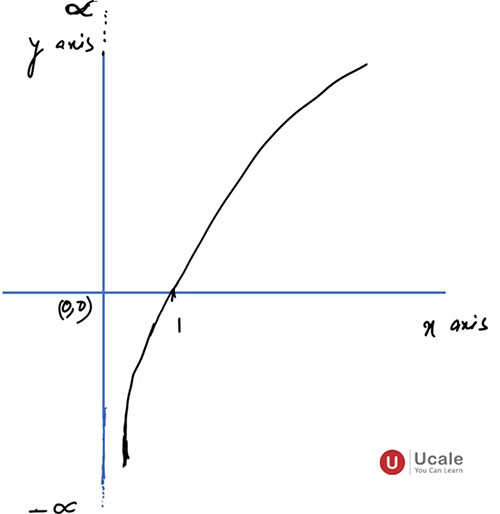
- If [a>1], function is increasing
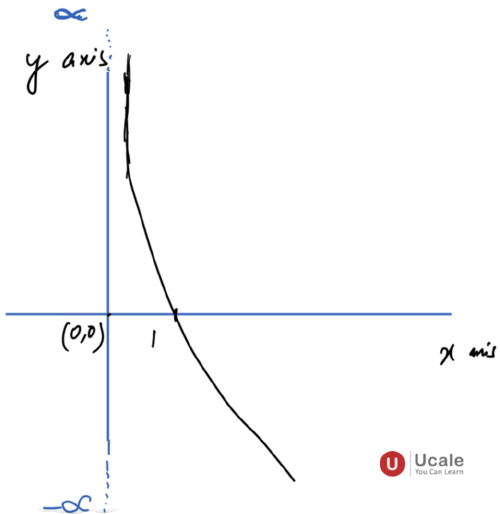
- If [0<a<1], function is decreasing
- Graph always passes through [(1,0)]
6. Graphical Behaviour
- The graph never touches the y-axis
- The y-axis is a vertical asymptote
- Function is continuous in its domain
For [a > 1]
For [0 < a < 1]
7. Conceptual Questions with Solutions
1. What is a logarithmic function?
A logarithmic function is a function that is the inverse of an exponential function and answers the question: to what power must a base be raised.
2. Why must the base of a logarithm be positive?
Because a negative base does not produce real values for all real inputs.
3. Why is base equal to 1 not allowed?
If [a=1], then [\log_1 x] has no meaning since [1^y=1] for all [y].
4. What is the domain of a logarithmic function?
The domain is all positive real numbers, i.e. [(0,∞)].
5. What is the range of a logarithmic function?
The range is all real numbers, i.e. [(−∞,∞)].
6. Why is logarithmic function undefined for x ≤ 0?
Because there exists no real power of a positive base that gives zero or a negative number.
7. What is the value of [\log_a 1]?
[\log_a 1 = 0] because any base raised to power zero equals one.
8. What does [\log_a a = 1] signify?
It signifies that the base must be raised to power 1 to get itself.
9. When is a logarithmic function increasing?
When the base is greater than 1.
10. When is a logarithmic function decreasing?
When the base lies between 0 and 1.
11. Is logarithmic function one–one?
Yes, because it is strictly monotonic in its domain.
12. Does a logarithmic function have an inverse?
Yes. Its inverse is an exponential function.
13. Why is y-axis a vertical asymptote?
Because the function is undefined at x=0 and approaches it closely.
14. Where does the graph of a logarithmic function always pass?
It always passes through the point [(1,0)].
15. Why are logarithmic functions important?
They help simplify large calculations and model inverse growth processes.
8. FAQ / Common Misconceptions
1. Logarithmic function is defined for all real numbers.
False. It is defined only for positive real numbers.
2. Base of logarithm can be zero.
False. Base must be positive and not equal to 1.
3. Logarithmic functions can give negative values.
True. The range includes all real numbers.
4. Logarithmic graph touches the y-axis.
False. The y-axis is a vertical asymptote.
5. [\log_a x] is a polynomial.
False. The variable is inside logarithm.
6. If base is less than 1, function is increasing.
False. It becomes decreasing.
7. [\log_1 x] is valid.
False. It has no mathematical meaning.
8. Logarithmic function is discontinuous.
False. It is continuous in its domain.
9. Logarithms and exponentials are unrelated.
False. They are inverse functions.
10. Logarithmic functions are not useful in real life.
False. They are used in science, engineering, and finance.
9. Practice Questions with Step-by-Step Solutions
Question 1. Evaluate [\log_2 8].
Step-by-Step Solution:
Write in exponential form: [2^x = 8].
Since [2^3 = 8], we get [x=3].
Conclusion:
[\log_2 8 = 3]
Question 2. Find the domain of [f(x)=\log_5 x].
Step-by-Step Solution:
Logarithmic function is defined only for positive arguments.
So [x>0].
Conclusion:
Domain = [(0,∞)]
Question 3. Evaluate [\log_{10} 1].
Step-by-Step Solution:
For any base, [\log_a 1 = 0].
Conclusion:
[\log_{10} 1 = 0]
Question 4. Evaluate [\log_3 27].
Step-by-Step Solution:
Write exponential form: [3^x = 27].
Since [3^3 = 27], [x=3].
Conclusion:
[\log_3 27 = 3]
Question 5. State whether [f(x)=\log_2 x] is increasing or decreasing.
Step-by-Step Solution:
Base [2>1].
Logarithmic functions with base greater than [1] are increasing.
Conclusion:
The function is increasing.
Question 6. Find [f(1)] if [f(x)=\log_7 x].
Step-by-Step Solution:
Substitute [x=1].
[\log_7 1 = 0].
Conclusion:
[f(1)=0]
Question 7. Is [f(x)=\log_5 x] one–one?
Step-by-Step Solution:
Logarithmic functions are strictly monotonic.
Strictly monotonic functions are one–one.
Conclusion:
Yes, the function is one–one.
Question 8. Does the graph of [f(x)=\log_3 x] intersect the y-axis?
Step-by-Step Solution:
Logarithmic functions are defined only for [x>0].
At [x=0], function is undefined.
Conclusion:
The graph does not intersect the y-axis.
Question 9. Find the value of [\log_4 4].
Step-by-Step Solution:
For any base [a], [\log_a a = 1].
Conclusion:
[\log_4 4 = 1]
Question 10. Find the range of [f(x)=\log_2 x].
Step-by-Step Solution:
Logarithmic function can take any real value.
Conclusion:
Range = [(−∞,∞)]
 Continue with Google