


1. Concept Overview
The Least Integer Function helps us move a real number to the next integer on the right, whenever the number is not already an integer.
In simple words, it tells us:
“What is the smallest integer that is greater than or equal to the given number?”
2. Definition of Least Integer Function
The least integer function of [x], denoted by [ ⌈x⌉ ], is defined as:
[⌈x⌉][ =] the smallest integer [≥ x]
3. Understanding Through Examples
- [⌈3.2⌉ = 4]
- [⌈5⌉ = 5]
- [⌈−2.4⌉ = −2]
Important observation:
For negative numbers, LIF moves toward zero.
4. Domain and Range
Domain:
All real numbers
[(−∞,∞)]
Range:
All integers
[{…, −3, −2, −1, 0, 1, 2, 3, …}]
5. Graph of Least Integer Function
- Graph consists of horizontal line segments
- Each segment is open on the left and closed on the right
- Function is discontinuous at every integer
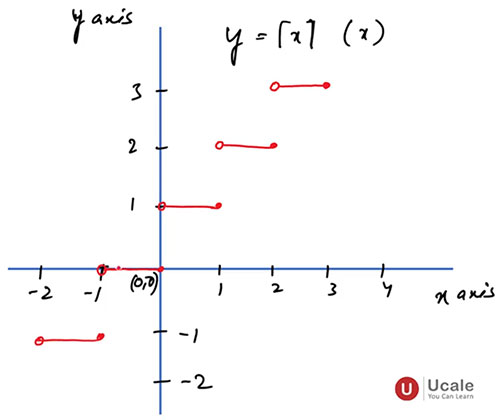
6. Step Nature of LIF
Like GIF, the least integer function is a step function because it changes value in jumps.
7. Properties of Least Integer Function
- [⌈x⌉ − 1 < x ≤ ⌈x⌉]
- [⌈x⌉ = x] when x is an integer
- Discontinuous at all integers
- Continuous on each interval [(n, n+1)]
- Not one–one
8. Examples with Solutions
Example 1. Find the value of [⌈3.4⌉].
Solution:
The smallest integer greater than or equal to 3.4 is 4.
So, [⌈3.4⌉ = 4]
Example 2. Find the value of [⌈−1.7⌉].
Solution:
The smallest integer greater than or equal to −1.7 is −1.
So, [⌈−1.7⌉ = −1]
Example 3. Evaluate [⌈6⌉].
Solution:
If the number itself is an integer, the value remains the same.
So, [⌈6⌉ = 6]
Example 4. Find the value of [⌈x⌉] when [2 < x ≤ 3].
Solution:
For all x in this interval, the smallest integer ≥ x is 3.
So, [⌈x⌉ = 3]
Example 5. Find the value of [⌈−x⌉] when [x = 2.3].
Solution:
First calculate [−x = −2.3].
The smallest integer ≥ −2.3 is −2.
So, [⌈−x⌉ = −2]
9. Conceptual Questions with Solutions
1. What does the least integer function represent?
It gives the smallest integer greater than or equal to x.
2. What is ⌈4.1⌉?
The smallest integer ≥ 4.1 is 5.
3. What is ⌈−2.6⌉?
The smallest integer ≥ −2.6 is −2.
4. What happens when x is an integer?
The function value remains unchanged.
5. What is the domain of LIF?
The domain is all real numbers.
6. What is the range of LIF?
The range is all integers.
7. Why is LIF discontinuous?
Because the function value jumps at every integer.
8. Is LIF continuous anywhere?
Yes, it is continuous on each open interval [(n, n+1)].
9. Is the least integer function one–one?
No, many values of x give the same output.
10. Why is it called a step function?
Because its graph consists of steps.
11. How is LIF different from GIF?
LIF moves to the right, while GIF moves to the left.
12. What is ⌈x⌉ when [0 < x ≤ 1]?
The value is 1.
13. What type of function is LIF?
It is a many–one function.
14. Where are closed points in the graph?
At the right end of each interval.
15. Why is LIF important?
It is useful in studying inequalities and discontinuity.
10. FAQ / Common Misconceptions
1. ⌈x⌉ gives the nearest integer.
False. It gives the smallest integer greater than or equal to x.
2. ⌈−2.3⌉ = −3
False. The correct value is −2.
3. LIF is continuous.
False. It is discontinuous at every integer.
4. Range of LIF is real numbers.
False. The range is only integers.
5. LIF is one–one.
False. It is many–one.
6. ⌈x⌉ < x always.
False. Always ⌈x⌉ ≥ x.
7. LIF graph is slanted.
False. It consists of horizontal segments.
8. ⌈x⌉ changes smoothly.
False. It changes in jumps.
9. LIF is undefined at integers.
False. It is defined everywhere.
10. LIF has no practical use.
False. It is widely used in mathematics.
11. Practice Questions with Step-by-Step Solutions
Question 1. Find the value of [⌈4.2⌉].
Step-by-Step Solution:
Identify the smallest integer greater than or equal to 4.2.
The next integer on the right is 5.
Conclusion:
[⌈4.2⌉ = 5]
Question 2. Find the value of [⌈−3.6⌉].
Step-by-Step Solution:
Move right from −3.6 on the number line.
The nearest integer ≥ −3.6 is −3.
Conclusion:
[⌈−3.6⌉ = −3]
Question 3. Evaluate [⌈9⌉].
Step-by-Step Solution:
Since 9 is an integer, its least integer value remains unchanged.
Conclusion:
[⌈9⌉ = 9]
Question 4. Find the value of [⌈x⌉] when [0 < x ≤ 1].
Step-by-Step Solution:
For all x between 0 and 1, the smallest integer ≥ x is 1.
Conclusion:
[⌈x⌉ = 1]
Question 5. Find the value of [⌈−x⌉] when [x = 1.6].
Step-by-Step Solution:
Substitute x: [−x = −1.6].
The smallest integer ≥ −1.6 is −1.
Conclusion:
[⌈−x⌉ = −1]
Question 6. Solve [⌈x⌉ = 2].
Step-by-Step Solution:
[⌈x⌉ = 2] means x lies between 1 and 2.
Exclude 1 but include 2.
Conclusion:
[1 < x ≤ 2]
Question 7. Solve [⌈x⌉ = −1].
Step-by-Step Solution:
[⌈x⌉ = −1] means x lies between −2 and −1.
Exclude −2 but include −1.
Conclusion:
[−2 < x ≤ −1]
Question 8. Find the domain of [f(x) = ⌈x⌉].
Step-by-Step Solution:
The least integer function is defined for all real numbers.
Conclusion:
Domain = [(−∞,∞)]
Question 9. Is the least integer function one–one?
Step-by-Step Solution:
Different values of x can give the same output.
Example: [⌈1.1⌉ = ⌈1.8⌉ = 2].
Conclusion:
LIF is not one–one.
Question 10. State the points of discontinuity of [⌈x⌉].
Step-by-Step Solution:
The function jumps at every integer value.
Conclusion:
LIF is discontinuous at all integers.
 Continue with Google