


1. Concept Overview
A square root function is a function in which the variable appears inside a square root.
It is one of the most important functions because it introduces:
- restricted domain
- non-negative outputs
- new graph shapes
In simple words, this function answers:
“What number, when squared, gives the given value?”
2. Basic Square Root Function
The basic square root function is:
[f(x) = √x]
3. Domain of Square Root Function
Since square root of a negative number is not real,
For [f(x) = √x]:
[x ≥ 0]
Domain:
[ {[}0, ∞) ]
4. Range of Square Root Function
The square root is always non-negative.
Range:
[ {[}0, ∞) ]
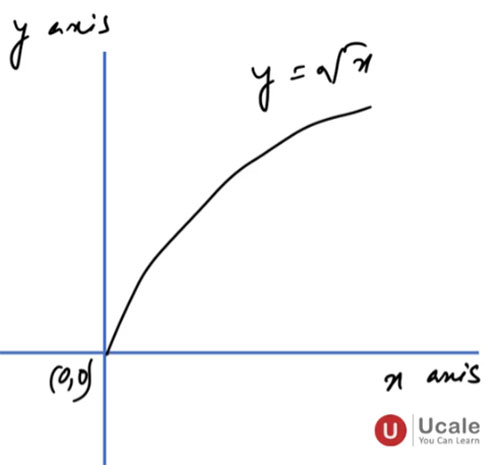
5. Important Points of the Graph
| x | f(x) = √x |
|---|---|
| 0 | 0 |
| 1 | 1 |
| 4 | 2 |
| 9 | 3 |
The graph:
- Starts from the origin
- Increases slowly
- Lies only in the first quadrant
6. General Square Root Function
A general square root function is:
[f(x) = √(ax + b)]
Here:
- The expression inside the root must be ≥ 0
- Domain depends on solving:
[ax + b ≥ 0]
7. Key Observations
- Square root functions are not defined for negative inputs
- Output is always ≥ 0
- Graph is continuous in its domain
- Function is one–one in its domain
8. Examples with Solutions
Example 1. Find the value of [f(x) = √x] at [x = 16].
Solution:
Substitute [x = 16].
[f(16) = √16 = 4]
Example 2. Find the domain of [f(x) = √x].
Solution:
For square root to be defined:
[x ≥ 0]
Domain:
[ {[}0, ∞) ]
Example 3. Find the value of [f(x) = √(x − 3)] at [x = 7].
Solution:
Substitute [x = 7].
[f(7) = √(7 − 3)][ = √4 = 2]
Example 4. Find the domain of [f(x) = √(2x − 5)].
Solution:
For the expression inside the root to be non-negative:
[2x − 5 ≥ 0]
Solving,
[2x ≥ 5]
[x ≥ 5/2]
Domain:
[ {[}5/2, ∞) ]
Example 5. Is the function [f(x) = √x] one–one?
Solution:
The function is strictly increasing on its domain.
Hence, it is one–one.
9. Conceptual Questions with Solutions
1. Why is [√x] not defined for [x < 0]?
Because the square root of a negative number is not a real number.
2. What is the domain of [f(x) = √x]?
The domain is all x such that [x ≥ 0].
3. What is the range of [√x]?
The range is [{[}0, ∞)].
4. Is the square root function continuous?
Yes, it is continuous on its domain.
5. Is [√x] a one–one function?
Yes, it is strictly increasing in its domain.
6. Does [√x] ever give a negative value?
No, the output is always non-negative.
7. Where does the graph of [√x] start?
It starts from the origin [(0,0)].
8. In which quadrant does the graph lie?
Only in the first quadrant.
9. What happens to the graph as x increases?
The graph increases but at a decreasing rate.
10. Is [√x] defined at [x = 0]?
Yes, and [√0 = 0].
11. Is [√x] an even or odd function?
It is neither even nor odd.
12. What is [√1]?
The value is 1.
13. Can [√x] be decreasing?
No, it is always increasing.
14. Why is the domain restricted?
Because the expression inside the root must be non-negative.
15. Why is [√x] important?
It is used in graphs, equations, inequalities, and calculus.
10. FAQ / Common Misconceptions
1. [√x] is defined for all real x.
False. It is defined only for [x ≥ 0].
2. [√x] can be negative.
False. The square root is always non-negative.
3. [√x] is discontinuous.
False. It is continuous in its domain.
4. The graph exists in all quadrants.
False. It lies only in the first quadrant.
5. [√x] is many–one.
False. It is one–one.
6. [√(x²) = x] always.
False. [√(x²) = |x|].
7. Domain and range are same.
False. Both are [{[}0,∞)] but represent different concepts.
8. [√x] grows faster than x.
False. It grows slower than x.
9. [√0] is undefined.
False. [√0 = 0].
10. Square root functions are not important.
False. They are fundamental in mathematics.
11. Practice Questions with Step-by-Step Solutions
Question 1. Find the value of [√25].
Step-by-Step Solution:
Identify the number whose square is 25.
That number is 5.
Conclusion:
[√25 = 5]
Question 2. Find the domain of [f(x) = √(x − 4)].
Step-by-Step Solution:
The expression inside the square root must be non-negative.
So, [x − 4 ≥ 0].
Solving,
[x ≥ 4]
Conclusion:
Domain = [ {[}4, ∞) ]
Question 3. Find the value of [f(x) = √(3x + 1)] at [x = 5].
Step-by-Step Solution:
Substitute [x = 5].
[3x + 1 = 16].
[√16 = 4].
Conclusion:
[f(5) = 4]
Question 4. Find the domain of [f(x) = √(7 − x)].
Step-by-Step Solution:
For square root to exist, [7 − x ≥ 0].
Solving, [x ≤ 7].
Conclusion:
Domain = [ (−∞, 7{]} ]
Question 5. Is the function [f(x) = √(x + 2)] defined at [x = −3]?
Step-by-Step Solution:
Substitute [x = −3].
[x + 2 = −1], which is negative.
Conclusion:
The function is not defined at [x = −3].
Question 6. Find the domain of [f(x) = √(2x + 6)].
Step-by-Step Solution:
Set [2x + 6 ≥ 0].
[2x ≥ −6].
[x ≥ −3].
Conclusion:
Domain = [{[}−3, ∞) ]
Question 7. Find the value of [f(x) = √(x − 1)] at [x = 10].
Step-by-Step Solution:
Substitute [x = 10].
[x − 1 = 9].
[√9 = 3].
Conclusion:
[f(10) = 3]
Question 8. Find the domain of [f(x) = √(5x − 2)].
Step-by-Step Solution:
For real values, [5x − 2 ≥ 0].
[5x ≥ 2].
[x ≥ 2/5].
Conclusion:
Domain = [{[}2/5, ∞) ]
Question 9. Is the square root function continuous?
Step-by-Step Solution:
The function √x is continuous in its domain.
Conclusion:
Yes, the square root function is continuous.
Question 10. State the range of [f(x) = √x].
Step-by-Step Solution:
Square root values are always non-negative.
Conclusion:
Range = [{[}0, ∞) ]
 Continue with Google