


1. Statement of the Theorem
If a function [f(x)] satisfies all the following three conditions on the closed interval [a,b]:
- [f(x)] is continuous on the closed interval [a,b]
- [f(x)] is differentiable on the open interval (a,b)
- [f(a)=f(b)]
Then there exists at least one [c] in the interval [(a,b)] such that:
[\dfrac{d}{dx}(f(x))\big|_{x=c}=0]
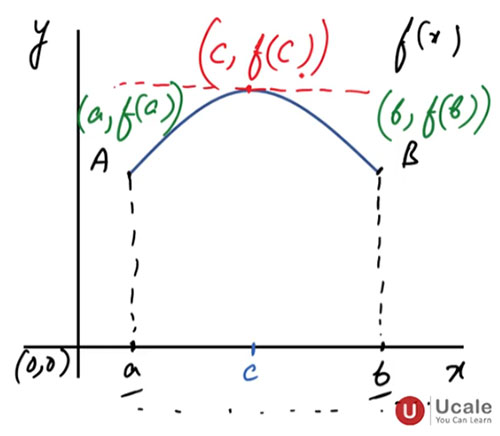
In short:
If a function starts and ends at the same height and has no break or sharp corner → slope becomes zero somewhere between!
2. Explanation in Simple Language
Imagine walking on a smooth road (no jumps or sharp turns), starting and ending at the same height.
You must reach a peak or valley in between where the tangent is horizontal → slope = 0.
Rolle’s theorem guarantees such a point exists!
3. Conditions Checklist
| Condition | Meaning |
|---|---|
| Continuity on [a,b] | No breaks, holes, jumps |
| Differentiability on (a,b) | Smooth curve — no sharp corners |
| Equal end values | [f(a)=f(b)] |
Only when ✔✔✔ all three conditions are satisfied → Rolle’s Theorem applies.
4. Key Formula
If Rolle’s Theorem applies:
[\exists\ c\in(a,b)\ \text{such that}\ \dfrac{d}{dx}(f(x))\big|_{x=c}=0]
5. Example With Step-by-Step Solution
Example
Check if Rolle’s Theorem applies to [f(x)=x^{2}-4x+3] on the interval [1,3]. If yes, find the value of [c].
Step-by-Step Solution:
- Check continuity → Polynomial → Continuous on [1,3].
- Check differentiability → Polynomial → Differentiable on (1,3).
- [f(1)=1^{2}-4(1)+3=0]
[f(3)=3^{2}-4(3)+3=0]
Thus [f(1)=f(3)] ✔ - Rolle’s Theorem applies → find [c] such that [\dfrac{d}{dx}(f(x))=0]
[\dfrac{d}{dx}(x^{2}-4x+3)=2x-4]
Set [2x-4=0][ \Rightarrow x=2] - Check if [2\in(1,3)] → Yes ✔
Conclusion:
Rolle’s Theorem applies and [c=2].
6. More Worked Examples
Example 2
Check if Rolle’s Theorem applies to [f(x)=\sin x] on the interval [0,\pi]. If yes, find the value of [c].
- Continuous & differentiable → ✔
- [f(0)=0,\ f(\pi)=0] → ✔
- [\dfrac{d}{dx}(\sin x)=\cos x]
Set [\cos x=0] → [x=\dfrac{\pi}{2}] - Lies in (0,π) → ✔
Conclusion: [c=\dfrac{\pi}{2}]
Example 3
Check if Rolle’s Theorem applies to [f(x)=|x|] on the interval [-1,1].
- Continuous? ✔
- Differentiable? ❌ Not at [x=0]
- [f(-1)=f(1)=1] ✔
Rolle’s Theorem does not apply because differentiability fails at 0.
7. Conceptual Questions With Solutions (15 Minimum)
1. Why must a function be continuous for Rolle’s Theorem?
If the function has breaks or jumps, the curve may not ensure a point with zero slope. Continuity ensures a smooth path between [a] and [b].
2. Why must the function be differentiable on (a,b)?
Differentiability ensures no sharp corners. At a sharp corner, slope is undefined.
3. What if [f(a)≠f(b)]?
Then the function begins and ends at different heights → slope may never be zero → Rolle’s Theorem fails.
4. Why is the condition [f(a)=f(b)] important?
It ensures the curve must turn up or down somewhere between, creating a horizontal tangent.
5. Can Rolle’s Theorem give more than one value of c?
Yes, it guarantees at least one. There may be many where the slope becomes zero.
6. What type of function never satisfies Rolle’s Theorem?
Functions with discontinuity or non-differentiability or unequal end values.
7. Can Rolle’s Theorem apply to a constant function?
Yes — derivative = 0 at every point → infinite values of [c].
8. Does differentiability guarantee continuity?
Yes — if a function is differentiable, it is always continuous.
9. Does continuity guarantee differentiability?
No — e.g., [f(x)=|x|] is continuous but not differentiable at 0.
10. What is the geometrical meaning of the theorem?
There exists a point where tangent is horizontal → slope = 0 → peak/valley.
11. If Rolle’s Theorem holds, what is guaranteed?
At least one point [c] in (a,b) where [\dfrac{d}{dx}(f(x))=0].
12. What happens if function has a cusp inside (a,b)?
Derivative is undefined → The theorem fails.
13. Are endpoint values included in differentiability check?
No → differentiability is required only in the open interval (a,b).
14. Rolle’s Theorem implies existence of a stationary point. True?
Yes — stationary point means slope zero.
15. Is Rolle’s Theorem a special case of Mean Value Theorem?
Yes — when [f(a)=f(b)], MVT reduces to Rolle’s.
8. FAQ / Common Misconceptions (10 Minimum)
1. If continuity fails only at one point, can we apply Rolle’s Theorem?
No. Even one discontinuity breaks the condition.
2. If function is continuous everywhere but derivative undefined at one point?
No, differentiability must hold on whole (a,b).
3. If end values differ only slightly, can we still use it?
No — condition must hold exactly: [f(a)=f(b)].
4. Rolle guarantees exactly one value of c?
No, only “at least one”.
5. Can the value of c be at endpoints?
No — it must lie strictly inside (a,b).
6. Does horizontal tangent always mean local maximum or minimum?
No — can be point of inflection too.
7. Any continuous differentiable function always satisfies Rolle?
No — [f(a)=f(b)] must also hold.
8. Is the theorem applicable to piecewise smooth function?
Only if continuity + differentiability hold throughout.
9. Rolle’s theorem is only theoretical?
No — used to prove existence of roots, etc.
10. Is f(x)=|x| on [-1,1] satisfying Rolle’s?
No — non differentiable at 0.
 Continue with Google