


1. Definition
Slope (or gradient) of a line refers to how steep the line is.
It measures change in y with respect to change in x.
[
\boxed{m = \dfrac{\Delta y}{\Delta x}}
]
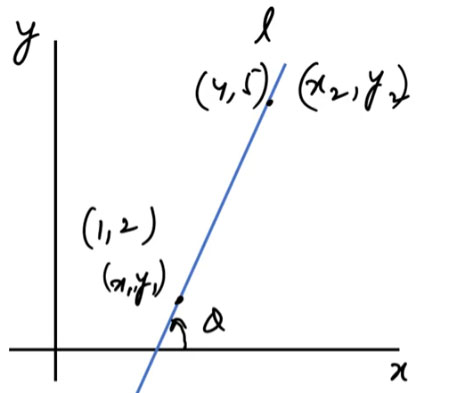
If a line passes through points [A(x_{1},y_{1})] and [B(x_{2},y_{2})], then:
[
\boxed{m = \dfrac{y_{2}-y_{1}}{x_{2}-x_{1}}}
]
2. Trigonometric Interpretation
If a line makes an angle [\theta] with the positive x-axis:
[
\boxed{m = \tan\theta}
]
This connects slope directly with geometry + trigonometry.
3. Calculus Interpretation
(Slope of Tangent Line)
For a curve [y = f(x)]:
[\text{Slope of tangent at }x=a ][= \left(\dfrac{dy}{dx}\right)_{x=a}]
Thus, slope links algebra + geometry + calculus together.
4. Combined Master Formula
[m = \dfrac{\Delta y}{\Delta x} ][= \tan\theta ][= \left(\dfrac{dy}{dx}\right)_{\text{at that point}}]
5. Geometrical & Trigonometric Interpretation of Slope
If a line makes an angle [\theta] with the positive x-axis, then:
[
\boxed{m = \tan\theta}
]
This means slope is literally the tangent of the angle the line makes with the x-axis.
Observations:
| Angle [\theta] | Nature of Line | Slope [m] | Sign |
|---|---|---|---|
| [0^\circ] | Horizontal | 0 | Zero slope |
| (0 to 90°) | Rises to right | Positive | m > 0 |
| [90^\circ] | Vertical | Undefined | Infinite slope |
| (90° to 180°) | Falls to right | Negative | m < 0 |
Thus, slope gives direction + steepness of a line.
6. Examples (with Tangent Interpretation)
Example 1
Find slope of line [y = 3x + 1].
Solution:
- Compare with [y = mx + c] → [m = 3]
- Derivative: [\dfrac{dy}{dx} = 3]
- Thus, slope of tangent at every point = 3
- Angle with x-axis:
[m = \tan\theta][ = 3 ⇒ \theta = \tan^{-1}(3)]
Answer: Slope = 3
Example 2
Find slope of tangent to [y = x^{2}] at [x = 2].
Solution:
- [\dfrac{dy}{dx} = 2x]
- At [x = 2]: slope
[m = 2(2) = 4] - Angle with x-axis:
[\theta = \tan^{-1}(4)]
Answer: Slope of tangent = 4
Example 3
Find slope of a line passing through points [(2,5)] and [(-1,-1)].
Solution:
[m] [= \dfrac{5 – (-1)}{2 – (-1)}][ = \dfrac{6}{3}][ = 2]
[
\theta = \tan^{-1}(2)
]
Answer: Slope = 2
7. Conceptual Questions with Solutions
1. What does slope indicate about a line?
Slope tells the **steepness** and **direction** of a line. Positive slope → line rises to the right. Negative slope → line falls to the right. Zero slope → horizontal line. Undefined slope → vertical line.
2. If slope [m=0], what does the line look like?
A **horizontal** line parallel to x-axis. Example: [y = 4].
3. If slope is undefined, what does the line look like?
A **vertical** line parallel to y-axis. Example: [x = 2].
4. If [m=2], is the line increasing or decreasing?
[m > 0] → **Increasing line** (rises to the right).
5. If [m=-3], what kind of line is it?
[m < 0] → **Decreasing line** (falls to the right).
6. What is the slope of a line making [45^\circ] with the x-axis?
[m = \tan45^\circ = 1].
7. What is the slope of a line making [90^\circ] with x-axis?
[m = \tan90^\circ] = **Undefined** → vertical line.
8. What angle does a line with slope [\sqrt{3}] make?
[m ][= \tan\theta ][= \sqrt{3} ][⇒ \theta = 60^\circ].
9. If the slope of tangent to a curve is zero at a point, what does it represent?
The tangent is **horizontal**. Curve may have a turning point (max or min).
10. What is slope if [\dfrac{dy}{dx} = -\tan30^\circ] at a point?
[m = -\tan30^\circ ][= -\dfrac{1}{\sqrt{3}}].
11. Why is slope called a rate measure?
Because [m = \dfrac{\Delta y}{\Delta x}] = **rate of change of y with respect to x**.
12. Is slope constant for all curves?
No. Only **straight lines** have constant slope. Curves have **different slopes at different points** → use [\dfrac{dy}{dx}].
13. What is the slope of tangent to [y = x^2] at [x = 0]?
[\dfrac{dy}{dx} ][= 2x ⇒ 2(0) = 0] → horizontal tangent.
14. If a line rises by 8 units when moving 2 units horizontally, what is slope?
[m = \dfrac{8}{2} = 4].
15. If a line makes a negative angle with positive x-axis, what sign is slope?
Angle between line and +x-axis measured anticlockwise must be between 0° and 180°. But if the line **falls**, slope is **negative**.
8. FAQ / Common Misconceptions
1. Does slope always increase as the line rises?
Yes. Rising right → [m > 0]. But rising left → slope is **negative**.
2. Is slope the angle of the line?
No. Slope = [\tan\theta], **not** [\theta] itself.
3. If a line is vertical, does it have slope zero?
Incorrect. Vertical line → **Undefined slope**.
4. Does a line always rise to the right?
No. If [m < 0], it **falls** to the right.
5. If [m = 0], can the line be vertical?
No. [m = 0] → horizontal line.
6. Can slope of a curve be found between two points?
Not exact slope at a point. We need **derivative** for instantaneous slope.
7. Is slope always defined for all x-values?
No. Vertical tangents → derivative undefined.
8. If [\dfrac{dy}{dx}] is constant, does it always represent a line?
Yes. Constant derivative → straight line.
9. Can slope be a fraction?
Yes. Fractions simply represent **gentler slopes**.
10. Does a negative slope mean the line goes backward?
No. It still moves **forward along x-axis** but **downward** in y-direction.
9. Review Checkpoint Summary
✔ Algebra link → [\dfrac{\Delta y}{\Delta x}]
✔ Trigonometry link → [\tan\theta]
✔ Calculus link → [\dfrac{dy}{dx})] (slope of tangent)
 Continue with Google