


1. Statement / Concept Overview
The slope (or gradient) of a straight line joining two given points measures how steep the line is and indicates the rate of change of y with respect to x between those two points.
Statement:
If a straight line passes through two points [A(x₁, y₁)] and [B(x₂, y₂)], then its slope is given by the ratio of the change in y-coordinates to the change in x-coordinates.
2. Clear Explanation and Mathematical Derivation
Let a straight line pass through two distinct points:
[A(x_1, y_1)] and [B(x_2, y_2)]
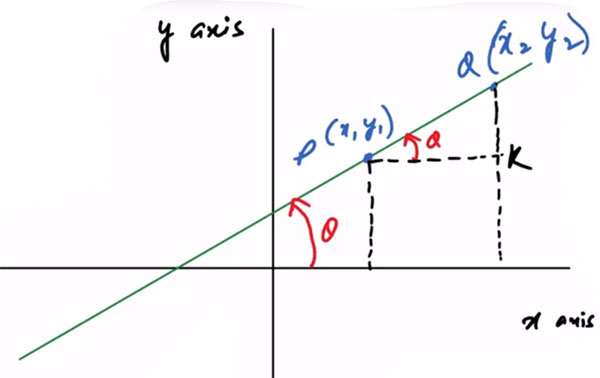
- Horizontal change (run):
[\Delta x = x_2 − x_1] - Vertical change (rise):
[\Delta y = y_2 − y_1]
By definition, slope [m] is:
[m = \dfrac{\text{Change in y}}{\text{Change in x}}]
Therefore,
[m = \dfrac{y_2 − y_1}{x_2 − x_1},] [\quad] [\text{provided } x_2 \neq x_1]
Special Observations
- If [y₂ = y₁] → horizontal line → [m = 0]
- If [x₂ = x₁] → vertical line → slope not defined
- Interchanging the points does not change the slope:
[\dfrac{y₂ − y₁}{x₂ − x₁} = \dfrac{y₁ − y₂}{x₁ − x₂}]
3. Key Features
- Slope depends only on the relative positions of the two points
- Same two points always give the same slope
- Determines whether the line is rising, falling, horizontal, or vertical
- Fundamental in finding the equation of a straight line
4. Important Formulas to Remember
| Description | Formula |
|---|---|
| Slope between two points | [m = \dfrac{y_2 − y_1}{x_2 − x_1}] |
| Horizontal line | [m = 0] |
| Vertical line | Slope not defined |
| Condition | [x_2 \neq x_1] |
5. Conceptual Questions with Detailed Solutions
1. Why must [x₂ ≠ x₁] in the slope formula?
Because slope involves division by [x₂ − x₁]. If both x-coordinates are equal, division by zero occurs, which is not defined.
2. Does the order of points affect the slope?
No. Interchanging the points changes both numerator and denominator signs, leaving the ratio unchanged.
3. What does a positive slope indicate?
A positive slope indicates that y increases as x increases, so the line rises from left to right.
4. What does a negative slope indicate?
A negative slope indicates that y decreases as x increases, so the line falls from left to right.
5. Can slope be zero using two points?
Yes. If both points have the same y-coordinate, the slope is zero.
6. When is slope not defined using two points?
When both points have the same x-coordinate, the line becomes vertical.
7. Is slope always a real number?
Slope can be any real number, zero, or undefined.
8. Can slope be fractional?
Yes. Most lines have fractional slopes.
9. What does magnitude of slope represent?
It represents how steep the line is. Greater magnitude means steeper line.
10. Can two different pairs of points give different slopes on the same line?
No. All points on a straight line give the same slope.
11. Why is slope dimensionless?
Because it is the ratio of two lengths measured in the same unit.
12. Can slope help identify the nature of a line?
Yes. The sign and value of slope directly indicate the orientation of the line.
13. Is slope related to angle of inclination?
Yes. [m = \tan \theta], where [\theta] is the angle with the x-axis.
14. Can slope be greater than 1?
Yes. It indicates a steep rising or falling line.
15. Can slope be used to check collinearity?
Yes. If slopes between multiple point pairs are equal, the points are collinear.
6. FAQ / Common Misconceptions
1. Slope formula works even when x-coordinates are equal.
Incorrect. It fails due to division by zero.
2. Negative slope means the line is below x-axis.
Incorrect. It means the line falls from left to right.
3. Larger slope always means higher y-intercept.
False. Slope and intercept are independent.
4. Zero slope and undefined slope are the same.
False. Zero slope is horizontal; undefined slope is vertical.
5. Slope depends on origin.
False. It depends only on relative positions of points.
6. A line with slope 1 always passes through origin.
False. It only means [\theta = 45°].
7. Slope cannot be a fraction.
False. Fractional slopes are very common.
8. Vertical lines have zero slope.
False. Vertical lines have undefined slope.
9. Same slope means same line.
False. Lines may be parallel.
10. Slope changes if points are swapped.
False. It remains the same.
7. Practice Questions with Step-by-Step Solutions
Question 1. Find the slope of the line joining (1, 2) and (5, 10).
Step-by-Step Solution:
Given points: [ (1, 2), (5, 10) ]
Use slope formula:
[m = \dfrac{y₂ − y₁}{x₂ − x₁}]
Substitute values:
[m = \dfrac{10 − 2}{5 − 1}]
Simplify:
[m = \dfrac{8}{4} = 2]
Conclusion:
Slope is [2].
Question 2. Find the slope of the line joining (−2, 3) and (4, −3).
Step-by-Step Solution:
Points: [ (−2, 3), (4, −3) ]
Apply formula:
[m = \dfrac{−3 − 3}{4 − (−2)}]
Simplify:
[m = \dfrac{−6}{6} = −1]
Conclusion:
Slope is [−1].
Question 3. Find the slope of the line joining (3, 5) and (3, −2).
Step-by-Step Solution:
Points have same x-coordinate.
[x₂ − x₁ = 0]
Conclusion:
Slope is not defined (vertical line).
Question 4. Find the slope of the line joining (−1, 4) and (2, 4).
Step-by-Step Solution:
Points have same y-coordinate.
Apply formula:
[m = \dfrac{4 − 4}{2 − (−1)}]
Simplify:
[m = 0]
Conclusion:
Slope is [0].
Question 5. Find the slope of the line joining (0, 0) and (7, −14).
Step-by-Step Solution:
Apply slope formula:
[m = \dfrac{−14 − 0}{7 − 0}]
Simplify:
[m = −2]
Conclusion:
Slope is [−2].
Question 6. Find the slope of the line joining (−5, −1) and (1, 2).
Step-by-Step Solution:
Apply formula:
[m = \dfrac{2 − (−1)}{1 − (−5)}]
Simplify:
[m = \dfrac{3}{6} = \dfrac{1}{2}]
Conclusion:
Slope is [\dfrac{1}{2}].
Question 7. Find the slope of the line joining (2, 7) and (−4, 1).
Step-by-Step Solution:
Apply formula:
[m = \dfrac{1 − 7}{−4 − 2}]
Simplify:
[m = \dfrac{−6}{−6} = 1]
Conclusion:
Slope is [1].
Question 8. Find the slope of the line joining (6, −3) and (2, 5).
Step-by-Step Solution:
Apply formula:
[m = \dfrac{5 − (−3)}{2 − 6}]
Simplify:
[m = \dfrac{8}{−4} = −2]
Conclusion:
Slope is [−2].
Question 9. Find the slope of the line joining (−1, −1) and (4, 9).
Step-by-Step Solution:
Apply formula:
[m = \dfrac{9 − (−1)}{4 − (−1)}]
Simplify:
[m = \dfrac{10}{5} = 2]
Conclusion:
Slope is [2].
Question 10. Find the slope of the line joining (a, b) and (a + 3, b + 6).
Step-by-Step Solution:
Apply formula:
[m = \dfrac{(b + 6) − b}{(a + 3) − a}]
Simplify:
[m = \dfrac{6}{3} = 2]
Conclusion:
Slope is [2].
 Continue with Google