


1. Concept Overview
Three points are said to be collinear if they lie on the same straight line.
Statement:
Three points [A(x_1, y_1)], [B(x_2, y_2)] and [C(x_3, y_3)] are collinear if and only if the slope of the line joining any two pairs of points is the same.
2. Clear Explanation and Mathematical Derivation
Method 1: Slope Method (Most Important)
Let the three points be:
- [P(x_1, y_1)]
- [Q(x_2, y_2)]
- [R(x_3, y_3)]
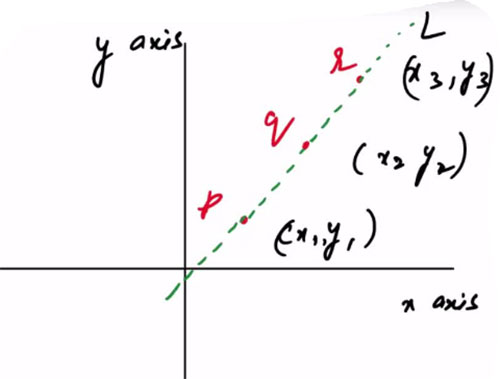
Slope of line AB:
[m_{PQ} = \dfrac{y_2 − y_1}{x_2 − x_1}]
Slope of line BC:
[m_{QR} = \dfrac{y_3 − y_2}{x_3 − x_2}]
Slope of line AC:
[m_{PR} = \dfrac{y_3 − y_1}{x_3 − x_1}]
Condition for collinearity:
[m_{PQ} = m_{QR} = m_{PR}]
If any two slopes are equal, the third will also be equal, and hence the points are collinear.
Method 2: Area of Triangle Method (Conceptual Understanding)
Three points are collinear if and only if the area of the triangle formed by them is zero.
Area of triangle formed by three points is:
[\text{Area} ][= \dfrac{1}{2} \left| x_1(y_2 − y_3) + x_2(y_3 − y_1) + x_3(y_1 − y_2) \right|]
Condition for collinearity:
[x_1(y_2 − y_3) + x_2(y_3 − y_1) + x_3(y_1 − y_2) ][= 0]
(Though in Class 11, slope method is preferred, this formula is very useful later.)
3. Key Features
- Collinear points lie on one straight line
- Slope between any two pairs is the same
- Area of triangle formed is zero
- Widely used to:
- Check straight-line motion
- Verify geometric alignment
- Solve coordinate geometry problems
4. Important Formulas to Remember
| Purpose | Formula |
|---|---|
| Slope PQ | [\dfrac{y_2 − y_1}{x_2 − x_1}] |
| Slope QR | [\dfrac{y_3 − y_2}{x_3 − x_2}] |
| Collinearity condition | Slopes equal |
| Area condition | [x_1(y_2 − y_3) + x_2(y_3 − y_1) + x_3(y_1 − y_2) ][= 0] |
5. Conceptual Questions with Detailed Solutions
1. What does it mean for three points to be collinear?
It means all three points lie on the same straight line, so one point lies on the line joining the other two.
2. Why is slope used to check collinearity?
Because a straight line has a constant slope. If slopes between different pairs of points are equal, they lie on the same line.
3. Is it enough to compare only two slopes?
Yes. If slope AB equals slope BC, the third slope will automatically be equal.
4. Can vertical-line points be collinear?
Yes. If all x-coordinates are equal, the points lie on a vertical straight line.
5. Can horizontal-line points be collinear?
Yes. If all y-coordinates are equal, the points lie on a horizontal straight line.
6. What happens to the area of triangle for collinear points?
The area becomes zero because no triangle can be formed.
7. Are collinear points always distinct?
Usually yes, but if two points coincide, slope may become undefined and special care is needed.
8. Can three non-collinear points have equal distances?
Yes. Distance has no role in collinearity; slope is the deciding factor.
9. Is collinearity dependent on origin?
No. Shifting axes does not affect collinearity.
10. Is area method better than slope method?
Not for beginners. Slope method is simpler and more intuitive.
11. Can four points be collinear?
Yes. Any number of points can lie on the same straight line.
12. Can collinearity help in finding unknown constants?
Yes. Many problems use collinearity to determine unknown values.
13. Does collinearity imply equal slopes only?
Yes. Equal slopes guarantee the same straight line.
14. Is collinearity a necessary condition for straight-line motion?
Yes. Motion along a straight line implies collinearity of position points.
15. Can collinearity be checked graphically?
Yes, but algebraic methods are more accurate.
6. FAQ / Common Misconceptions
1. Equal distances mean points are collinear.
False. Distance has no relation to collinearity.
2. Only slope method works.
False. Area method also works.
3. Vertical line points cannot be checked using slope.
False. If all x-values are equal, points are collinear.
4. Collinearity depends on scale of graph.
False. It is scale-independent.
5. Coinciding points are always collinear.
True, but slope becomes undefined and must be treated carefully.
6. Area zero always implies collinearity.
True for coordinate geometry.
7. Slopes must be integers.
False. Slopes can be fractional or irrational.
8. Collinearity is a physical quantity.
False. It is a geometrical concept.
9. Any three points form a triangle.
False. Collinear points do not.
10. Checking two slopes is insufficient.
False. Two slopes are enough.
7. Practice Questions with Full Step-by-Step Solutions
Question 1. Check whether the points (1, 2), (2, 4) and (3, 6) are collinear.
Step-by-Step Solution:
Points: [A(1, 2)], [B(2, 4)], [C(3, 6)]
Slope AB:
[m_{AB} = \dfrac{4 − 2}{2 − 1} = 2]
Slope BC:
[m_{BC} = \dfrac{6 − 4}{3 − 2} = 2]
Since [m_{AB} = m_{BC}]
Conclusion:
The points are collinear.
Question 2. Check whether the points (−1, 3), (2, 5) and (4, 6) are collinear.
Step-by-Step Solution:
Slope AB:
[m_{AB} = \dfrac{5 − 3}{2 − (−1)} = \dfrac{2}{3}]
Slope BC:
[m_{BC} = \dfrac{6 − 5}{4 − 2} = \dfrac{1}{2}]
Slopes are not equal.
Conclusion:
Points are not collinear.
Question 3. Check collinearity of (3, 1), (3, 4) and (3, −2).
Step-by-Step Solution:
All x-coordinates are equal.
Points lie on [x = 3].
Conclusion:
The points are collinear.
Question 4. Find the value of k for which points (1, 2), (2, k) and (3, 6) are collinear.
Step-by-Step Solution:
Slope AB:
[m_{AB} = \dfrac{k − 2}{2 − 1} = k − 2]
Slope BC:
[m_{BC} = \dfrac{6 − k}{3 − 2} = 6 − k]
For collinearity:
[k − 2 = 6 − k]
Solve:
[2k = 8 ⇒ k = 4]
Conclusion:
For [k = 4], the points are collinear.
Question 5. Check whether (0, 0), (2, 3) and (4, 6) are collinear.
Step-by-Step Solution:
Slope AB:
[m = \dfrac{3}{2}]
Slope BC:
[m = \dfrac{3}{2}]
Slopes are equal.
Conclusion:
Points are collinear.
 Continue with Google