


1. Concept Overview
The intercept form of a straight line is used when:
- The x-intercept and
- The y-intercept
of the line are known.
Statement:
If a straight line cuts the x-axis at [(a, 0)] and the y-axis at [(0, b)], then its equation is:
[\boxed{\dfrac{x}{a} + \dfrac{y}{b} = 1}]
2. Mathematical Derivation
Understanding Intercepts
- x-intercept [a]:
The value of [x] where the line cuts the x-axis ⇒ [y = 0] - y-intercept [b]:
The value of [y] where the line cuts the y-axis ⇒ [x = 0]
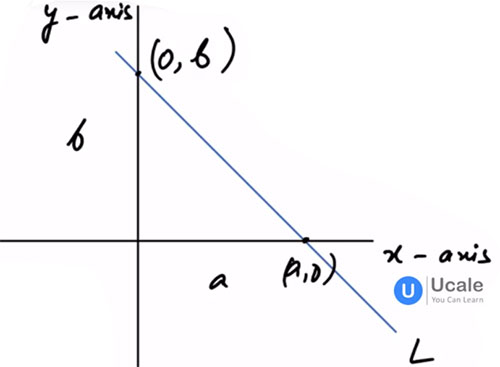
Derivation
Let the equation of the line be in the general linear form:
[Ax + By + C = 0]
- At x-intercept [(a, 0)]:
[Aa + C = 0] ⇒ [C = −Aa] - At y-intercept [(0, b)]:
[Bb + C = 0] ⇒ [C = −Bb]
Since [C] must be same:
[Aa = Bb]
Divide the general equation by [C] appropriately to get:
[\boxed{\left(\dfrac{x}{a} + \dfrac{y}{b} = 1\right)}]
This is the intercept form.
3. Key Features
- Directly shows both intercepts
- Very useful for graph drawing
- Cannot represent:
- Lines passing through origin
- Lines parallel to axes
- Easy to convert into other forms
4. Important Formulas to Remember
| Description | Formula |
|---|---|
| Intercept form | [\dfrac{x}{a} + \dfrac{y}{b} = 1] |
| x-intercept | [(a, 0)] |
| y-intercept | [(0, b)] |
6. Conceptual Questions with Detailed Solutions
1. Why does the intercept form [\dfrac{x}{a} + \dfrac{y}{b} = 1] fail when a line is parallel to the y-axis?
The intercept form assumes the line cuts the x-axis at [(a, 0)].
If a line is parallel to the y-axis, it never intersects the x-axis, so the x-intercept is undefined (infinite).
Hence, [a] does not exist, and [\dfrac{x}{a}] becomes meaningless.
Key Insight:
Intercept form works only when both intercepts exist and are finite.
2. Can a line passing through the origin be written in intercept form? Explain.
A line through the origin has intercepts:
x-intercept = 0
y-intercept = 0
Substituting in intercept form gives:
[\dfrac{x}{0} + \dfrac{y}{0} = 1]
which is undefined.
Conclusion:
A line passing through the origin cannot be represented in intercept form.
Exam Tip:
Intercept form always represents a line not passing through the origin.
3. If the intercepts of a line are equal, what does it say about the slope of the line?
Let [a = b].
Intercept form:
[\dfrac{x}{a} + \dfrac{y}{a} = 1]
Simplifying:
[x + y = a]
Slope of the line:
[y = −x + a] ⇒ slope [m = −1]
Hidden Concept:
Equal intercepts ⇒ slope is always −1, regardless of the value of the intercept.
4. What happens to the graph of a line if both intercepts are negative?
Let [a < 0] and [b < 0].
Intercept points:
[(a, 0)] lies on negative x-axis
[(0, b)] lies on negative y-axis
So the line lies mainly in the third quadrant.
Conceptual Understanding:
Signs of intercepts directly indicate which quadrant the line leans towards.
5. A line has intercepts 4 and −4. What special property does this line have?
Equation:
[\dfrac{x}{4} + \dfrac{y}{−4} = 1]
Simplifying:
[x − y = 4]
Slope = 1
Hidden Insight:
When intercepts are equal in magnitude but opposite in sign, the line is inclined at 45° to the x-axis.
6. Why does intercept form always represent a non-parallel line to both axes?
Intercept form requires:
Finite x-intercept ⇒ not parallel to y-axis
Finite y-intercept ⇒ not parallel to x-axis
So the line must cut both axes.
Conclusion:
Intercept form automatically excludes lines parallel to either axis.
7. If the x-intercept is doubled while the y-intercept is unchanged, how does the slope change?
Slope of intercept form:
[m = −\dfrac{b}{a}]
If [a → 2a], then:
[m → −\dfrac{b}{2a}]
Result:
The magnitude of slope becomes half, so the line becomes less steep.
8. Can two different lines have the same intercept form? Justify.
Intercept form:
[\dfrac{x}{a} + \dfrac{y}{b} = 1]
Each pair [(a, b)] uniquely determines the intercepts and hence the line.
Conclusion:
Two different lines cannot have the same intercept form.
9. If a line has intercepts in the ratio 2 : 3, what does it imply about its equation?
Let intercepts be:
[a = 2k], [b = 3k]
Equation:
[\dfrac{x}{2k} + \dfrac{y}{3k} = 1]
Simplifying:
[3x + 2y = 6k]
Conceptual Point:
Only the ratio of intercepts controls the direction of the line, not their absolute values.
10. Why is intercept form preferred for graphing a line quickly?
Because intercept form gives:
x-intercept directly as [(a, 0)]
y-intercept directly as [(0, b)]
Only two points are needed to draw a straight line.
Exam Strategy:
Intercept form is the fastest form for sketching graphs.
11. If a line cuts equal intercepts on the axes but lies in the second quadrant, what is its equation?
Second quadrant ⇒ x-intercept negative, y-intercept positive.
Let:
[a = −k], [b = k]
Equation:
[\dfrac{x}{−k} + \dfrac{y}{k} = 1]
Simplifying:
[y − x = k]
Hidden Understanding:
Signs of intercepts determine orientation and quadrant, not equality.
12. How can you identify from intercept form whether a line is increasing or decreasing?
Slope:
[m = −\dfrac{b}{a}]
If [a] and [b] have same sign ⇒ slope negative ⇒ decreasing line
If signs are opposite ⇒ slope positive ⇒ increasing line
Key Concept:
Intercept signs encode the nature of monotonicity.
13. Can the intercept form represent a vertical or horizontal line?
Vertical line ⇒ x-intercept undefined ❌
Horizontal line ⇒ y-intercept exists, x-intercept exists ✔
So:
Horizontal lines can be written in intercept form
Vertical lines cannot
Exam Trap:
Students often think neither is possible — only vertical lines fail.
14. If a line’s intercepts are reciprocals of each other, what is special about its equation?
Let:
[a = k], [b = \dfrac{1}{k}]
Equation:
[\dfrac{x}{k} + ky = 1]
Multiplying by [k]:
[x + k^2 y = k]
Conceptual Insight:
Intercept form can generate equations with quadratic coefficients without curves.
15. Why is intercept form not suitable for algebraic manipulation compared to general form?
Intercept form highlights geometry (intercepts), not algebra.
General form [Ax + By + C = 0] is:
Better for solving systems
Better for distance, angle, and normal form
Conclusion:
Intercept form is geometrically powerful but algebraically limited.
7. FAQ / Common Misconceptions
1. Is intercept form valid for every straight line?
No. Intercept form requires the line to cut both axes at finite points.
If a line is:
Parallel to x-axis ⇒ y-intercept undefined
Parallel to y-axis ⇒ x-intercept undefined
Conclusion:
Intercept form works only for lines intersecting both axes.
2. Many students think intercepts mean “distance from origin”. Why is this wrong?
Intercepts are signed coordinates, not distances.
Example:
x-intercept [−4] means point [(−4, 0)], not 4 units away positively.
Key Idea:
Distance is always positive, intercepts can be positive or negative.
3. If a line has intercepts 0 and b, can we write it in intercept form?
No.
x-intercept = 0 ⇒ line passes through origin ⇒ intercept form fails.
Hidden Rule:
Intercept form never represents a line passing through the origin.
4. Does changing both intercepts proportionally change the line?
No.
Example:
Intercepts (2, 4)
Intercepts (4, 8)
Both give the same line, because their ratio is unchanged.
Concept:
Direction depends on the ratio, not absolute intercept values.
5. Why do some books say intercept form is “not unique”?
Because multiplying numerator and denominator by the same non-zero constant does not change the line.
Example:
[\dfrac{x}{2} + \dfrac{y}{3} = 1]
and
[\dfrac{x}{4} + \dfrac{y}{6} = 1]
represent the same straight line.
Exam Trap:
Students mistake algebraic form change as a new line.
6. Can intercept form help in identifying the quadrant in which a line lies?
Yes, immediately.
Both intercepts positive ⇒ line leans toward first quadrant
One positive, one negative ⇒ second or fourth quadrant
Both negative ⇒ third quadrant
Geometric Strength:
Intercept form is visually powerful.
7. Why is slope always negative when both intercepts are positive?
Slope:
[m = −\dfrac{b}{a}]
If [a > 0] and [b > 0], then [m < 0].
Conceptual Meaning:
As x increases, y must decrease to satisfy the equation.
8. Students often think a larger intercept means a steeper line. Is this always true?
No.
Slope depends on:
[m = −\dfrac{b}{a}]
If both intercepts increase proportionally, slope remains unchanged.
Important Insight:
Steepness depends on ratio, not magnitude.
9. Why is intercept form rarely used in coordinate proofs?
Because proofs require:
Algebraic manipulation
Comparison of coefficients
Intercept form is geometrically intuitive but algebraically weak.
Hence:
General form is preferred in proofs.
10. Can intercept form directly give the angle a line makes with the x-axis?
Not directly.
You must first find slope:
[m = −\dfrac{b}{a}]
Then:
[\tan \theta = m]
Misconception:
Intercept form does not bypass slope calculation.
11. Why is intercept form heavily tested in graph-based questions?
Because:
Intercepts are directly readable
Graph can be sketched without calculation
Exam Insight:
Intercept form is a favorite in MCQs and case-based questions.
12. Is intercept form suitable for finding distance of a point from a line?
No.
Distance formula requires:
[Ax + By + C = 0]
So intercept form must first be converted to general form.
Common Mistake:
Trying to apply distance formula directly.
8. Practice Questions with Step-by-Step Solutions
Question 1. Find the equation of the line with x-intercept 4 and y-intercept 2.
Step-by-Step Solution:
x-intercept [a = 4]
y-intercept [b = 2]
Use intercept form:
[\dfrac{x}{4} + \dfrac{y}{2} = 1]
Simplify:
[\dfrac{x}{4} + \dfrac{2y}{4} = 1]
Conclusion:
Equation of the line is [\dfrac{x}{4} + \dfrac{y}{2} = 1].
Question 2. Find the equation of the line cutting x-axis at −3 and y-axis at 6.
Step-by-Step Solution:
[a = −3], [b = 6]
Intercept form:
[\dfrac{x}{−3} + \dfrac{y}{6} = 1]
Simplify:
[−\dfrac{x}{3} + \dfrac{y}{6} = 1]
Conclusion:
Equation is [−\dfrac{x}{3} + \dfrac{y}{6} = 1].
Question 3. Find the equation of the line whose intercepts on the axes are 5 and −5.
Step-by-Step Solution:
[a = 5], [b = −5]
Intercept form:
[\dfrac{x}{5} + \dfrac{y}{−5} = 1]
Simplify:
[\dfrac{x}{5} − \dfrac{y}{5} = 1]
Conclusion:
Equation is [\dfrac{x − y}{5} = 1].
Question 4. Find the equation of the line whose x-intercept is 2 and y-intercept is −4.
Step-by-Step Solution:
[a = 2], [b = −4]
Intercept form:
[\dfrac{x}{2} + \dfrac{y}{−4} = 1]
Simplify:
[\dfrac{x}{2} − \dfrac{y}{4} = 1]
Conclusion:
Equation is [\dfrac{x}{2} − \dfrac{y}{4} = 1].
Question 5. Find the equation of the line whose intercepts are a and b on the x- and y-axes respectively.
Step-by-Step Solution:
Given x-intercept [a]
Given y-intercept [b]
Intercept form:
[\dfrac{x}{a} + \dfrac{y}{b} = 1]
Conclusion:
Required equation is [\dfrac{x}{a} + \dfrac{y}{b} = 1].
Question 6. Find the equation of the line which cuts the x-axis at 8 and the y-axis at 4.
Step-by-Step Solution:
x-intercept [a = 8]
y-intercept [b = 4]
Use intercept form:
[\dfrac{x}{8} + \dfrac{y}{4} = 1]
(Optional simplification)
[\dfrac{x}{8} + \dfrac{2y}{8} = 1]
Conclusion:
Equation of the line is [\dfrac{x}{8} + \dfrac{y}{4} = 1].
Question 7. Find the equation of the line whose x-intercept is −5 and y-intercept is −10.
Step-by-Step Solution:
x-intercept [a = −5]
y-intercept [b = −10]
Intercept form:
[\dfrac{x}{−5} + \dfrac{y}{−10} = 1]
Simplify signs:
[−\dfrac{x}{5} − \dfrac{y}{10} = 1]
Conclusion:
Equation of the line is [−\dfrac{x}{5} − \dfrac{y}{10} = 1].
Question 8. Find the equation of the line whose intercept on the x-axis is 3 and on the y-axis is −6.
Step-by-Step Solution:
[a = 3], [b = −6]
Intercept form:
[\dfrac{x}{3} + \dfrac{y}{−6} = 1]
Simplify:
[\dfrac{x}{3} − \dfrac{y}{6} = 1]
Conclusion:
Equation of the line is [\dfrac{x}{3} − \dfrac{y}{6} = 1].
Question 9. Find the equation of the straight line whose intercepts on the axes are equal to 7 units.
Step-by-Step Solution:
Equal intercepts ⇒ [a = b = 7]
Intercept form:
[\dfrac{x}{7} + \dfrac{y}{7} = 1]
Simplify:
[\dfrac{x + y}{7} = 1]
Conclusion:
Equation of the line is [x + y = 7].
Question 10. Find the equation of the line whose intercepts on the x- and y-axes are a and −a respectively.
Step-by-Step Solution:
Given x-intercept [a]
Given y-intercept [−a]
Intercept form:
[\dfrac{x}{a} + \dfrac{y}{−a} = 1]
Simplify:
[\dfrac{x − y}{a} = 1]
Conclusion:
Equation of the line is [x − y = a].
 Continue with Google