


1. Statement of the Concept
The distance between two parallel lines is the length of the perpendicular drawn from any point on one line to the other line.
Since parallel lines never intersect, this perpendicular distance is constant everywhere.
2. Mathematical Explanation & Derivation
Standard Form of Parallel Lines
Two straight lines are parallel if they have identical coefficients of (x) and (y):
[L_1: ax + by + c_1 = 0]
[L_2: ax + by + c_2 = 0]
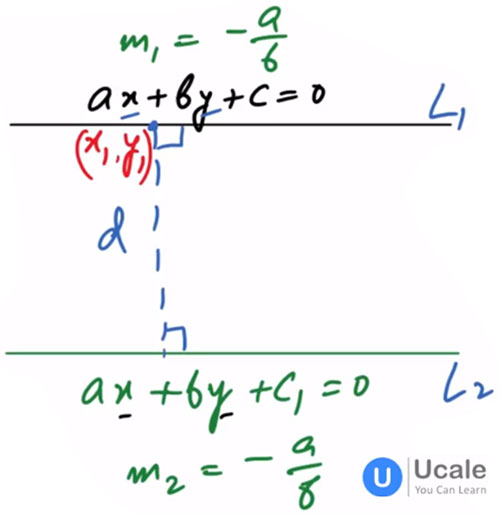
Idea Behind the Formula (Hidden Concept)
- Pick any point on the first line.
- Measure its perpendicular distance from the second line.
- That distance is the distance between the two parallel lines.
Derivation
Take a point [(x_1, y_1)] on the line
[
ax + by + c_1 = 0
]
Distance of this point from
[
ax + by + c_2 = 0
]
Using perpendicular distance formula:
[d = \dfrac{|ax_1 + by_1 + c_2|}{\sqrt{a^2 + b^2}}]
Since the point lies on the first line:
[
ax_1 + by_1 = -c_1
]
Substitute:
[
d = \dfrac{|c_2 – c_1|}{\sqrt{a^2 + b^2}}
]
3. Final Formula (Must Remember)
[d = \dfrac{|c_1 – c_2|}{\sqrt{a^2 + b^2}}]
Only valid when both lines are parallel
Coefficients of (x) and (y) must be identical
4. Key Features / Observations
- Distance is independent of slope
- Distance is always positive
- If ([c_1 = c_2]), then distance = 0 ⇒ same line
- Formula fails if lines are not parallel
5. Important Formula Table
| Situation | Formula |
|---|---|
| Distance between ([ax + by + c_1 = 0]) and ([ax + by + c_2 = 0]) | [d = \dfrac{|c_1 – c_2|}{\sqrt{a^2 + b^2}}] |
| Distance between two horizontal lines ([y = c_1], [y = c_2]) | [|(c_2 – c_1)|] |
| Distance between two vertical lines ([x = c_1], [x = c_2]) | [|(c_2 – c_1)|] |
6. Conceptual Questions with Solutions
1. Why must the coefficients of x and y be identical in the distance formula?
If coefficients differ, the slopes differ, meaning the lines intersect.
Distance between intersecting lines is not constant; hence the formula is invalid.
2. What happens to the distance if both equations are multiplied by different constants?
Distance changes unless both equations are normalized to identical coefficients.
This tests whether students understand equation standardization.
3. Can distance between two parallel lines ever be negative?
No. Absolute value ensures distance is always non-negative, as distance is a magnitude.
4. Why does the formula not involve slope explicitly?
Slope is embedded inside $ \displaystyle \sqrt{{{{a}^{2}}+{{b}^{2}}}}$.
Distance depends on orientation, not inclination angle.
5. If distance is zero, what does it imply?
Both lines coincide; they are the same line written differently.
6. Why is perpendicular distance used and not vertical distance?
Only perpendicular distance gives the shortest distance between two lines.
7. Does the formula work for vertical lines?
Yes. For $ \displaystyle x+c=0 $ substitute
[a=1], [b=0].
8. Can two lines with same slope but different coefficients be parallel?
Yes, after dividing by constants to make coefficients identical.
9. Why is normalization sometimes required before applying the formula?
Because distance depends on actual geometry, not algebraic scaling.
10. Is distance dependent on the chosen point?
No. Any perpendicular gives the same distance due to parallelism.
11. Can this formula be derived using vectors?
Yes. Using projection of displacement vector on normal vector.
12. What does [\sqrt{a^2 + b^2}] geometrically represent?
Magnitude of the normal vector to the line.
13. Can distance ever depend on x or y values?
No. Distance is a constant for parallel lines.
14. Why is this topic frequently asked in exams?
It tests:
Parallelism
Normalization
Formula application
Conceptual clarity
15. What is the biggest student mistake in this topic?
Applying the formula without first checking parallelism.
7. FAQ / Common Misconceptions
1. Distance formula works for any two lines
False. Only for parallel lines.
2. Multiply equations freely before using formula
Wrong unless both are normalized equally.
3. Distance depends on slope value
Distance depends on normal, not slope.
4. Vertical and horizontal lines need special formulas
Same formula works.
5. Negative distance has meaning
Distance is scalar.
6. Coincident lines have maximum distance
Distance is zero.
7. Same intercept means same line
Only if slopes are also same.
8. Absolute value can be removed
Leads to sign errors.
9. Parallelism check is optional
Mandatory.
10. Distance changes with coordinate shift
Geometry is invariant.
8. Practice Questions with Solutions
Question 1: Find the distance between the parallel lines [3x + 4y – 5 = 0] and [3x + 4y + 7 = 0].
Step-by-Step Solution:
1. Compare both equations with [[ax + by + c = 0]]:
[a = 3,][\quad] [b = 4,][\quad] [c_1 = -5,][\quad] [c_2 = 7]
2. Distance formula:
[d = \dfrac{|c_1 – c_2|}{\sqrt{a^2 + b^2}}]
3. Substitute:
[
d = \dfrac{|-5 – 7|}{\sqrt{3^2 + 4^2}}
]
4. Simplify:
[
d = \dfrac{12}{\sqrt{25}} = \dfrac{12}{5}
]
Answer:
[d = \dfrac{12}{5}]
Question 2: Find the distance between the lines [5x – 12y + 1 = 0] and [5x – 12y – 11 = 0].
Step-by-Step Solution:
1. [a = 5,][\quad] [b = -12,][\quad][ c_1 = 1,][\quad] [c_2 = -11]
2. Apply formula:
[
d = \dfrac{|1 + 11|}{\sqrt{25 + 144}}
]
3. Simplify:
[
d = \dfrac{12}{\sqrt{169}} = \dfrac{12}{13}
]
Answer
[d = \dfrac{12}{13}]
Question 3: Find the distance between [2x – y + 3 = 0] and [2x – y – 5 = 0].
Step-by-Step Solution:
1. [a = 2,][\quad] [b = -1,][\quad] [c_1 = 3,][\quad] [c_2 = -5]
2. Distance:
[
d = \dfrac{|3 + 5|}{\sqrt{4 + 1}}
]
3. Simplify:
[
d = \dfrac{8}{\sqrt{5}}
]
Answer:
[d = \dfrac{8}{\sqrt{5}}]
Question 4: Find the distance between the lines [y = 3x + 4] and [y = 3x – 2].
Step-by-Step Solution:
1. Convert to general form:
[3x – y + 4 = 0,][\quad][3x – y – 2 = 0]
2. [a = 3,][\quad] [b = -1,][\quad] [c_1 = 4,][\quad] [c_2 = -2]
3. Apply formula:
[
d = \dfrac{|4 + 2|}{\sqrt{9 + 1}}
]
4. Simplify:
[
d = \dfrac{6}{\sqrt{10}}
]
Answer
[d = \dfrac{6}{\sqrt{10}}]
Question 5: Find the distance between [x + 2y – 3 = 0] and [x + 2y + 5 = 0].
Step-by-Step Solution
1. [a = 1,][\quad] [b = 2,][\quad] [c_1 = -3,][\quad] [c_2 = 5]
2. Apply formula:
[
d = \dfrac{|-3 – 5|}{\sqrt{1 + 4}}
]
3. Simplify:
[
d = \dfrac{8}{\sqrt{5}}
]
Answer
[d = \dfrac{8}{\sqrt{5}}]
Question 6: Find the distance between the lines [2x – 4y + 1 = 0] and [x – 2y – 6 = 0].
Step-by-Step Solution:
1. Multiply second equation by 2:
[
2x – 4y – 12 = 0
]
2. Now:
[c_1 = 1,][\quad] [c_2 = -12]
3. Apply formula:
[
d = \dfrac{|1 + 12|}{\sqrt{4 + 16}}
]
4. Simplify:
[
d = \dfrac{13}{\sqrt{20}}
]
Answer:
[d = \dfrac{13}{\sqrt{20}}]
Question 7: Find the distance between the parallel lines [ax + by + c = 0] and [ax + by – c = 0].
Step-by-Step Solution:
1. [c_1 = c,][\quad] [c_2 = -c]
2. Apply formula:
[
d = \dfrac{|c + c|}{\sqrt{a^2 + b^2}}
]
Answer
[d = \dfrac{2|c|}{\sqrt{a^2 + b^2}}]
Question 8: Find the distance between the lines [3x – 4y + 10 = 0]] and [6x – 8y – 6 = 0].
Step-by-Step Solution:
1. Divide second equation by 2:
[
3x – 4y – 3 = 0
]
2. [c_1 = 10,][\quad] [c_2 = -3]
3. Apply formula:
[
d = \dfrac{|10 + 3|}{\sqrt{9 + 16}}
]
4. Simplify:
[
d = \dfrac{13}{5}
]
Answer:
[d = \dfrac{13}{5}]
Question 9: Find the distance between the lines [y = mx + c_1] and [y = mx + c_2].
Step-by-Step Solution:
1. Convert to general form:
[mx – y + c_1 = 0,][\quad] [mx – y + c_2 = 0]
2. Apply formula:
[d = \dfrac{|c_1 – c_2|}{\sqrt{m^2 + 1}}]
Answer:
[d = \dfrac{|c_1 – c_2|}{\sqrt{m^2 + 1}}]
Question 10: If the distance between the lines [4x + 3y + 5 = 0] and [4x + 3y + k = 0] is [2], find [k].
Step-by-Step Solution:
1. Apply formula:
[
\dfrac{|5 – k|}{\sqrt{16 + 9}} = 2
]
2. Simplify:
[
\dfrac{|5 – k|}{5} = 2
]
3. Multiply:
[
|5 – k| = 10
]
4. Two cases:
[
5 – k = 10 \Rightarrow k = -5
]
[
5 – k = -10 \Rightarrow k = 15
]
Answer:
[k = -5 \text{ or } 15]
 Continue with Google