

1. Concept Overview / Statement of the Concept
A capacitor is a device that stores electric charge and electrical energy.
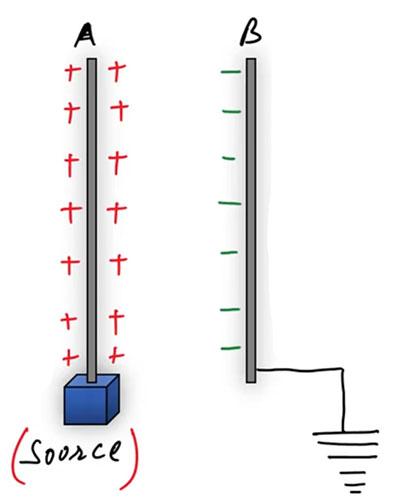
It consists of two conductors (called plates) separated by an insulating medium (air, vacuum, or a dielectric).
When a potential difference is applied across the plates:
- One plate becomes positively charged (+Q)
- The other becomes negatively charged (–Q)
The ability of a capacitor to store charge is called its capacitance.
Capacitance defines how much charge a capacitor can store per unit potential difference:
[C = \dfrac{Q}{V}]
Why capacitors are important:
- They store energy in electric circuits
- They smooth voltage fluctuations in power supply systems
- They are essential in filters, oscillators, camera flashes, and communication systems
A capacitor does not allow DC current to pass through, but it can allow AC signals through (because charge can accumulate and discharge periodically).
2. Clear Explanation
A capacitor stores charge due to electric field formation between its plates.
If the plates carry charges +Q and –Q and the potential difference between them is V, then:
[C = \dfrac{Q}{V}]
The capacitance depends on:
- Geometry of plates (size, shape, area)
- Separation between plates
- Nature of dielectric inserted between them
A dielectric medium increases capacitance by reducing the electric field and allowing more charge to be stored at the same voltage.
3. Dimensions and Units
Dimensions of Capacitance
[C] = [\dfrac{Q}{V}] = [\dfrac{AT}{ML^{2}T^{-3}A^{-1}}] [= M^{-1}L^{-2}T^{4}A^{2}]
SI Unit
- Farad (F)
- 1 Farad = 1 Coulomb per Volt
- Practical commonly used units:
- microfarad [(μF)] = [(10^{-6}) F]
- nanofarad [(nF)] [= (10^{-9}) F]
- picofarad [(pF)] [= (10^{-12}) F]
4. Key Features
- A capacitor always has two plates and a dielectric in between.
- The charge stored is directly proportional to voltage:
[Q \propto V] - No conduction current flows through capacitor plates.
- Energy is stored in the electric field between the plates.
- Capacitance increases when:
- Plate area increases
- Separation decreases
- Dielectric constant increases
- Capacitors are used to block DC, allow AC, and store energy.
5. Important Formulas to Remember
| Quantity | Formula |
|---|---|
| Capacitance | [C = \dfrac{Q}{V}] |
| Charge stored | [Q = CV] |
| Energy stored in capacitor | [U = \dfrac{1}{2}CV^{2}] |
| Energy in terms of Q | [U = \dfrac{Q^{2}}{2C}] |
| Energy in terms of V and Q | [U = \dfrac{1}{2}QV] |
| Electric field in capacitor | [E = \dfrac{V}{d}] |
6. Conceptual Questions with Solutions
1. Why does a capacitor store equal and opposite charges on its plates?
Because when one plate is connected to the positive terminal, electrons are pulled away from it, depositing them onto the other plate through the circuit. Hence charges always appear in +Q and -Q pairs.
2. Why can’t a capacitor have different magnitudes of charge on its plates?
If one plate has +Q and the other had some different charge, electric field lines could not terminate properly. Charge always appears in equal and opposite amounts because electrons flow between plates.
3. Why does inserting a dielectric increase capacitance?
Because dielectric molecules polarize and reduce the effective electric field between plates, allowing more charge to accumulate for the same voltage.
4. Why does a capacitor block DC current?
In steady DC, charges accumulate on plates until electric field cancels further flow. No continuous conduction path exists.
5. Why can a capacitor allow AC to pass?
In AC, voltage changes continuously, so charge flows in and out of plates, mimicking current flow.
6. Why does capacitance increase when plate area increases?
Larger area allows more charge to be stored for the same potential difference.
7. Why does capacitance decrease when separation increases?
Because electric field weakens and potential difference rises more for a given charge.
8. Is the charge stored in the dielectric?
No. Charge is stored only on capacitor plates. The dielectric only polarizes.
9. Why do capacitors store energy?
Work is done in separating charges and building up an electric field, which stores energy.
10. Does the capacitor leak current?
Ideally no. But real dielectrics have tiny leakage currents due to imperfections.
11. Why is the electric field uniform in a parallel plate capacitor?
Because plates are large and parallel, causing field lines to be straight, equal, and parallel in the central region.
12. Why is capacitance independent of charge stored?
Capacitance is a geometric/electrical property of the capacitor, not dependent on Q or V.
13. Can a capacitor store infinite charge?
No. When voltage exceeds breakdown potential of dielectric, dielectric fails and capacitor discharges.
14. Why do we use capacitors in camera flashes?
They store electrical energy quickly and release it suddenly to produce a bright flash.
15. Why does touching capacitor terminals discharge it?
Because your body provides a conductive path allowing accumulated charges to neutralize.
7. FAQ / Common Misconceptions
1. Do capacitors create charge?
No. They only separate existing charges; they do not create new charge.
2. Does a capacitor have charge on the dielectric?
No, the dielectric has no free charge. Only polarization happens.
3. Does current pass through capacitor plates?
No. Only displacement current (changing electric field) occurs between plates.
4. Is capacitance dependent on supply voltage?
No. It depends only on geometry and dielectric.
5. Do both plates store the same amount of energy?
Energy is stored in the electric field between plates, not on the plates.
6. Does the capacitor lose energy when disconnected?
Ideally no. Real capacitors slowly leak due to imperfect dielectrics.
7. Is a larger capacitor always better?
No. Capacitance depends on application — too much capacitance may slow circuits.
8. Do capacitors block AC?
No. They block DC but can pass AC (via displacement current).
9. Can capacitors be charged indefinitely?
No. Charging stops when potential difference equals supply voltage.
10. Does energy stay stored forever?
No. Leakage and internal resistance cause slow discharge.
8. Practice Questions (With Step-by-Step Solutions)
1. A capacitor has capacitance 5 μF. If it is charged to 12 V, find the charge stored.
Solution:
[Q = CV]
[Q = 5 \times 10^{-6} \times 12]
[Q = 60 \times 10^{-6} \text{ C}]
[\boxed{Q = 60\ \mu C}]
2. A capacitor stores 40 μC when connected to a 20 V supply. Find its capacitance.
[C = \dfrac{Q}{V}]
[C = \dfrac{40 \times 10^{-6}}{20}]
[C = 2 \times 10^{-6} \text{ F}]
[\boxed{C = 2 \mu F}]
3. A capacitor of capacitance 4 μF is charged to 100 V. Find energy stored.
[U = \dfrac{1}{2}CV^{2}]
[U = \dfrac{1}{2} \times 4 \times 10^{-6} \times 10000]
[U = 0.02\ \text{J}]
[\boxed{0.02\ \text{J}}]
4. A capacitor has 3 μF capacitance. How much potential difference is needed to store 15 μC?
[V = \dfrac{Q}{C}]
[V = \dfrac{15 \times 10^{-6}}{3 \times 10^{-6}}]
[V = 5\ \text{V}]
[\boxed{5\text{ V}}]
5. A capacitor’s energy is 0.5 J when charged to 50 V. Find its capacitance.
[U = \dfrac{1}{2}CV^{2}]
[0.5 = \dfrac{1}{2}C(50)^{2}]
[0.5 = 1250C]
[C = 4 \times 10^{-4}\ \text{F}]
[\boxed{C = 400\ \mu F}]
 Sign in with Google