

1. Statement of the Law / Concept Overview
Ampere’s Circuital Law is a fundamental relationship in magnetism that connects:
- The magnetic field produced by electric currents, and
- The path (closed loop) around which we measure that magnetic field.
In simple terms:
Any current-carrying conductor produces a magnetic field.
If you move around the conductor along a closed loop, the total (line integral) of magnetic field along that loop depends only on how much current passes through the loop.
Formal Statement
According to Ampere’s Circuital Law:
[\displaystyle \oint \vec{B} \cdot d\vec{l}] [= \mu_0 I_{\text{enclosed}}]
It means:
- Take any closed imaginary path (called an Amperian loop).
- Multiply the magnetic field [ \vec{B} ] at each point with the tiny path element [ d\vec{l} ].
- Add (integrate) this all around the loop.
- The result depends only on the total current passing through the surface enclosed by that loop, not on shape or size of the loop.
Why This Law is Important
- It allows us to calculate magnetic fields easily for symmetrical systems.
- Similar to how Gauss’s Law simplifies electric fields, Ampere’s Law simplifies magnetic fields.
- It works best for:
- Infinite straight wires
- Solenoids
- Toroids
- Coaxial cables
2. Clear Explanation and Mathematical Derivation
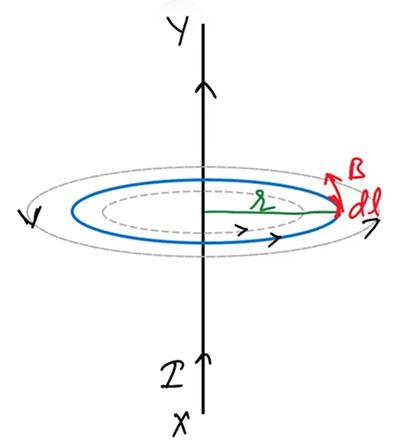
Consider a long, straight conductor carrying current [I].
We choose a circular Amperian loop of radius [r] centered on the wire.
Step 1: Symmetry Argument
- Magnetic field magnitude [B] is same at every point on a circle around the wire.
- Direction of [\vec{B}] is tangential to the circle (given by Right Hand Thumb Rule).
- Therefore, angle between [\vec{B}] and [d\vec{l}] is [0^\circ].
So,
[\vec{B} \cdot d\vec{l}] = [B dl]
Step 2: Apply Ampere’s Circuital Law
[\displaystyle \oint \vec{B} \cdot d\vec{l}] [= B \displaystyle \oint dl] [= B (2\pi r)]
Step 3: Relate to enclosed current
[\displaystyle \oint \vec{B} \cdot d\vec{l}] [= \mu_0 I]
So,
[B (2\pi r) = \mu_0 I]
Final Result
[
\boxed{B = \dfrac{\mu_0 I}{2\pi r}}
]
This matches the result obtained via the Biot–Savart Law, but Ampere’s Law provides it much faster.
3. Dimensions and Units
Magnetic Field [B]
- SI Unit: Tesla (T)
- Dimensions: [M A^{-1} T^{-2}] or [kg·s^{-2}·A^{-1}]
Permeability of free space [\mu_0]
- Value: [4\pi \times 10^{-7} \text{H/m}]
- Unit: Henry per meter (H/m)
4. Key Features
- Applies only to steady currents.
- Works best for systems with high symmetry:
- cylindrical symmetry
- planar symmetry
- toroidal symmetry
- The loop can be:
- circular
- square
- arbitrary shape
- Only current that passes through the surface enclosed by the loop contributes.
- Currents outside the Amperian loop do not affect the integral.
5. Important Formulas to Remember
| Situation | Magnetic Field |
|---|---|
| Straight long wire | [B] [= \dfrac{\mu_0 I}{2\pi r}] |
| Solenoid | [B] [= \mu_0 n I] |
| Toroid | [B] [= \dfrac{\mu_0 N I}{2\pi r}] |
| Ampere’s Law (general) | [\displaystyle \oint \vec{B} \cdot d\vec{l}] [= \mu_0 I_{\text{enclosed}}] |
6. Conceptual Questions with Solutions
1. Why does Ampere’s Law require a closed loop?
Because magnetic field lines always form closed loops. To capture the total circulation of magnetic field, integration must be over a closed path.
2. Does the shape of the Amperian loop matter?
No. Ampere’s Law depends only on the current enclosed, not the loop shape. But symmetry determines whether the law can simplify calculations.
3. Why is Ampere’s Law similar to Gauss’s Law?
Both laws link fields to enclosed sources: Gauss’s Law links electric flux to charge; Ampere’s Law links magnetic circulation to current.
4. What happens if no current passes through the Amperian loop?
The line integral becomes zero: [\displaystyle \oint \vec{B} \cdot d\vec{l} = 0].
5. Does Ampere’s Law work for time-varying currents?
Not by itself. Maxwell added the displacement current term to fix this. That extended law is the Ampere–Maxwell Law.
6. Why is magnetic field tangential around a straight conductor?
Direction follows Right Hand Thumb Rule: curling fingers show magnetic field direction.
7. Why does the magnitude of magnetic field remain constant on a circular Amperian loop?
Due to cylindrical symmetry: each point at distance [r] from the wire is equivalent.
8. Can an Amperian loop be outside the conductor?
Yes. Only enclosed current matters.
9. Does current outside the loop affect the line integral?
No. Currents outside do not contribute to the enclosed current.
10. Why do we choose symmetrical loops?
To simplify [\displaystyle \oint \vec{B} \cdot d\vec{l}] so that [B] can be taken out of the integral.
11. What is the physical meaning of the integral [\displaystyle \oint \vec{B} \cdot d\vec{l}]?
It measures the total “circulation” of magnetic field along the loop.
12. Why is Ampere’s Law exact even for arbitrary loop shapes?
Because it is a fundamental law of nature, derived from Maxwell’s equations.
13. What if the magnetic field is not uniform over the loop?
Then [\displaystyle \oint \vec{B} \cdot d\vec{l}] must be computed by splitting into segments with known variation.
14. What if part of the loop is inside the conductor?
Then only the proportional part of current enclosed by that area contributes.
15. Can magnetic field exist without current?
Not in Ampere’s original law. But Maxwell corrected this by adding displacement current.
7. FAQ / Common Misconceptions
1. Ampere’s Law works only for circular loops — True or False?
False. It works for any closed loop. Symmetry just makes calculations easier.
2. Does magnetic field depend only on enclosed current?
Yes, the line integral depends only on enclosed current.
3. If the wire is not infinitely long, is Ampere’s Law invalid?
No. Ampere’s Law is always valid, but symmetry may be lost, so B is harder to compute.
4. Does Ampere’s Law give direction of magnetic field?
No. It gives magnitude; direction comes from Right Hand Thumb Rule.
5. Is [\mu_0] a constant everywhere?
Only in vacuum. In materials, permeability changes.
6. Is Ampere’s Law dependent on loop area?
No. Only enclosed current matters.
7. Can magnetic field lines ever start or end?
No. They always form closed loops.
8. Why doesn’t current outside the loop contribute?
Because field contributions cancel in pairs, giving zero net circulation.
9. Is the line integral of B always zero if there is no enclosed current?
Yes.
10. Does Ampere’s Law apply inside the conductor?
Yes. Enclosed current depends on fraction of cross-section enclosed.
8. Practice Questions (Step-by-Step Solutions)
Q1. A long wire carries current [I = 5,A]. Find the magnetic field at distance [r = 4,cm].
Solution:
[B = \dfrac{\mu_0 I}{2\pi r}]
Substitute:
[B] [= \dfrac{4\pi \times 10^{-7} \times 5}{2\pi \times 0.04}]
[B = 2.5 \times 10^{-5},T]
Q2. A current of [10,A] flows through a conductor. At what distance is the magnetic field [5 \times 10^{-5},T]?
[B = \dfrac{\mu_0 I}{2\pi r}]
[r = \dfrac{\mu_0 I}{2\pi B}]
[r] [= \dfrac{4\pi \times 10^{-7} \times 10}{2\pi \times 5 \times 10^{-5}}]
[r = 0.04,m]
Q3. The magnetic field at a point is [10^{-4},T] due to a wire. If the current doubles, what happens to B?
[
B \propto I
]
So new field:
[B’ = 2B] [= 2 \times 10^{-4} T]
Q4. A wire carries [8,A]. Find B at [2,cm].
[B = \dfrac{\mu_0 I}{2\pi r}]
[B] [= \dfrac{4\pi \times 10^{-7} \times 8}{2\pi \times 0.02}]
[B = 8 \times 10^{-5} T]
Q5. Magnetic field measured at 10 cm is [2 \times 10^{-6},T]. Find the current.
[I] [= \dfrac{2\pi r B}{\mu_0}]
[I] [= \dfrac{2\pi \times 0.1 \times 2 \times 10^{-6}}{4\pi \times 10^{-7}}]
[I = 1 A]
 Sign in with Google