

1. Statement of the Concept
The angle between two straight lines is defined as the acute angle between their directions of inclination.
If two lines have slopes [m_1] and [m_2], then the angle [θ] between them is given by a standard trigonometric relation.
2. Explanation and Mathematical Derivation
Step 1: Slopes and Inclinations
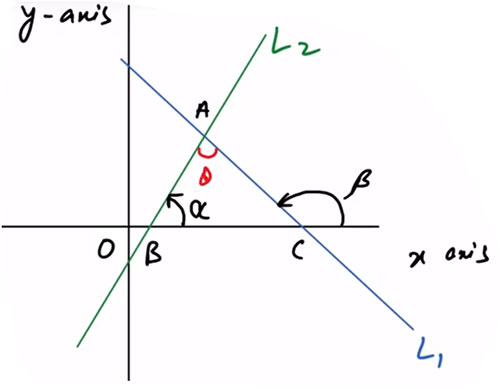
- Let the two lines make angles [\alpha] and [\beta] with the positive x-axis.
- Their slopes are:
- [m_1 = \tan\beta]
- [m_2 = \tan\alpha]
Step 2: Angle Between the Lines
The angle between the two lines is:
[θ = |\beta − \alpha|]
Using the identity:
[\tan (\beta − \alpha) ][= \dfrac{\tan \beta − \tan \alpha}{1 + \tan \beta \tan \alpha}]
Final Formula
[\tan \theta = \left| \dfrac{m_1 – m_2}{1 + m_1 m_2} \right|]
3. Key Features and Important Observations
- Angle between two lines is always taken as the acute angle
- If [m_1 = m_2] ⇒ lines are parallel
- If [m_1 m_2 = −1] ⇒ lines are perpendicular
- Formula is valid only when both slopes are finite
- Vertical lines need special treatment using direction ratios
4. Important Formulas to Remember
| Situation | Condition |
|---|---|
| Angle between two lines | [tan θ ][= \dfrac{\tan \beta − \tan \alpha}{1 + \tan \beta \tan \alpha}] |
| Parallel lines | [m_1 = m_2] |
| Perpendicular lines | [m_1 m_2 = −1] |
| Acute angle | [0° ≤ θ ≤ 90°] |
5. Conceptual Questions with Solutions
1. Why do we take the absolute value in the angle formula?
The angle between two lines is always measured as the smallest (acute) angle between them.
Since slopes can be ordered arbitrarily, the difference [m_1 − m_2] may be negative.
Absolute value ensures the angle remains positive and meaningful.
2. Can the angle between two lines ever be obtuse?
Geometrically, two lines form four angles, two acute and two obtuse.
By convention, the angle between two lines always refers to the acute angle only.
3. Why does the formula fail for vertical lines?
Vertical lines have infinite slope, so [m = tan θ] is undefined.
In such cases, we must use:
direction ratios, or
angle between normals
4. How does the formula detect perpendicularity?
If [m_1 m_2 = −1], then denominator becomes zero:
[1 + m_1 m_2 = 0]
Hence:
[tan θ → ∞ ⇒ θ = 90°]
5. Is the angle dependent on the position of the lines?
No.
The angle depends only on direction, not on where the lines are located.
6. FAQs / Common Misconceptions (Deep Exam Points)
1. Students often forget that the angle must be acute.
Even if the calculation gives [θ > 90°], the smaller angle must be chosen.
2. Confusion between angle of line and angle between lines.
Angle of line → measured from x-axis
Angle between lines → difference of inclinations
3. Many students directly substitute equations without finding slope.
Always reduce each equation to slope form or explicitly compute [m].
4. Vertical line cases are often mishandled.
If one line is vertical and the other has slope [m], then:
[θ = tan⁻¹ |1/m|]
5. Absolute value is sometimes ignored.
Ignoring absolute value can lead to negative angles, which are meaningless here.
8. Practice Questions with Step-by-Step Solutions
Question 1. Find the angle between the lines having slopes [m_1 = 1] and [m_2 = 0].
Step-by-Step Solution:
Formula for angle between two lines:
[\tan \theta = \left| \dfrac{m_1 – m_2}{1 + m_1 m_2} \right|]
Substitute values:
[\tan \theta = \left| \dfrac{1 – 0}{1 + (1)(0)} \right|]
Simplify:
[\tan \theta = 1]
Find angle:
[\theta = 45°]
Conclusion:
Angle between the lines is 45°.
Question 2. Find the angle between the lines [y = 2x + 1] and [y = −x + 3].
Step-by-Step Solution:
Slopes of the lines:
[m_1 = 2], [m_2 = −1]
Apply formula:
[\tan \theta = \left| \dfrac{2 − (−1)}{1 + (2)(−1)} \right|]
Simplify numerator and denominator:
[\tan \theta = \left| \dfrac{3}{−1} \right| = 3]
Find angle:
[\theta = \tan^{-1}(3)]
Conclusion:
Angle between the lines is
[ \theta = \tan^{-1}(3) ].
Question 3. Find the angle between the lines [3x − 4y + 5 = 0] and [4x + 3y − 7 = 0].
Step-by-Step Solution:
Convert first line to slope form:
[3x − 4y + 5 = 0 ⇒ 4y = 3x + 5 ⇒ y = \dfrac{3}{4}x + \dfrac{5}{4}]
So, [m_1 = \dfrac{3}{4}]
Convert second line:
[4x + 3y − 7 = 0 ⇒ 3y = −4x + 7 ⇒ y = −\dfrac{4}{3}x + \dfrac{7}{3}]
So, [m_2 = −\dfrac{4}{3}]
Multiply slopes:
[m_1 m_2 = \dfrac{3}{4} × (−\dfrac{4}{3}) = −1]
Since [m_1 m_2 = −1], lines are perpendicular.
Conclusion:
Angle between the lines is 90°.
Question 4. Find the angle between the lines [2x + y − 4 = 0] and [x − 2y + 1 = 0].
Step-by-Step Solution:
First line:
[y = −2x + 4 ⇒ m_1 = −2]
Second line:
[−2y = −x − 1 ⇒ y = \dfrac{1}{2}x + \dfrac{1}{2} ⇒ m_2 = \dfrac{1}{2}]
Apply formula:
[\tan \theta = \left| \dfrac{−2 − \dfrac{1}{2}}{1 + (−2)(\dfrac{1}{2})} \right|]
Simplify:
[\tan \theta = \left| \dfrac{−\dfrac{5}{2}}{1 − 1} \right|]
Denominator is zero ⇒ [\tan \theta → ∞]
Conclusion:
Angle between the lines is 90°.
Question 5. Find the angle between the line [y = √3 x + 2] and the x-axis.
Step-by-Step Solution:
Slope of the line:
[m = √3]
Slope of x-axis:
[m = 0]
Apply formula:
[\tan \theta = \left| \dfrac{√3 − 0}{1 + 0} \right| = √3]
Find angle:
[\theta = 60°]
Conclusion:
Angle between the line and x-axis is 60°.
Question 6. Find the acute angle between the lines [x = 2] and [3x − y + 4 = 0].
Step-by-Step Solution:
Line [x = 2] is vertical.
Slope of second line:
[3x − y + 4 = 0 ⇒ y = 3x + 4 ⇒ m = 3]
Angle between vertical line and another line:
[\tan \theta = \left| \dfrac{1}{m} \right|]
Substitute:
[\tan \theta = \dfrac{1}{3}]
Conclusion:
Angle between the lines is
[ \theta = \tan^{-1}\left(\dfrac{1}{3}\right) ].
Question 7. If the angle between two lines is [45°] and slope of one line is [1], find the slope of the other line.
Step-by-Step Solution:
Given:
[θ = 45°], [m_1 = 1]
Formula:
[\tan 45° = \left| \dfrac{1 − m_2}{1 + m_2} \right|]
Since [\tan 45° = 1]:
[\left| \dfrac{1 − m_2}{1 + m_2} \right| = 1]
Case 1:
[1 − m_2 = 1 + m_2 ⇒ m_2 = 0]
Case 2:
[1 − m_2 = −(1 + m_2)] ⇒ contradiction
Conclusion:
Slope of the other line is
[ m_2 = 0 ].
Question 8. Find the angle between the lines [2x − y + 1 = 0] and [4x − 2y + 5 = 0].
Step-by-Step Solution:
First line:
[y = 2x + 1 ⇒ m_1 = 2]
Second line:
[2y = 4x + 5 ⇒ y = 2x + \dfrac{5}{2} ⇒ m_2 = 2]
Since [m_1 = m_2], lines are parallel.
Conclusion:
Angle between the lines is 0°.
Question 9. Find the angle between the lines whose equations are given by [\dfrac{x − 1}{2} = \dfrac{y − 3}{3}] and [\dfrac{x + 2}{−1} = \dfrac{y − 1}{2}].
Step-by-Step Solution:
Direction ratios of first line:
[a_1 = 2], [b_1 = 3]
Slope:
[m_1 = \dfrac{3}{2}]
Direction ratios of second line:
[a_2 = −1], [b_2 = 2]
Slope:
[m_2 = −2]
Apply formula:
[\tan \theta = \left| \dfrac{\dfrac{3}{2} − (−2)}{1 + (\dfrac{3}{2})(−2)} \right|]
Simplify:
[\tan \theta = \left| \dfrac{\dfrac{7}{2}}{1 − 3} \right| = \dfrac{7}{4}]
Conclusion:
Angle between the lines is
[ \theta = \tan^{-1}\left(\dfrac{7}{4}\right) ].
Question 10. Prove that the lines [ax + by + c = 0] and [bx − ay + d = 0] are perpendicular.
Step-by-Step Solution:
Slope of first line:
[by = −ax − c ⇒ m_1 = −\dfrac{a}{b}]
Slope of second line:
[−ay = −bx − d ⇒ m_2 = \dfrac{b}{a}]
Multiply slopes:
[m_1 m_2 = −\dfrac{a}{b} × \dfrac{b}{a} = −1]
Conclusion:
Since [m_1 m_2 = −1], the lines are perpendicular.
 Sign in with Google