

The angle of friction may be defined as the angle which the resultant of the limiting friction and normal reaction makes with the normal reaction.
In the figure, the resultant of limiting friction and normal reaction \( R \) makes an angle \( \alpha \) with normal reaction. Therefore, by definition, \( \alpha \) is the angle of friction.
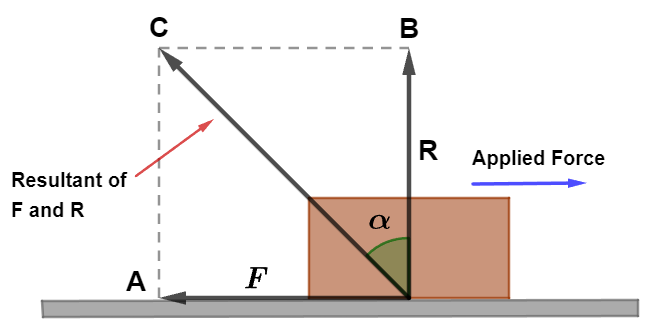
It follows that
\[
\tan \alpha = \frac{BC}{OB} = \frac{OA}{OB} = \frac{F}{R}
\]
But \( \dfrac{F}{R} = \mu \), coefficient of limiting friction
\[
\therefore \, \tan \alpha = \mu \quad …\text{(1)}
\]
Hence, coefficient of limiting friction is equal to the tangent of the angle of friction.
Example:
A force of 98 N is just able to move a body weighing 45 kgf on rough horizontal surface. Calculate the coefficient of friction and angle of friction.
Solution:
Here, \( F = 98 \, \text{N}, \, R = Mg = 45 \, \text{kgf} = 45 \times 9.8 \, \text{N} \)
\[
\mu = \frac{F}{R} = \frac{98}{45 \times 9.8} = 0.22
\]
If \( \alpha \) is the angle of friction, then
\[
\tan \alpha = \mu = 0.22
\]
\[
\therefore \, \alpha = \tan^{-1} (0.22) = 12^\circ – 32′
\]
 Sign in with Google