


1. Concept Overview
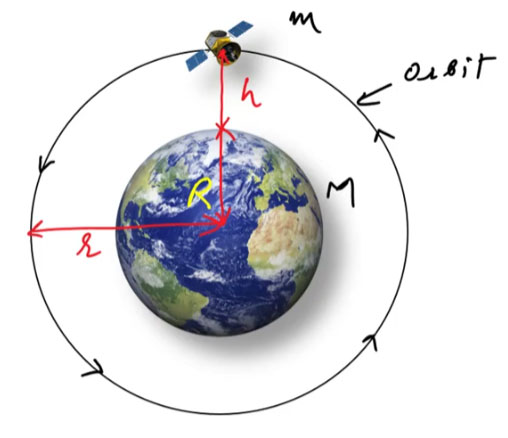
When a satellite revolves around the Earth in an orbit, it possesses both linear and angular momentum.
The angular momentum of a satellite is the measure of the amount of rotation it has due to its orbital motion around Earth.
It is defined as the moment of momentum of the satellite about the center of the Earth.
[
L = m v r
]
where:
- ([L]) = angular momentum
- ([m]) = mass of the satellite
- ([v]) = orbital velocity
- ([r]) = distance of the satellite from the Earth’s center (orbital radius)
2. Explanation and Derivation
The linear momentum of a satellite is:
[
p = m v
]
The satellite moves in a circular path of radius ([r]).
The angular momentum about the Earth’s center is given by:
[
L = r \times p = m v r
]
From Newton’s Law of Gravitation providing centripetal force:
[
\dfrac{G M m}{r^2} = \dfrac{m v^2}{r}
]
[
v = \sqrt{\dfrac{G M}{r}}
]
Substitute this value of ([v]) in the expression of ([L]):
[
L = m r \sqrt{\dfrac{G M}{r}}
]
Simplifying,
[
L = m \sqrt{G M r}
]
Hence, the angular momentum of a satellite revolving in a circular orbit of radius ([r]) is directly proportional to the square root of the radius.
3. Dimensions and Units
| Quantity | Symbol | Dimensions | SI Unit |
|---|---|---|---|
| Angular momentum | [L] | [M L² T⁻¹] | [kg·m²·s⁻¹] |
| Mass | [m] | [M] | [kg] |
| Orbital radius | [r] | [L] | [m] |
| Gravitational constant | [G] | [M⁻¹ L³ T⁻²] | [N·m²·kg⁻²] |
| Mass of Earth | [M] | [M] | [kg] |
4. Key Features
- Angular momentum is conserved in the absence of external torque.
- For circular orbits, it remains constant.
- For elliptical orbits, angular momentum changes with position but its magnitude remains constant (equal areas in equal times — Kepler’s 2nd Law).
- Depends on mass of the satellite, radius of orbit, and Earth’s mass.
- It connects gravitational motion to rotational dynamics.
5. Important Formulas to Remember
| Formula | Description |
|---|---|
| [L = m v r] | Definition of angular momentum |
| [v = \sqrt{\dfrac{G M}{r}}] | Orbital velocity |
| [L = m \sqrt{G M r}] | Angular momentum in circular orbit |
| [L_1 = L_2] | Law of conservation of angular momentum (when no external torque acts) |
6. Conceptual Questions with Solutions
1. On what factors does the angular momentum of a satellite depend?
It depends on the mass of the satellite [m], the mass of the Earth [M], and the orbital radius [r].
2. What happens to angular momentum if the orbital radius increases?
Since [L = m \sqrt{G M r}], angular momentum increases with the square root of radius.
3. Why is angular momentum conserved in satellite motion?
Because no external torque acts on the satellite–Earth system.
4. Is angular momentum a vector quantity?
Yes, it has both magnitude and direction; the direction is perpendicular to the plane of orbit.
5. How does the angular momentum vary for an elliptical orbit?
The magnitude remains constant, but its direction changes continuously along the orbit.
6. What happens to the angular momentum if the satellite moves closer to Earth?
Velocity increases as radius decreases, keeping [L = m v r] constant — demonstrating conservation.
7. Does mass of the Earth affect satellite’s angular momentum?
Yes, [L = m \sqrt{G M r}], so angular momentum increases with the square root of Earth’s mass.
8. Can a stationary satellite have angular momentum?
No. A stationary body has zero velocity, hence zero angular momentum.
9. How does conservation of angular momentum explain Kepler’s second law?
Kepler’s second law (equal areas in equal times) results from conservation of angular momentum in elliptical motion.
10. What provides torque to the satellite?
There is practically no external torque on a satellite in space, hence [L] remains conserved.
11. What happens to [L] if the mass of the satellite doubles?
Angular momentum doubles since [L ∝ m].
12. Why does the angular momentum of a planet remain constant?
Because the gravitational force acts along the line joining the planet and the Sun, so torque is zero.
13. What is the direction of angular momentum of a satellite?
Perpendicular to the plane of motion, following the right-hand rule.
14. Is angular momentum dependent on orbital velocity?
Yes, [L = m v r]; as [v] changes with [r], angular momentum changes accordingly.
15. What does it mean when we say angular momentum is quantized?
It means the satellite can occupy only discrete angular momentum states, conceptually similar to electrons in orbitals.
7. FAQ / Common Misconceptions
1. Angular momentum changes with time for circular motion.
❌ False. It remains constant in circular motion since torque is zero.
2. Linear momentum and angular momentum are unrelated.
❌ False. Angular momentum is the moment of linear momentum: [L = r × p].
3. Only rotating bodies possess angular momentum.
❌ False. Any object moving in a circular path possesses angular momentum.
4. If a satellite’s mass changes, angular momentum remains constant.
❌ False. [L ∝ m], so if mass changes, angular momentum changes.
5. Angular momentum depends on the shape of the orbit only.
❌ False. It depends on mass, velocity, and radius.
6. Gravitational force can provide torque to the satellite.
❌ False. The gravitational force acts radially and passes through the center of motion, so no torque acts.
7. For an elliptical orbit, angular momentum is not conserved.
❌ False. It is conserved in magnitude (Kepler’s second law).
8. Direction of angular momentum is along the orbit.
❌ False. It is perpendicular to the orbital plane.
9. Conservation of angular momentum applies only to satellites.
❌ False. It applies to all isolated systems, including rotating planets and galaxies.
10. If external torque acts, angular momentum can still be conserved.
❌ False. External torque changes angular momentum.
8. Practice Questions (With Step-by-Step Solutions)
Q1. Derive the expression for angular momentum of a satellite in circular orbit.
Solution:
[L = m v r,] [\quad \text{and}] [\quad v = \sqrt{\dfrac{G M}{r}}]
[
\Rightarrow L = m \sqrt{G M r}
]
Q2. Calculate angular momentum of a 500 kg satellite revolving at a radius of [7 × 10^6 \text{ m}] around Earth.
(Given: [G = 6.67 × 10^{-11}], [M = 6 × 10^{24}])
[
L = m \sqrt{G M r}
]
[L] [= 500 \sqrt{6.67 × 10^{-11} × 6 × 10^{24} × 7 × 10^6}]
[
L ≈ 2.65 × 10^{14} \text{ kg·m²·s⁻¹}
]
Q3. A satellite doubles its orbital radius. By what factor does its angular momentum change?
[L ∝ \sqrt{r} \Rightarrow L_2/L_1] [= \sqrt{r_2/r_1}] [= \sqrt{2}] [≈ 1.414]
Q4. Explain how conservation of angular momentum affects a satellite moving closer to Earth.
As radius decreases, velocity increases to keep ([L = m v r]) constant.
Q5. For a planet of mass [M] and a satellite of mass [m], derive [L ∝ \sqrt{r}].
Using gravitational equilibrium: [v = \sqrt{\dfrac{G M}{r}}],
[L = m v r] [= m \sqrt{G M r}] [\Rightarrow L ∝ \sqrt{r}]
 Sign in with Google