

1. Concept Overview
Magnets are materials that have the natural ability to attract certain substances such as iron, nickel, and cobalt. A magnet always possesses two poles—a north pole (N) and a south pole (S). The most fundamental property is:
“Like poles repel; unlike poles attract.”
Magnets create a region around them called the magnetic field, within which magnetic effects are observed.
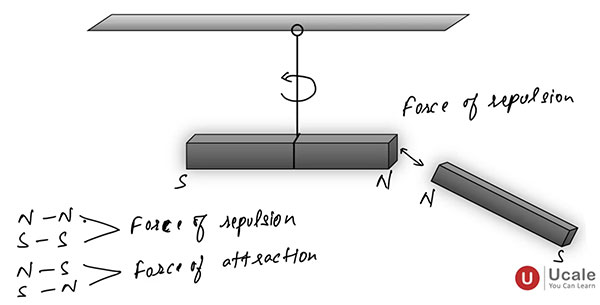

Key Points
- Magnets always exist as dipoles—they cannot be broken into isolated north or south poles.
- The magnetic effect is strongest at the poles of the magnet.
- The region around a magnet where its influence can be detected (using a compass or another magnet) is called the magnetic field.
- A freely suspended magnet always comes to rest such that one pole points towards the geographic north (hence called the north-seeking pole).
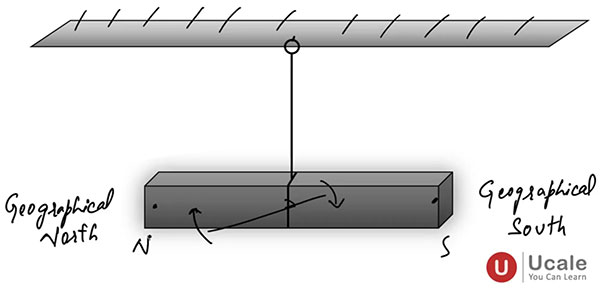
Image Credit: Ucale.org - Magnetic force is a non-contact force, meaning magnets can attract or repel without touching.
2. Clear Explanation and Mathematical Derivation
Although “Basic Properties of Magnets” is mostly conceptual, we introduce formal definitions used throughout magnetism.
Magnetic Pole Strength
Every magnetic pole has a strength (analogous to electric charge) denoted by [m].
It measures how strong a magnetic pole is.
Magnetic Dipole
A bar magnet is modeled as two equal and opposite magnetic poles separated by a distance:
- Magnetic dipole moment:
[M = m \times 2l]
Where
[m] = pole strength
[2l] = distance between poles (magnetic length)
Magnetic Field Due to a Pole
At a distance [r] from a magnetic pole:
[B = \dfrac{\mu_0}{4\pi} \dfrac{m}{r^2}]
This resembles Coulomb’s law, showing how fundamental magnets are to magnetic phenomena.
Direction of Magnetic Field Lines
- Always emerge from north pole and end at south pole outside the magnet.
- Inside the magnet, they travel from south to north, forming continuous closed loops.
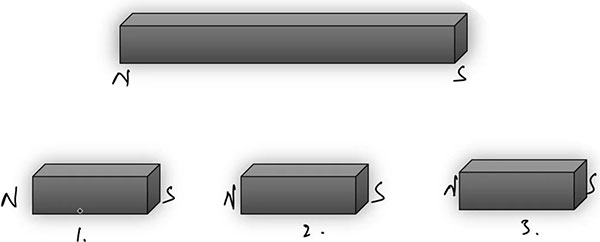
No Monopoles
If a magnet is cut into pieces, each piece becomes a smaller magnet with both poles.
You cannot isolate a single pole.
3. Dimensions and Units
| Quantity | Expression | Dimensions | SI Unit |
|---|---|---|---|
| Magnetic pole strength | [m] | [A·m] | ampere-metre |
| Magnetic dipole moment | [M = m \cdot 2l] | [A·m^2] | A·m² |
| Magnetic field (due to a pole) | [B = \dfrac{\mu_0}{4\pi} \dfrac{m}{r^2}] | [M T^{-2} A^{-1}] | tesla (T) |
4. Key Features
- Every magnet has two poles — never isolated.
- Poles always exist in equal and opposite pairs.
- Magnets obey inverse-square-like laws (similar to Coulomb’s law).
- Magnetic field strength varies from point to point.
- The magnetic force acts at a distance.
- Magnetic lines of force never intersect.
- Magnetic properties arise from the motion of electrons (atomic currents).
5. Important Formulas to Remember
| Purpose | Formula |
|---|---|
| Magnetic dipole moment | [M = m \cdot 2l] |
| Magnetic field due to a pole | [B = \dfrac{\mu_0}{4\pi} \dfrac{m}{r^2}] |
| Magnetic field lines direction | North → South (outside), South → North (inside) |
6. Conceptual Questions with Solutions
1. Why does a freely suspended magnet always point north-south?
Because Earth behaves like a giant magnet. The magnet aligns with Earth’s magnetic field, causing its north pole to point roughly toward the geographic north.
2. Why do magnets have two poles?
Because magnetic field lines always form closed loops. A single isolated pole cannot exist, so magnets are always dipoles.
3. Why does cutting a magnet produce smaller magnets instead of isolating poles?
Magnetic domains realign in each piece, producing both north and south poles in every fragment.
4. Why are magnetic field lines closer near the poles?
Because the magnetic field is strongest near the poles, so field lines are denser in that region.
5. Why do like magnetic poles repel each other?
Because their magnetic field lines attempt to move in opposite directions, leading to a repulsive force.
6. Why don’t magnetic field lines intersect?
If they intersected, the magnetic field would have two directions at one point, which is impossible.
7. Why is the force strongest at the poles of a magnet?
Because surface density of magnetic field lines is highest at the poles.
8. Why do magnets attract iron but not materials like plastic?
Because iron has magnetic domains that can align with the magnet’s field, while plastic does not.
9. Why do bar magnets tend to align along the Earth’s magnetic field?
Because the torque experienced by a dipole in a magnetic field makes it align along the field direction.
10. Why is the north pole of a magnet called the north-seeking pole?
Because when suspended freely, it moves toward the geographic north.
11. Why is the geographic north actually the magnetic south pole of Earth?
Because the north pole of a magnet is attracted to Earth’s magnetic south (which lies near geographic north).
12. Why does a magnet lose its magnetism when heated?
Thermal agitation disrupts alignment of magnetic domains, reducing magnetization.
13. Why does hammering a magnet reduce its magnetism?
Mechanical vibrations disturb the alignment of magnetic domains.
14. Why can magnetic forces act through non-magnetic materials?
Because magnetic fields can pass through most materials without significant weakening.
15. Why do magnetic lines form closed loops?
Because a magnetic dipole creates a continuous field that has no beginning or end, unlike electric charges.
7. FAQ / Common Misconceptions
1. Is the Earth a perfect bar magnet?
No. It only behaves approximately like one; its field is irregular and dynamic.
2. Does a magnet have to be made of iron?
No. Many materials, including alloys and rare-earth metals, can be magnetic.
3. Can we shield magnetic fields completely?
No. Magnetic fields cannot be completely blocked, only redirected using soft iron or mu-metal.
4. Is the north pole of a magnet the same as the Earth’s geographic north?
No. A magnet’s north pole actually points toward Earth’s magnetic south, located near the geographic north.
5. Does attraction always mean both objects are magnets?
No. Magnets also attract soft iron objects due to induced magnetism.
6. Is magnetic force the strongest at the center of a bar magnet?
No. It is strongest at the poles and weakest at the center.
7. Can a magnet attract all metals?
No. Only ferromagnetic metals (iron, nickel, cobalt) are strongly attracted.
8. Are magnetic fields and electric fields identical?
No. They are related but arise from different causes (static charges vs moving charges).
9. Do magnetic lines begin at the north pole?
Outside the magnet, yes. But inside the magnet, they travel from south to north, forming closed loops.
10. Can a magnet ever have unequal pole strengths?
No. Poles always exist in equal and opposite pairs.
8. Practice Questions (With Step-by-Step Solutions)
1. A bar magnet is cut into two equal parts. What happens to the magnetic pole strength of each part?
Solution:
Original magnet: pole strength = [m]
When cut into two equal parts, magnetic domains rearrange.
Each piece becomes a smaller magnet with poles N and S.
Pole strength becomes approximately [m/2].
2. A magnet is freely suspended and comes to rest pointing north-south. What does this indicate?
Solution:
It indicates Earth has a magnetic field.
The magnet aligns with the Earth’s magnetic field, pointing north-south.
3. The magnetic field due to a pole is [2\times10^{-5}] T at a distance of 10 cm. Find pole strength.
[B = \dfrac{\mu_0}{4\pi} \dfrac{m}{r^2}]
[m = \dfrac{B r^2 4\pi}{\mu_0}]
Substitute:
[r = 0.1\ \text{m}]
[m] [= \dfrac{2\times10^{-5} \times (0.1)^2 \times 4\pi}{4\pi \times 10^{-7}}]
[m = 0.2\ \text{A·m}]
4. If field lines are dense near the poles of a magnet, what does it indicate?
Solution:
It indicates a stronger magnetic field near the poles.
5. Why does heating a magnet above Curie temperature destroy its magnetism?
Solution:
At Curie temperature, thermal energy disrupts magnetic domain alignment, thus removing magnetism.
 Sign in with Google