

1. Statement of the Law / Concept Overview
Biot–Savart’s Law gives the magnetic field produced at a point in space due to a small current element.
It states:
The magnetic field [d\vec{B}] produced at a point due to a current element [I d\vec{l}] is directly proportional to the current, the length of the element, and the sine of the angle between the element and the line joining it to the point, and inversely proportional to the square of the distance from the element.
Mathematically,
[d\vec{B}] = [\left(\dfrac{\mu_{0}}{4\pi} \dfrac{I d\vec{l} \times \hat{r}}{r^{2}}\right)]
2. Clear Explanation and Mathematical Derivation
Consider a small current element [I , d\vec{l}].
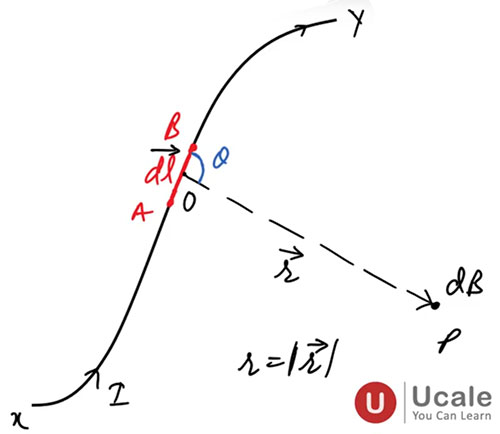
Let:
- [r] = distance of the observation point from the current element
- [\hat{r}] = unit vector from the element toward the point
- [\theta] = angle between [d\vec{l}] and [\hat{r}]
The magnitude of the magnetic field is:
[dB] = [\left(\dfrac{\mu_{0}}{4\pi} \dfrac{I dl \sin\theta}{r^{2}}\right)]
Direction:
It is perpendicular to the plane formed by [d\vec{l}] and [\hat{r}], determined by the right-hand rule for cross products.
Derivation (Conceptual)
- Experiments show that a steady current produces a magnetic field.
- The field is stronger when:
- current increases
- the observation point is closer
- the current element is oriented perpendicularly to the line joining the point
- These dependencies lead to the proportionality:
[dB] [\propto I dl \sin\theta] [\quad] [\text{and}] [\quad] [dB] [\propto \dfrac{1}{r^{2}}]
- Introducing the constant [\dfrac{\mu_{0}}{4\pi}] gives the complete formula.
3. Dimensions and Units
Dimensions of Magnetic Field [B]
[B] = [\left( M T^{-2} I^{-1}\right)]
SI Unit: Tesla (T)
1 Tesla = 1 Weber / m².
4. Key Features
- Biot–Savart’s law applies to steady (constant) currents only.
- It is useful when:
- the current path has symmetry
- the field is required at points close to the conductor
- The law is fundamental for deriving magnetic fields of:
- circular loops
- straight long wires
- solenoids
- Direction is governed by cross product, not by Fleming’s rules.
- It helps derive Ampere’s circuital law for special cases.
5. Important Formulas to Remember
| Case | Magnetic Field |
|---|---|
| General current element | [ d\vec{B}] [= \left(\dfrac{\mu_{0}}{4\pi} \dfrac{I d\vec{l} \times \hat{r}}{r^{2}} \right)] |
| Straight long current-carrying wire | [B] [= \left(\dfrac{\mu_{0} I}{2\pi r} \right)] |
| Circular loop (axis center) | [B] [= \left(\dfrac{\mu_{0} I}{2R} \right)] |
| Arc of circle angle [\theta] | [B] [= \left(\dfrac{\mu_{0} I \theta}{4\pi R} \right)] |
6. Conceptual Questions with Solutions
1. Why does the magnetic field depend on sinθ?
Because only the component of [d\vec{l}] perpendicular to [\hat{r}] contributes to circular magnetic field lines. Parallel components produce no field at that point.
2. What happens to the field if the observation point lies along the extension of the current element?
Then [\theta = 0°], so [\sin\theta = 0]. Thus, [dB = 0].
3. Does a longer element produce more field?
Yes, because [dB \propto dl]. A longer wire segment produces a stronger contribution.
4. Why is the law invalid for varying currents?
Changing currents produce electromagnetic waves; the simple [1/r^{2}] dependence no longer holds.
5. Which rule determines the direction of magnetic field?
The **right-hand thumb rule** / cross-product rule. Not Fleming’s rules.
6. Does Biot–Savart’s law work for closed loops?
Yes. Integrating [d\vec{B}] around the loop gives the net field.
7. Why is μ₀/4π used as the constant?
It ensures consistency with experimentally measured magnetic field units.
8. What happens to B if the distance is doubled?
It becomes one-fourth because [B \propto 1/r^{2}].
9. Why does a straight wire give a 1/r dependence instead of 1/r²?
Because integrating [1/r^{2}] along the infinite wire yields a net [1/r] result.
10. What does the cross product signify here?
It gives both magnitude and **direction** of the magnetic field.
11. Why does direction change when current direction is reversed?
Because [d\vec{l}] reverses, so [d\vec{l} \times \hat{r}] changes sign.
12. Do stationary charges create magnetic fields?
No. Only moving charges (current) produce magnetic fields.
13. Why does the field form concentric circles?
Because the magnetic effect spreads symmetrically around the wire’s axis.
14. Does the law apply inside a wire?
Yes, but the current distribution must be known (uniform or non-uniform).
15. Why is Biot–Savart’s law more fundamental than Ampere’s law?
Because it applies to **any** current configuration, not only symmetric cases.
7. FAQ / Common Misconceptions
1. Is the magnetic field due to a current element radial?
No. It is **perpendicular** to the plane of [d\vec{l}] and [\hat{r}].
2. Does magnetic field decrease as 1/r² for all wires?
No. That’s true for a small element, not for entire wires.
3. Is Fleming’s left-hand rule involved here?
No. That rule is for force on conductors, not for Biot–Savart’s law.
4. Can the law apply to point charges?
Yes, for moving charges (current = charge flow).
5. Does the direction depend on observer’s position?
No. It depends only on current direction and geometry.
6. Does B become infinite at r = 0?
Yes mathematically, but in reality wires have finite thickness.
7. Does the field exist inside a hollow conductor?
Yes, but depends on current distribution.
8. Is Biot–Savart a relativistic effect?
Indirectly, yes. Magnetism arises from relativistic transformations of electric fields.
9. Does the law assume vacuum everywhere?
No. In materials, the constant becomes [\mu], not [\mu_{0}].
10. Does length of wire matter for field direction?
No. Direction is set by cross product, independent of length.
8. Practice Questions (with Step-by-Step Solutions)
Q1. Find the magnetic field at the center of a circular loop of radius [R] carrying current [I].
Solution:
Using Biot–Savart:
[B] [= \left( \dfrac{\mu_{0} I}{2R} \right)]
Q2. A current of 5 A flows in a long straight wire. Find the magnetic field at 2 cm from the wire.
Solution:
[B] [= \left(\dfrac{\mu_{0} I}{2\pi r} \right)]
[B] [= \left( \dfrac{4\pi \times 10^{-7} \times 5}{2\pi \times 0.02} \right)]
[B] [= 5 \times 10^{-5} \text{T}]
Q3. A small element of wire of length [dl = 0.01 , m] carries current [3 A]. Point P is 0.2 m away, making angle [60°]. Find [dB].
[dB] [= \left( \dfrac{\mu_{0}}{4\pi} \dfrac{I dl \sin 60^{\circ}}{r^{2}} \right)]
[dB] [= \left( 10^{-7} \dfrac{3 \times 0.01 \times 0.866}{0.04} \right)] [= 6.5 \times 10^{-8} \text{T}]
Q4. Find B for a semicircular arc of radius 0.5 m carrying 4 A.
[B] [= \left( \dfrac{\mu_{0} I \theta}{4\pi R} \right)]
For semicircle, [\theta = \pi].
[B] [= \left( \dfrac{4\pi \times 10^{-7} \times 4 \times \pi}{4\pi \times 0.5} \right)]
[
B = 8 \times 10^{-7} \text{T}
]
Q5. Two long parallel wires carry currents I in the same direction. Explain the magnetic field at a point midway.
Solution:
- Both fields have equal magnitude: [B] [= \left( \dfrac{\mu_{0} I}{2\pi r} \right)]
- Directions are opposite at the midpoint.
Therefore, they cancel out, giving net B = 0.
 Sign in with Google