

1. Concept Overview
When capacitors are connected in parallel, the equivalent capacitance is the sum of the individual capacitances.
In this arrangement, the potential difference remains the same across all capacitors, while charge divides among them.
2. Clear Explanation and Mathematical Derivation
Consider three capacitors [C_1], [C_2], and [C_3] connected in parallel across a potential difference [V].
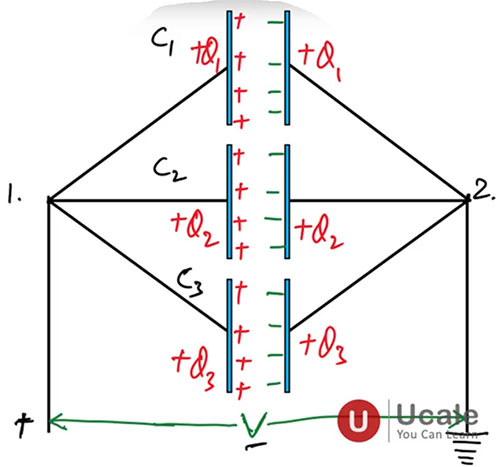
Same Potential Across All Capacitors
Since all capacitors are connected directly across the same two points:
[V_1 = V_2 = V_3] [= V]
Charge Distribution
Let the charges on each capacitor be [Q_1], [Q_2], and [Q_3].
Using the basic capacitor relation:
[
Q = C V
]
So:
[Q_1] [= C_1 V] [,\quad] [Q_2 = C_2 V] [,\quad] [Q_3 = C_3 V]
Total Charge
[Q_{total}] [= Q_1 + Q_2 + Q_3]
[Q_{total}] [= (C_1 + C_2 + C_3)V]
But by definition:
[
Q_{total} = C_{eq} V
]
Thus:
[C_{eq} V] [= (C_1 + C_2 + C_3)V]
Cancel [V]:
[C_{eq}] [= C_1 + C_2 + C_3]
This is the result.
3. Dimensions and Units
- Dimension of Capacitance: [M^{-1}L^{-2}T^{4}A^{2}]
- SI Unit: Farad (F)
4. Key Features
- Equivalent capacitance is the sum of all capacitances.
- Total capacitance is always greater than the largest capacitor.
- All capacitors experience the same potential difference.
- Charge distributes according to the capacitance:
[
Q \propto C
] - Used when more charge storage or larger effective plate area is needed.
5. Important Formulas to Remember
| Quantity | Formula |
|---|---|
| Equivalent capacitance | [ C_{eq}] [= C_1 + C_2 + \dots + C_n ] |
| Charge on each capacitor | [ Q_i = C_i V ] |
| Total charge | [ Q_{total} = C_{eq} V ] |
| Potential remains same | [ V_1 = V_2 = \dots] [= V ] |
| Ratio of charges | [ \dfrac{Q_1}{Q_2}] [= \dfrac{C_1}{C_2} ] |
6. Conceptual Questions with Solutions
1. Why is the potential difference same across all capacitors in parallel?
Because all capacitors are connected directly across the same two terminals, so both plates of each capacitor are at the same potentials.
2. Why does equivalent capacitance increase when capacitors are connected in parallel?
Connecting in parallel increases the effective plate area because the capacitors act like plates connected side by side. Larger area → higher capacitance.
3. Why does charge divide in a parallel combination?
Each capacitor takes charge depending on its capacitance. Since [Q = C V] and [V] is same, larger capacitors store more charge.
4. Is it possible for a capacitor in parallel to receive zero charge?
Only if its capacitance is zero, which is impossible physically. Every capacitor stores some charge because [Q = C V].
5. Why is parallel combination used when higher capacitance is needed?
Because the combination behaves like a single capacitor with increased effective plate area, hence larger capacitance.
6. Why does adding one more capacitor in parallel increase total charge storage?
Because each capacitor contributes extra charge equal to [C_i V], increasing total charge.
7. Does energy add in a parallel capacitor network?
Yes. Total energy is sum of energies stored in each capacitor.
8. Why doesn’t voltage divide in parallel?
Because all components share the same input and output terminals. Voltage is a property of terminals, not components themselves.
9. Why is parallel connection preferred in electronic circuits?
It ensures that each component receives the same stable voltage, important for consistent functioning.
10. Can parallel capacitors supply more current?
Yes. With higher equivalent capacitance, the combination can deliver more charge per unit time.
11. How does parallel combination affect discharge time?
Larger capacitance leads to slower discharge, increasing time constant when connected with resistors.
12. Why does connecting in parallel not affect capacitance due to separation?
Because plate separation remains same; only area increases.
13. Why does equivalent capacitance add algebraically in parallel?
Because charges add linearly while voltage remains same: [ Q_{total} = Q_1 + Q_2 + \dots ]
14. Why does a larger capacitor store more energy in parallel?
Because it stores more charge: [ U = \dfrac{1}{2} C V^2 ]
15. Why do parallel capacitors act like one capacitor with larger area?
Their plates effectively combine side by side, increasing the total plate area and hence capacitance.
7. FAQ / Common Misconceptions
1. Misconception: Voltage divides in parallel.
Truth: Voltage is same across all capacitors because they connect to same terminals.
2. Misconception: Charge is same on each capacitor in parallel.
Truth: Charge divides depending on capacitance: [Q_i = C_i V].
3. Why is parallel equivalent capacitance larger than any individual capacitor?
Because capacitances add directly.
4. Does one faulty capacitor in parallel stop the circuit?
No. Other capacitors continue functioning since each gets supply independently.
5. Is more energy stored in series or parallel?
Parallel, because total capacitance is higher.
6. Can parallel capacitors create very large capacitance values?
Yes. Adding many capacitors increases [C_{eq}] significantly.
7. Does a parallel combination change voltage rating?
No. Voltage rating remains equal to the lowest-rated capacitor.
8. Do capacitors need to be identical to work in parallel?
No. Different capacitances still work; charge distribution adjusts accordingly.
9. Is the total charge simply the sum of individual charges?
Yes. [Q_{total} = Q_1 + Q_2 + \dots]
10. Why is parallel combination safer for high charge storage?
Because charge spreads across multiple capacitors, reducing stress on each.
8. Practice Questions (with Step-by-Step Solutions)
1. Three capacitors of 2 μF, 3 μF, and 5 μF are connected in parallel. Find [C_{eq}].
Solution:
[C_{eq}] [= 2 + 3 + 5 = 10 \text{μF}]
2. Two capacitors, 4 μF and 6 μF, are connected in parallel across 20 V. Find total charge.
Solution:
[Q_{total}] [= C_{eq} V] [= (4+6) \times 20] [= 200 \text{μC}]
3. A 10 μF capacitor and a 30 μF capacitor are in parallel across 12 V. Find charges.
Solution:
[Q_1] [= 10 \times 12] [= 120 \text{μC}]
[Q_2] [= 30 \times 12] [= 360 \text{μC}]
4. Find energy stored in each capacitor (same as above).
Solution:
[U_1] [= \dfrac{1}{2} C V^2] [= \dfrac{1}{2}(10)(12^2)] [= 720 \text{μJ}]
[U_2] [= \dfrac{1}{2}(30)(12^2)] [= 2160 \text{μJ}]
5. Two capacitors (5 μF and 15 μF) are connected in parallel across 100 V. Find ratio of charges.
Solution:
[\dfrac{Q_1}{Q_2}] [= \dfrac{C_1}{C_2}] [= \dfrac{5}{15}] [= \dfrac{1}{3}]
 Sign in with Google