

1. Concept Overview
When capacitors are connected in series, the reciprocal of the equivalent capacitance is equal to the sum of the reciprocals of individual capacitances.
Also, in a series combination, charge remains same on all capacitors, while potential divides.
2. Clear Explanation and Mathematical Derivation
Consider three capacitors [C_1], [C_2], and [C_3] connected in series across a potential difference [V].
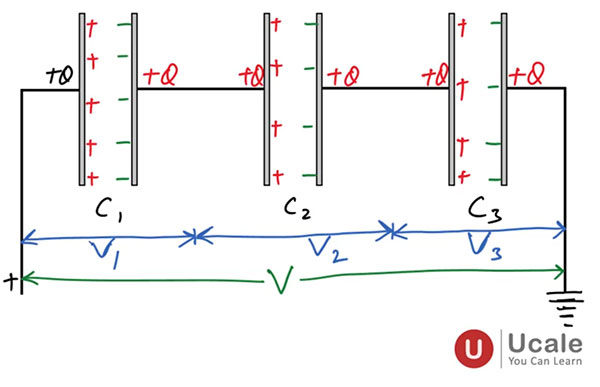
Charge Distribution
In series:
- The same charge [Q] flows through each capacitor.
- This is because there is only one path for charge movement.
Thus,
[Q] [= Q_1 = Q_2 = Q_3]
Potential Distribution
Let the potentials be [V_1], [V_2], and [V_3]. Then:
[V] [= V_1 + V_2 + V_3]
Using relation:
[Q = C V] [\Rightarrow V = \dfrac{Q}{C}]
So:
[V] [= \dfrac{Q}{C_1} + \dfrac{Q}{C_2} + \dfrac{Q}{C_3}]
Factor out [Q]:
[V] [= Q \left( \dfrac{1}{C_1} + \dfrac{1}{C_2} + \dfrac{1}{C_3} \right)]
Also:
[V = \dfrac{Q}{C_{eq}}]
Equating:
[\dfrac{Q}{C_{eq}}] [= Q \left( \dfrac{1}{C_1} + \dfrac{1}{C_2} + \dfrac{1}{C_3} \right)]
Canceling [Q]:
[\dfrac{1}{C_{eq}}] [= \dfrac{1}{C_1} + \dfrac{1}{C_2} + \dfrac{1}{C_3}]
This is the result.
3. Dimensions and Units
- Dimension of Capacitance: [M^{-1}L^{-2}T^{4}A^{2}]
- SI Unit: Farad (F)
4. Key Features
- Equivalent capacitance of series is always less than the smallest capacitor.
- Total charge on each capacitor is same.
- Total potential is the sum of individual potentials.
- Used when a high working voltage is required (since voltage divides).
5. Important Formulas to Remember
| Quantity | Formula |
|---|---|
| Equivalent capacitance (two capacitors) | [ \dfrac{1}{C_{eq}}] [= \dfrac{1}{C_1} + \dfrac{1}{C_2} ] |
| Equivalent capacitance (n capacitors) | [ \dfrac{1}{C_{eq}}] [= \sum_{i=1}^n \dfrac{1}{C_i} ] |
| Same charge on each capacitor | [ Q_1 = Q_2 = Q_3] [= Q ] |
| Potential division | [ V_i = \dfrac{Q}{C_i} ] |
| Ratio of potentials | [ \dfrac{V_1}{V_2}] [= \dfrac{C_2}{C_1} ] |
6. Conceptual Questions with Solutions
1. Why is the charge same on all capacitors in series?
Because in a series circuit, there is only one path for charge to flow. Any charge that flows onto the first capacitor must flow through all the others, making the charge on all capacitors identical.
2. Why does the potential difference divide across capacitors in series?
Total charge is same but capacitances differ. Since [V = \dfrac{Q}{C}], a capacitor with smaller capacitance experiences a larger voltage drop, causing the total voltage to split across capacitors.
3. Why is the equivalent capacitance in series always less than the smallest capacitor?
Because we add reciprocals: [\dfrac{1}{C_{eq}} = \dfrac{1}{C_1} + \dfrac{1}{C_2} + \dots]. The reciprocal sum increases, so the actual capacitance decreases and becomes smaller than the smallest.
4. What determines how much voltage each capacitor receives in series?
The value of capacitance. A smaller capacitor receives a larger voltage because [V \propto \dfrac{1}{C}].
5. Does energy stored divide equally among capacitors in series?
No. Energy depends on [U = \dfrac{1}{2} C V^2], and since voltage differs across capacitors, energy stored is different for each.
6. Is it possible for one capacitor in a series circuit to receive dangerously high voltage?
Yes. A capacitor with significantly lower capacitance will get a high voltage drop, potentially exceeding its breakdown limit.
7. Why is series combination used when high voltage operation is needed?
Because the applied voltage divides across capacitors, reducing the stress on each individual capacitor.
8. If one capacitor in series fails (open), what happens to the circuit?
The entire series path breaks. No charge flows, and the circuit stops functioning.
9. Why does adding more capacitors in series decrease total capacitance?
Each additional capacitor adds another reciprocal term, increasing [\dfrac{1}{C_{eq}}] and therefore reducing [C_{eq}].
10. Which capacitor stores more energy in series?
The one with higher voltage across it, usually the capacitor with smaller capacitance.
11. Can series capacitors ever increase capacitance?
No, the equivalent capacitance is always less than any individual capacitor in the series.
12. How is charge conservation maintained in a series capacitor network?
Charges on the facing plates induce equal and opposite charges on adjacent plates, maintaining the same charge throughout.
13. Why does equivalent capacitance depend inversely on the effective plate area?
In series, effective plate separation increases and effective area decreases, lowering capacitance.
14. Why doesn’t potential remain same on capacitors in series?
Because capacitances are generally unequal; since [Q] is fixed and [V = \dfrac{Q}{C}], voltages must differ.
15. Why do series capacitors behave like a single capacitor with increased separation?
The plates between capacitors become effectively internal, increasing the total separation between the outermost plates and lowering capacitance.
7. FAQ / Common Misconceptions
1. Misconception: Charge divides in series.
Truth: Charge remains exactly the same on every capacitor in a series circuit.
2. Misconception: Larger capacitor gets more voltage.
Truth: Smaller capacitor gets more voltage because [V = \dfrac{Q}{C}].
3. Does dielectric material affect the series formula?
No. Only the individual values of [C_1], [C_2], etc. change. The formula using reciprocals remains same.
4. Why is series equivalent smaller than any capacitor?
Because reciprocals add, making total capacitance lower.
5. Can series capacitors handle higher voltage safely?
Yes, but only if voltage divides properly and ratings are not exceeded.
6. Is energy stored equal in all capacitors?
No. Energy depends on voltage squared, so capacitors with higher voltage store more energy.
7. Does adding infinite capacitors make capacitance zero?
It approaches zero but never becomes exactly zero.
8. Can a weak capacitor limit the performance of the series?
Yes, the smallest capacitor dominates the voltage distribution and equivalent capacitance.
9. Is series connection better than parallel for storing more charge?
No. Series reduces capacitance and therefore total charge stored.
10. Does current change through capacitors in series?
No. Current through each capacitor is identical because charge flow is the same in a single path.
8. Practice Questions (with Step-by-Step Solutions)
1. Find the equivalent capacitance of two capacitors [C_1 = 6 , \text{μF}] and [C_2 = 3 , \text{μF}] connected in series.
Solution:
[\dfrac{1}{C_{eq}}] [= \dfrac{1}{6} + \dfrac{1}{3}]
[= \dfrac{1}{6} + \dfrac{2}{6} = \dfrac{3}{6}]
[
C_{eq} = 2 , \text{μF}
]
2. Three capacitors [C_1 = 2], [C_2 = 4], [C_3 = 12] μF are in series. Find [C_{eq}].
Solution:
[\dfrac{1}{C_{eq}}] [= \dfrac{1}{2} + \dfrac{1}{4} + \dfrac{1}{12}]
[
= \dfrac{6 + 3 + 1}{12} = \dfrac{10}{12}
]
[
C_{eq} = 1.2 , \text{μF}
]
3. Two capacitors are in series and receive potentials 5 V and 15 V. If charge is same, find ratio of their capacitances.
Solution:
[
\dfrac{V_1}{V_2} = \dfrac{C_2}{C_1}
]
[
\dfrac{5}{15} = \dfrac{1}{3}
]
[
\dfrac{C_2}{C_1} = \dfrac{1}{3}
]
4. Two 10 μF capacitors are in series across 100 V. Find voltage across each.
Solution:
Since [C_1 = C_2], potentials are equal:
[
V_1 = V_2 = 50 \text{V}
]
5. A 2 μF capacitor is in series with a 8 μF capacitor. If the combination has charge [Q = 40 , \text{μC}], find potentials.
Solution:
For the 2 μF capacitor:
[V_1] [= \dfrac{Q}{C_1}] [= \dfrac{40}{2}] [= 20 \text{V}]
For the 8 μF capacitor:
[V_2] [= \dfrac{40}{8}] [= 5 \text{V}]
 Sign in with Google