


1. Concept Overview
A function is said to be increasing when its output rises as the input increases.
Formally:
A function [f(x)] is increasing on an interval if for any [x_{1} < x_{2},][f(x_{1}) \le f(x_{2})]
This definition is purely algebraic, based on comparing function values.
2. Algebraic Method
To check if a function is increasing without calculus:
Method:
Take two points [x_{1}] and [x_{2}] such that [x_{1} < x_{2}] and check whether:
[
f(x_{1}) \le f(x_{2})
]
If this holds for every such pair in that interval, then the function is increasing there.
Example (Algebraic Approach)
Check if [f(x)=2x+5] is increasing.
- Evaluate at any two points:
[x_{2} – x_{1} > 0]
[f(x_{2}) – f(x_{1}) = 2x_{2}+5 – (2x_{1}+5)] - Simplify:
[f(x_{2}) – f(x_{1}) = 2(x_{2}-x_{1})] - Since [x_{2}-x_{1} > 0], the whole expression is positive.
Conclusion: [f(x)=2x+5] is increasing everywhere.
3. Calculus Method
This is easier and more powerful.
A function is:
- Increasing when [\dfrac{d}{dx}(f(x)) \ge 0]
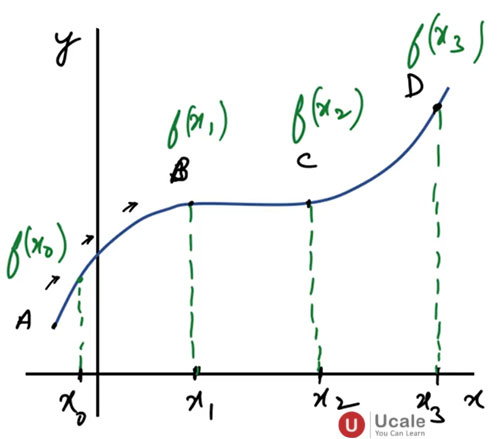
Image Credit: Ucale.org - Strictly Increasing when [\dfrac{d}{dx}(f(x)) > 0]
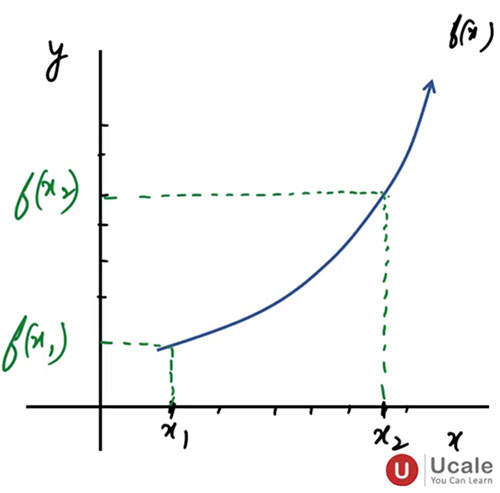
Image Credit: Ucale.org
Thus:
[f(x)] is increasing where [\dfrac{d}{dx}(f(x))\ge 0]
[f(x)] is strictly increasing where [\dfrac{d}{dx}(f(x)) > 0]
Example (Calculus Approach)
Check where [f(x)=x^{3}-3x] is increasing.
- Compute derivative:
[\dfrac{d}{dx}(f(x)) = 3x^{2}-3] - Set derivative ≥ 0:
[3x^{2}-3 \ge 0] - Divide 3: [x^{2}-1 \ge 0] → [(x-1)(x+1)\ge 0]
- Solve sign:
Increasing for [x \le -1] and [x \ge 1].
Conclusion: Function is increasing outside the interval [-1,1].
4. Key Features of Increasing Functions
- Graph slopes upward when moving left → right.
- Derivative is positive or zero.
- Function need not be strictly increasing; flat portions allowed.
- Used in optimization and monotonicity analysis.
- Useful for solving inequalities using monotonic operations.
5. Important Formulas to Remember
| Concept | Formula |
|---|---|
| Increasing (Calculus) | [\dfrac{d}{dx}(f(x)) \ge 0] |
| Strictly Increasing | [\dfrac{d}{dx}(f(x)) > 0] |
| Algebraic Test | [x_{1}<x_{2} \Rightarrow f(x_{1}) \le f(x_{2})] |
6. Conceptual Questions With Solutions
1. What is an increasing function?
A function whose output increases as input increases, meaning [x_{1}<x_{2}] implies [f(x_{1}) \le f(x_{2})].
2. How does the derivative determine increasing behaviour?
Where [\dfrac{d}{dx}(f(x)) \ge 0], the function is increasing.
3. Is a function increasing if derivative is zero?
Yes, flat regions (derivative zero) do not break increasing behaviour.
4. Is every linear function increasing?
Only if slope [m > 0]. If [m=0], constant; if [m<0], decreasing.
5. Can a function be increasing and decreasing in different intervals?
Yes, depending on sign of derivative in each interval.
6. Is [f(x)=x^{2}] increasing everywhere?
No. [\dfrac{d}{dx}(x^{2})=2x], negative for [x<0], positive for [x>0].
7. How do turning points affect increasing behaviour?
Turning points occur where derivative is zero; they mark possible changes in monotonicity.
8. Is increasing the same as strictly increasing?
No. Strict requires [f(x_{1}) < f(x_{2})].
9. Does an increasing function always grow fast?
No. It may grow very slowly or even remain constant on small intervals.
10. For [f(x)=\ln x], where is it increasing?
Derivative [\dfrac{1}{x} > 0] for all [x>0].
11. Why is derivative zero allowed?
Because derivative zero only means no change at that point; not decrease.
12. Can a piecewise function still be increasing?
Yes, if each piece and the overall function satisfy the increasing condition.
13. How does graph shape show increasing behaviour?
Graph moves upward from left to right.
14. Can a function with negative derivative be increasing?
No. Negative derivative means decreasing.
15. Does derivative always exist for increasing functions?
No. A function may be increasing even if not differentiable (e.g., [|x|]).
7. FAQ / Common Misconceptions
1. Increasing does not mean strictly increasing.
Many students think both are same; they are not. Strict requires [f(x_{1}) < f(x_{2})].
2. A flat region does not break increasing nature.
Derivative zero is allowed as long as function never goes down.
3. A positive function is not necessarily increasing.
Sign of function has nothing to do with sign of derivative.
4. Increasing does not imply positive derivative everywhere.
Derivative may be zero at points.
5. Derivative test works only when derivative exists.
Corner points must be checked algebraically.
6. Graph always rising does not guarantee strict increase.
Horizontal parts cause it to be “increasing” but not “strictly increasing”.
7. Positive slope at one point does not ensure increase on entire interval.
Derivative must be positive on whole interval.
8. Larger derivative does not necessarily mean larger function value.
Derivative tells rate of change, not value.
9. Increasing functions need not be smooth.
They can have corners or kinks.
10. A function can be increasing even if second derivative changes sign.
Second derivative affects concavity, not monotonicity.
8. Examples with Step by Step Solutions
Example 1
Determine where [f(x)=x^{3}-3x] is increasing.
Step-by-step solution:
- Compute derivative:
[\dfrac{d}{dx}\big(f(x)\big)][=3x^{2}-3]. - Find critical points by solving [\dfrac{d}{dx}f(x)=0]:
[3x^{2}-3=0][ \Rightarrow x^{2} =1 ][\Rightarrow x=\pm 1]. - Make a sign chart for [3x^{2}-3]: test intervals [-\infty,-1), (-1,1), (1,\infty):
- For [x<-1], pick [x=-2]: [3(4)-3=9>0] ⇒ derivative positive.
- For [-1<x<1], pick [x=0]: [3(0)-3=-3<0] ⇒ derivative negative.
- For [x>1], pick [x=2]: [3(4)-3=9>0] ⇒ derivative positive.
- Conclusion: [f(x)] is increasing on [(-\infty,-1)\cup(1,\infty)] and decreasing on [(-1,1)].
Example 2
Find intervals where [f(x)=\ln x – \dfrac{x}{2}] (domain [x>0]) is increasing.
Step-by-step solution:
- Compute derivative (valid for [x>0]):
[\dfrac{d}{dx}\big(f(x)\big)][=\dfrac{1}{x} – \dfrac{1}{2}]. - Solve [\dfrac{1}{x} – \dfrac{1}{2}=0] ⇒ [\dfrac{1}{x}][=\dfrac{1}{2} ⇒ x=2].
- Test sign of derivative on intervals (0,2) and (2,\infty):
- For [0<x<2], pick [x=1]: [1 – \tfrac{1}{2} = \tfrac{1}{2} >0] ⇒ increasing.
- For [x>2], pick [x=3]: [\tfrac{1}{3} – \tfrac{1}{2} ][= -\tfrac{1}{6} <0] ⇒ decreasing.
- Conclusion: [f(x)] is increasing on (0,2) and decreasing on (2,\infty). At [x=2] we have a local maximum.
Example 3
Determine where [f(x)=e^{-x^{2}}] is increasing or decreasing.
Step-by-step solution:
- Compute derivative using chain rule:
[\dfrac{d}{dx}\big(f(x)\big)][=e^{-x^{2}}\cdot(-2x) ][= -2x e^{-x^{2}}]. - Solve [\dfrac{d}{dx}f(x)=0]: note [e^{-x^{2}}>0] for all x, so zeros come from factor [-2x]: [x=0].
- Sign chart for [-2x e^{-x^{2}}]: since [e^{-x^{2}}>0], sign determined by [-2x]:
- For [x<0], [-2x>0] ⇒ derivative positive.
- For [x>0], [-2x<0] ⇒ derivative negative.
- Conclusion: [f(x)] is increasing on (-\infty,0) and decreasing on (0,\infty). The function attains a global maximum at [x=0].
Example 4
Find intervals of increase for [f(x)=\dfrac{x^{2}}{1+x^{2}}] on [\mathbb{R}].
Step-by-step solution:
- Compute derivative (use quotient rule):
[\dfrac{d}{dx}\big(f(x)\big)][=\dfrac{(2x)(1+x^{2}) – x^{2}(2x)}{(1+x^{2})^{2}} ][= \dfrac{2x + 2x^{3} – 2x^{3}}{(1+x^{2})^{2}} ][= \dfrac{2x}{(1+x^{2})^{2}}]. - Solve [\dfrac{2x}{(1+x^{2})^{2}}=0] ⇒ numerator [2x=0] ⇒ [x=0]. Denominator always positive.
- Sign chart for [2x/(1+x^{2})^{2}]: sign depends on [2x]:
- For [x<0], derivative negative ⇒ decreasing.
- For [x>0], derivative positive ⇒ increasing.
- Conclusion: [f(x)] is increasing on (0,\infty) and decreasing on (-\infty,0). At [x=0] is a global minimum.
Example 5
Determine where [f(x)=x^{4}-4x^{2}] is increasing.
Step-by-step solution:
- Compute derivative:
[\dfrac{d}{dx}\big(f(x)\big)=4x^{3}-8x ][= 4x(x^{2}-2) ][= 4x(x-\sqrt{2})(x+\sqrt{2})]. - Critical points: solve [4x(x^{2}-2)=0] ⇒ [x=0,\ \pm \sqrt{2}].
- Sign chart across intervals: [(-∞, -√2)], [(-√2,0)], [(0,√2)], [(√2,∞)]. Test values:
- Pick [x=-2] in [(-∞,-√2)]: factors → x negative, [(x-\sqrt{2})] negative, [(x+\sqrt{2})] negative ⇒ product 4*(−)(−)(−)= negative ⇒ derivative <0.
- Pick [x=-1] in [(-√2,0)]: x negative, [(x-\sqrt{2})] negative, [(x+\sqrt{2})] positive ⇒ product = 4*(−)(−)(+)= positive ⇒ derivative >0.
- Pick [x=1] in [(0,√2)]: x positive, [(x-\sqrt{2})] negative, [(x+\sqrt{2})] positive ⇒ product = 4*(+)(−)(+)= negative ⇒ derivative <0.
- Pick [x=2] in [(√2,∞)]: all factors positive ⇒ derivative >0.
- Conclusion: [f(x)] is increasing on [(-\sqrt{2},0)\cup(\sqrt{2},\infty)] and **decreasing on [(-\infty,-\sqrt{2})\cup(0,\sqrt{2})].
 Sign in with Google