

1. Concept Overview
While studying functions, domain, range, and graphs, we often restrict values of variables to certain parts of the number line.
These parts are called intervals.
In Class 12 Mathematics, open and closed intervals are extremely important because they are used in:
- Domain and range
- Limits and continuity
- Differentiation and increasing–decreasing functions
- Integration
A clear understanding of intervals makes higher mathematics much easier.
2. What is an Interval?
An interval is a set of real numbers lying between two given numbers.
Example:
- All real numbers between [1] and [5]
- All real numbers greater than [2]
- All real numbers less than or equal to [3]
Depending on whether the end points are included or excluded, intervals are classified as open or closed.
3. Open Interval
An open interval between [a] and [b] is the set of all real numbers strictly between [a] and [b].
Notation
Open interval from [a] to [b] is written as:
[(a, b)]
Meaning
- [a] is not included
- [b] is not included
Mathematically:
[(a, b) = { x : a < x < b }]
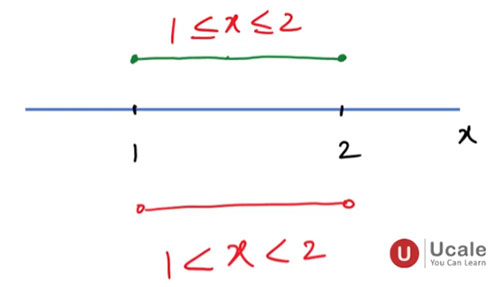
Number Line Representation
- End points are shown by hollow circles
4. Closed Interval
A closed interval between [a] and [b] is the set of all real numbers including [a] and [b].
Notation
Closed interval from [a] to [b] is written as:
[[a, b]]
Meaning
- [a] is included
- [b] is included
Mathematically:
[[a, b] = { x : a ≤ x ≤ b }]
Number Line Representation
- End points are shown by solid dots
5. Why Are Open and Closed Intervals Important?
- They decide whether a function is defined or not at boundary points
- They play a key role in continuity
- Many theorems apply only on closed intervals
- Increasing–decreasing behavior depends on interval type
Example:
A function may be continuous in [(1,3)] but not continuous at [(x=1)] or [(x=3)].
6. Comparison Between Open and Closed Interval
| Feature | Open Interval | Closed Interval |
|---|---|---|
| Notation | [(a, b)] | [[a, b]] |
| End points included | No | Yes |
| Inequality form | [a < x < b] | [a ≤ x ≤ b] |
| Boundary points | Excluded | Included |
7. Related Intervals (Brief Mention)
- Left open, right closed: [(a, b]]
- Left closed, right open: [[a, b)]
These are called half-open or half-closed intervals and are also used frequently in calculus.
8. Conceptual Questions with Solutions
1. What does the notation [(a,b)] represent?
It represents all real numbers strictly between [a] and [b], excluding both end points.
2. Why are open intervals written using round brackets?
Round brackets indicate that the boundary values are not included.
3. What does [[a,b]] mean in terms of inequality?
It means [a ≤ x ≤ b].
4. Can an interval include only one end point?
Yes. Such intervals are called half-open or half-closed intervals.
5. Why are closed intervals important in calculus?
Many important theorems apply only on closed intervals where boundary points are included.
6. Is [(2,2)] an interval?
No. Since there is no number strictly between [2] and [2], it is an empty set.
7. Is [[2,2]] an interval?
Yes. It contains exactly one element, [x=2].
8. How are end points shown on a number line for open intervals?
By hollow (empty) circles.
9. How are end points shown for closed intervals?
By solid dots.
10. Can a function be defined on an open interval only?
Yes. Many functions are defined only on open intervals.
11. Which interval includes both boundary points?
A closed interval.
12. Does [(a,b)] contain [a] or [b]?
No. It excludes both [a] and [b].
13. Why are inequalities used to define intervals?
They give a precise algebraic description of all elements of the interval.
14. Are open intervals finite or infinite?
They are finite if [a] and [b] are finite numbers.
15. How are intervals related to domain of a function?
The domain of a function is often expressed using intervals.
9. FAQ / Common Misconceptions
1. [(a,b)] and [[a,b]] mean the same thing.
False. One excludes end points, the other includes them.
2. An open interval never contains any numbers.
False. It contains infinitely many numbers between [a] and [b].
3. Closed intervals are always better than open intervals.
False. Both are used depending on the situation.
4. Boundary points do not matter in calculus.
False. Boundary points are crucial for continuity and theorems.
5. [(a,a)] is same as [[a,a]].
False. [(a,a)] is empty, while [[a,a]] contains one element.
6. Intervals can contain only integers.
False. Intervals contain real numbers.
7. Intervals are used only in Class 12.
False. They are used throughout higher mathematics.
8. Open intervals include boundary values.
False. They exclude boundary values.
9. Closed intervals exclude boundary values.
False. They include boundary values.
10. Interval notation is optional.
False. It is a standard and essential mathematical language.
10. Practice Questions: Open and Closed Interval
Question 1.
Write the interval represented by the inequality [2 < x < 6].
Step-by-Step Solution:
- The inequality shows that [x] lies strictly between [2] and [6].
- Neither [2] nor [6] is included.
Conclusion:
The interval is [(2,6)].
Question 2.
Write the interval represented by [3 ≤ x ≤ 5].
Step-by-Step Solution:
- The inequality includes both boundary values [3] and [5].
- This represents a closed interval.
Conclusion:
The interval is [[3,5]].
Question 3.
State whether the interval [(4,4)] is empty or not.
Step-by-Step Solution:
- An open interval requires numbers strictly between the end points.
- There is no number strictly between [4] and [4].
Conclusion:
[(4,4)] is an empty set.
Question 4.
State whether the interval [[4,4]] is empty or not.
Step-by-Step Solution:
- In a closed interval, end points are included.
- [[4,4]] contains the single element [x=4].
Conclusion:
[[4,4]] is not empty.
Question 5.
Write the inequality form of the interval [(1,5]].
Step-by-Step Solution:
- Left end is open, so [x>1].
- Right end is closed, so [x≤5].
Conclusion:
The inequality is [1 < x ≤ 5].
Question 6.
Write the interval notation for [x ≥ −2].
Step-by-Step Solution:
- The inequality includes [−2].
- The interval extends to infinity on the right.
Conclusion:
The interval is [[−2, ∞)].
Question 7.
Write the interval notation for [x < 3].
Step-by-Step Solution:
- The inequality excludes [3].
- The interval extends to negative infinity.
Conclusion:
The interval is [(−∞, 3)].
Question 8.
Which type of interval is [[0,7]]?
Step-by-Step Solution:
- Both end points [0] and [7] are included.
- Inclusion of both ends defines a closed interval.
Conclusion:
[[0,7]] is a closed interval.
Question 9.
Identify the interval represented by [−5 < x ≤ 2].
Step-by-Step Solution:
- Left end [−5] is excluded.
- Right end [2] is included.
Conclusion:
The interval is [(−5,2]].
Question 10.
Can the domain of a function be an open interval? Explain briefly.
Step-by-Step Solution:
- A function only requires that each input has exactly one output.
- Inclusion of boundary points is not compulsory.
Conclusion:
Yes, the domain of a function can be an open interval.
 Sign in with Google