

Conservative forces
A force is described as a conservative force if the work done by or against it when moving a body between two fixed points depends solely on the initial and final positions of the body and not on the specific path taken. This implies that the work done by or against a conservative force is the same regardless of the path between the initial and final positions.
For instance, gravitational force is a conservative force. To demonstrate this, let’s calculate the work done against gravity when moving a body of mass \( m \) through a height \( AB = h \) using different paths from \( A \) to \( B \).
The given figure depicts the body being lifted vertically. The applied force is \( F = mg \).
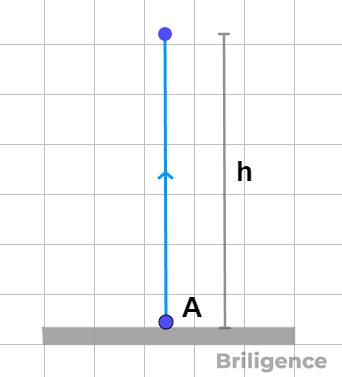
As work done \( W = \vec{F} \cdot \vec{S} = FS \cos \theta \)
$\displaystyle \therefore {{W}_{1}}=(mg)\cdot h\cos {{0}^{{}^\circ }}=mgh\text{ }\ldots (1)$
This second figure illustrates the body being moved along a smooth inclined plane \( CB \) of height \( AB = h \) and inclination \( \theta \).
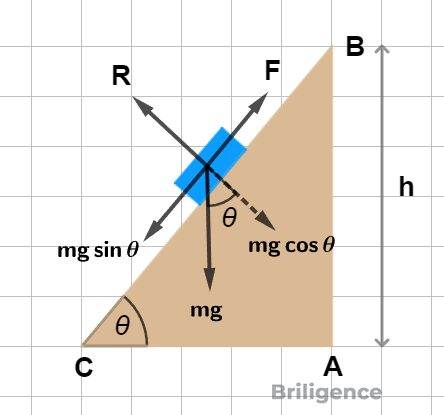
It is evident from from the above figure that the force applied is \( F = mg \sin \theta \), and the displacement along the direction of the force is \( CB \).
Thus,
\[
\text{Work done } = F \cdot CB = F \cdot (CB) \cos 0^\circ
\]
\[
W_2 = mg \sin \theta \times CB = mg \times \frac{AB}{CB} \times CB
\]
\[
W_2 = mgh \text{ }\ldots (2)
\]
The figure below shows the body being lifted through the same height \( AB = h \) over a staircase with \( n \) steps, each of vertical height \( h’ \) and horizontal width \( x \).
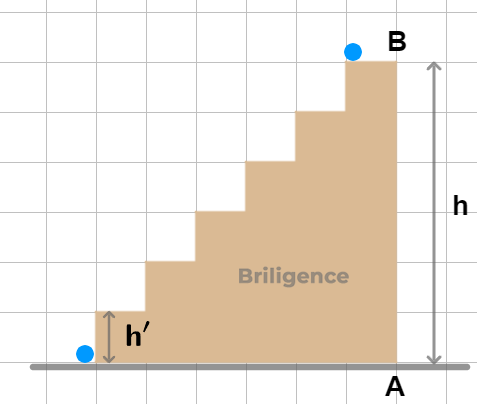
$ \displaystyle \begin{array}{l}{{W}_{3}}=n\left[ {mg{h}’\cos {{0}^{\circ }}+mgx\cos {{{90}}^{\circ }}} \right]\\{{W}_{3}}=n\times mg{h}’=mgh\ldots (3)\end{array}$
Again the figure below depicts another situation where the body is being transported through the same height \( AB = h \) using an arbitrary zig zag path. This path can be approximated as a large number of very small horizontal displacements (denoted by \( dx \)) and vertical displacements (denoted by \( dh \)).
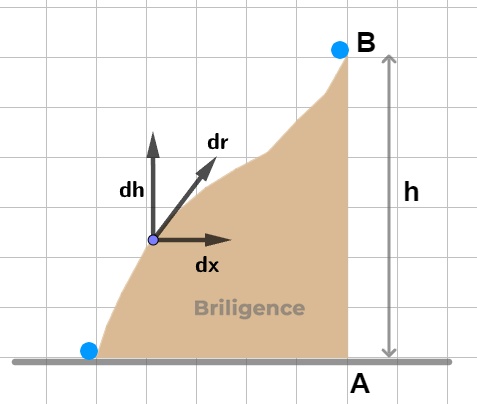
Thus, work done
$ \displaystyle \begin{array}{l}=\sum{m}g(dh)\cos {{0}^{{}^\circ }}+\sum{m}g(dx)\cos {{90}^{{}^\circ }}\\{{W}_{4}}=mgh\text{ }\ldots \text{(4)}\end{array}$
From this discussion, we conclude that \( W_1 = W_2 = W_3 = W_4 = mgh \), meaning that the work done remains consistent regardless of the path chosen between the specified initial position \( A \) and final position \( B \). This confirms that gravitational force is indeed a conservative force.
Other examples of conservative forces include:
- Elastic force in a spring.
- Electrostatic force between two charged bodies.
- Magnetic force between two magnetic poles.
The latter two forces are known as central forces because they act along the line joining the centers of two charged/magnetized bodies. Consequently, all central forces are conservative forces.
Properties of Conservative Forces
- Work done by or against a conservative force in moving a body from one position to another is determined only by the initial and final positions of the body.
- Work done by or against a conservative force is independent of the path taken by the body in moving from the initial to the final position.
- Work done by or against a conservative force in moving a body through any closed path (i.e., one where the final position coincides with the initial position) is always zero.
For instance, in the case of gravitational force, if we take work done in moving the body from \( A \) to \( B \) as negative (against gravity), then work done in moving the body from \( B \) to \( A \) (by gravity) must be taken as positive, i.e.,
\[
W_{AB} = -W_{BA}
\]
Therefore,
\[
W_{AB} + W_{BA} = 0 \ldots (5)
\]
In fact, work done in taking the body from \( A \) to \( B \) is stored in the body in the form of potential energy. This energy is expended in moving the body back from \( B \) to \( A \). Therefore, over the complete round trip (\( A \rightarrow B \rightarrow A \)), the total work done is zero.
Non-Conservative Forces
A force is said to be non-conservative if the work done by or against the force when moving a body from one position to another depends on the path taken between these two positions.
For example, frictional forces are non-conservative. If a body is moved from position \( A \) to position \( B \) on a rough surface, the work done against frictional force will depend on the length of the path between \( A \) and \( B \) and not solely on the positions \( A \) and \( B \).
Additionally, if the body is brought back to its initial position \( A \), work has to be done against the frictional forces, which always oppose the motion. Thus, work done against frictional forces in moving the body over a round trip is not zero.
Another example of a non-conservative force is the induction force in a cyclotron. The charged particle returns to its initial position with more kinetic energy than it initially had.
Important:
In a conservative field, work is independent of the path taken. For instance, if a body of mass \( m \) moves with a uniform speed from \( A \) to \( C \) in a gravitational field via path \( AC \) or \( ABC \) (Fig. 4.9), the work done remains the same and is equal to \( mgh \).
Remember:
The work done in moving a body over a smooth inclined plane does not depend on the slope of the inclined plane. \( W = mgh \), and it only depends on the height \( h \) of the inclined plane.
Work-Energy Relation for Non-Conservative Forces
When both conservative and non-conservative forces act on a body, the total work done is:
[W = W_c + W_{nc} = \Delta K]
For conservative forces:
[\Delta K + \Delta U = 0] → Total mechanical energy remains constant.
For non-conservative forces:
[\Delta K + \Delta U = W_{nc}] → Total mechanical energy changes.
Important Formulas to Remember
| Quantity | Formula | Remarks |
|---|---|---|
| Work done by conservative force | [W_c = -\Delta U] | Independent of path |
| Work done in a closed path | [\oint \vec{F_c} \cdot d\vec{r} = 0] | For conservative force |
| Potential energy and force relation | [\vec{F_c} = -\dfrac{dU}{dx}] | Derived from calculus |
| Work done by non-conservative force | [W_{nc} = \Delta K + \Delta U] | Depends on path |
| Total mechanical energy | [E = K + U] | Constant for conservative systems |
Practice Questions (with Solutions)
Q1. A body moves in the gravitational field of the Earth from height [h_1] to [h_2]. Find the work done by gravity.
Solution:
[\text{Work} = mg(h_1 – h_2)] (Independent of path)
Hence, gravitational force is conservative.
Q2. A block slides on a rough horizontal surface and comes to rest after moving some distance. Is the frictional force conservative?
Solution:
No, because the work done depends on the distance covered (path), not just initial and final positions.
Q3. A spring with constant [k] is stretched from [x_1] to [x_2]. Find the work done.
Solution:
[W = \dfrac{1}{2}k(x_1^2 – x_2^2)]
Since it depends only on the endpoints, the spring force is conservative.
Q4. A car moves with frictional resistance [f]. What is the energy lost after distance [s]?
Solution:
[W_{nc} = -fs]
Energy is dissipated as heat, hence non-conservative.
Conceptual Questions
1. What is the key difference between conservative and non-conservative forces?
Conservative forces are path-independent, while non-conservative forces depend on the path taken.
2. Is tension a conservative force?
No. Tension depends on the path and constraints of motion, so it is generally non-conservative.
3. Can friction ever be conservative?
No. Friction always dissipates energy as heat, hence non-conservative.
4. Why is gravitational force called conservative?
Because the work done depends only on vertical displacement, not on the path.
5. What is meant by potential energy function?
A scalar function [U(x)] such that [\vec{F_c} = -\dfrac{dU}{dx}].
6. If work done around a closed loop is zero, what does it indicate?
It indicates the force is conservative.
7. What happens to total mechanical energy under non-conservative forces?
It decreases due to conversion into heat or other forms.
8. Can all forces be represented by a potential function?
No, only conservative forces can be derived from potential energy functions.
9. Is magnetic force conservative?
No, magnetic force does no work on moving charges but cannot be derived from a scalar potential function.
10. If work done by a force between two points is independent of the path, what can be concluded?
The force is conservative.
9. FAQs / Common Misconceptions
1. Is zero work always done by conservative forces?
No. Work can be non-zero between two points, but zero over a closed path.
2. Does non-conservative mean energy is destroyed?
No. Energy is not destroyed—it’s transformed into other forms like heat or sound.
3. Can potential energy be defined for non-conservative forces?
Not generally, because the work depends on the path.
4. Is elastic spring force always conservative?
Yes, as long as the material follows Hooke’s law.
5. Why is air resistance non-conservative?
Because it depends on speed and direction, not only position.
 Sign in with Google