

1. Statement of the Concept / Overview
Dielectric constant or relative electrical permittivity (symbol: [\varepsilon_r]) is defined as:
The ratio of the permittivity of a medium to the permittivity of free space.
Mathematically,
[\varepsilon_r] [= \dfrac{\varepsilon}{\varepsilon_0}]
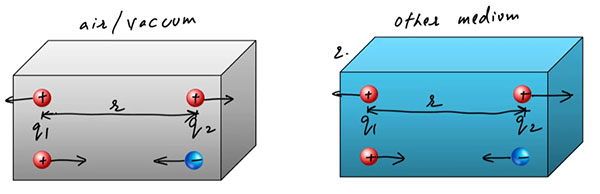
It tells us how much a medium reduces the electric force between two charges compared to vacuum.
2. Clear Explanation and Derivation
Permittivity [\varepsilon]
Permittivity of a medium indicates how well the medium can permit electric field lines to pass through it.
- Higher [\varepsilon] → electric field decreases
- Lower [\varepsilon] → electric field increases
Definition of Dielectric Constant
[\varepsilon_r] [= \dfrac{\varepsilon}{\varepsilon_0}]
Where:
- [\varepsilon] = permittivity of medium
- [\varepsilon_0] = permittivity of vacuum [= 8.85 \times 10^{-12}\ \text{F m}^{-1}]
Relation with Coulomb’s Law
Force in vacuum:
[F_0] = [\dfrac{1}{4\pi\varepsilon_0} \dfrac{q_1 q_2}{r^2}]
Force in a medium:
[F] [= \dfrac{1}{4\pi\varepsilon} \dfrac{q_1 q_2}{r^2}]
Divide the two:
[\dfrac{F}{F_0}] [= \dfrac{\varepsilon_0}{\varepsilon}]
Thus,
[F = \dfrac{F_0}{\varepsilon_r}]
Physical Meaning:
- If [\varepsilon_r = 1] → vacuum
- If [\varepsilon_r > 1] → force reduces
- Large [\varepsilon_r] → strong polarization → strong electric field suppression
3. Dimensions and Units
| Quantity | Dimensions | SI Unit |
|---|---|---|
| Permittivity [\varepsilon] | ([M^{-1} L^{-3} T^4 I^2]) | Farad per meter (F/m) |
| Dielectric constant [\varepsilon_r] | Dimensionless | No unit |
4. Key Features
- Measures how well a medium polarizes in presence of an electric field.
- Always [\varepsilon_r \geq 1].
- Determines the reduction of electrostatic force in a medium.
- Affects capacitance:
[C = \varepsilon_r C_0] - Depends on molecular structure and frequency of applied field.
- Higher dielectric constant → greater charge storage ability.
- Important in capacitors, insulators, and electrical circuits.
5. Important Formulas to Remember
| Concept | Formula |
|---|---|
| Dielectric constant | [\varepsilon_r] [= \dfrac{\varepsilon}{\varepsilon_0}] |
| Force in medium | [F] [= \dfrac{1}{4\pi\varepsilon} \dfrac{q_1 q_2}{r^2}] |
| Relation with vacuum force | [F] [= \dfrac{F_0}{\varepsilon_r}] |
| Capacitance in medium | [C] [= \varepsilon_r C_0] |
| Electric field in medium | [E] [= \dfrac{E_0}{\varepsilon_r}] |
6. Conceptual Questions with Solutions (At least 15)
1. Why is dielectric constant always greater than or equal to 1?
Because no medium can permit electric field lines better than vacuum. Thus: \[\varepsilon \geq \varepsilon_0 \Rightarrow \varepsilon_r \geq 1\]
2. Why does force decrease when charges are placed in a dielectric?
The medium gets polarized, producing an internal field opposite to external field → net field reduces → force reduces.
3. What does a high dielectric constant signify?
Greater ability to reduce electric field and store charge. Used in capacitors.
4. How does dielectric constant affect Coulomb’s Law?
Force becomes: \[ [F = \dfrac{F_0}{\varepsilon_r}] \] Higher \(\varepsilon_r\) → smaller force.
5. Why is water’s dielectric constant very high (≈ 80)?
Because water molecules are highly polar, aligning strongly with electric field and reducing it significantly.
6. Does dielectric constant depend on temperature?
Yes. Polarization ability changes with temperature, especially in polar molecules.
7. Can a conductor have a dielectric constant?
Not in electrostatics. Electric field inside a conductor is zero → behaves differently from dielectrics.
8. Why does a dielectric increase capacitance?
Because it reduces electric field, allowing plates to store more charge for the same potential.
9. Is dielectric constant the same for all frequencies?
No. At high frequencies, molecules cannot rotate fast → lower effective permittivity.
10. Why is dielectric constant dimensionless?
It is a ratio of same quantity: \(\varepsilon / \varepsilon_0\) → unit cancels.
11. What happens to force if [\varepsilon_r] becomes very large?
Force becomes extremely small: [F = \dfrac{F_0}{\varepsilon_r}]
12. Why is air approximated to vacuum for dielectric constant?
Because its value is very close to 1 (~1.0006), so difference is negligible.
13. Does dielectric constant affect electric field direction?
No. Only magnitude changes; direction is unaffected.
14. Is dielectric constant the same throughout a material?
Uniform in homogeneous materials but varies in anisotropic media.
15. What happens inside a dielectric slab placed in uniform electric field?
The field inside reduces to [E = \dfrac{E_0}{\varepsilon_r}]
7. FAQ / Common Misconceptions (At least 10)
1. Misconception: Dielectric constant can be less than 1.
No. Vacuum is the minimum reference; all physical media have \[\varepsilon_r \geq 1\].
2. Misconception: Dielectric constant measures conductivity.
Incorrect. It measures **polarizability**, not how well charges move.
3. Misconception: A dielectric creates charge.
No. It only **polarizes**; it does not create new charge.
4. Misconception: Dielectric constant has units.
False. It is dimensionless.
5. Misconception: Dielectric materials block electric field completely.
No. They only **reduce** the electric field, not block it.
6. Misconception: Polar and non-polar dielectrics behave the same.
No. Polar materials have orientation polarization; non-polar rely on induced polarization.
7. Misconception: All dielectrics have constant \[\varepsilon_r\].
No. It changes with temperature, frequency, and structure.
8. Misconception: Dielectrics increase electric field.
Incorrect. They always **reduce** electric field within them.
9. Misconception: Dielectric constant and permittivity are unrelated.
They are directly related: \[ [\varepsilon = \varepsilon_r \varepsilon_0] \]
10. Misconception: Only solid materials are dielectrics.
No. Liquids (water, oils) and gases (SF₆) can also be dielectrics.
8. Practice Questions (With Step-by-Step Solutions)
Q1. The force between two charges in vacuum is 12 N. If they are placed in a medium with [\varepsilon_r = 6], find the new force.
[F = \dfrac{F_0}{\varepsilon_r}]
[F = \dfrac{12}{6} = 2\ \text{N}]
Q2. The permittivity of a medium is [4.4 \times 10^{-11}\ \text{F/m}]. Find its dielectric constant.
[\varepsilon_r] [= \dfrac{\varepsilon}{\varepsilon_0}]
[\varepsilon_r] [= \dfrac{4.4 \times 10^{-11}}{8.85 \times 10^{-12}} \approx 4.97]
Q3. In a medium, electric field becomes [E = 50\ \text{V/m}]. If in vacuum it was [200\ \text{V/m}], find [\varepsilon_r].
[E] [= \dfrac{E_0}{\varepsilon_r}]
[\varepsilon_r] [= \dfrac{E_0}{E}] [= \dfrac{200}{50} = 4]
Q4. A capacitor has capacitance 10 pF in vacuum. What will be its capacitance in a medium with [\varepsilon_r = 3]?
[C = \varepsilon_r C_0]
[C = 3 \times 10 = 30\ \text{pF}]
Q5. The force between charges reduces to one-tenth in a medium. Find [\varepsilon_r].
[F = \dfrac{F_0}{\varepsilon_r}]
Given:
[F = \dfrac{F_0}{10}]
Thus,
[
\varepsilon_r = 10
]
 Sign in with Google