

1. Statement of the Law / Concept Overview
The additivity of electric charge states that total charge of a system is the algebraic sum of individual charges.
Electric charge does not depend on the arrangement, size, or shape of the body — it simply adds up arithmetically.
2. Clear Explanation and Mathematical Derivation
If a body has discrete charges
[q_1, q_2, q_3, \dots, q_n],
then the total charge is
[Q_{\text{total}} = \sum_{i=1}^{n} q_i.]
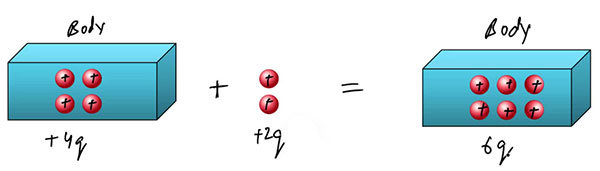
Key Points of Additivity:
- Charges add with their signs (positive or negative).
- Neutrality can occur if total charge becomes zero.
- Additivity is a direct result of charge being a scalar quantity.
Example Derivation:
Suppose three charges are placed on a conductor:
[q_1 = +4\ \text{C}], [\quad] [q_2 = -6\ \text{C}], [\quad] [q_3 = +2\ \text{C}]
Then,
[Q_{\text{total}}] [= +4 – 6 + 2] [= 0\ \text{C}]
The body becomes neutral, though charges exist on it.
3. Dimensions and Units
| Quantity | Dimensions | SI Unit |
|---|---|---|
| Electric Charge | ([IT]) | Coulomb (C) |
(Same as fundamental charge dimensionality.)
4. Key Features
- Electric charge is a scalar, hence obeys simple algebraic addition.
- Charges on an isolated system are conserved; only redistribution happens.
- Charge of a composite body = sum of charges of its constituent particles.
- Positive and negative charges cancel when summed.
- Neutrality means zero net charge, not “absence of charge”.
5. Important Formulas to Remember
| Concept | Formula |
|---|---|
| Total charge | [Q_{\text{total}}] [= q_1 + q_2 + q_3 + \dots] |
| Neutrality condition | [Q_{\text{total}} = 0] |
| Algebraic addition | Include signs (+ / −) for each charge |
6. Conceptual Questions with Solutions (Collapsible, class = ucale-faq)
1. If a body has charges +8 C and -3 C on two different parts, what is the total charge?
Total charge is the algebraic sum: \[Q = +8 + (-3) = +5\ \text{C}\]. The body is positively charged.
2. A body is neutral. Does it mean it has no charges at all?
No. Neutral means the total charge is zero: \[\sum q_i = 0\]. Positive and negative charges may both be present but cancel each other.
3. Three charges +2 C, +2 C, and -4 C are placed on a conductor. What is the net charge?
\[ Q = +2 + 2 – 4 = 0\ \text{C} \] The conductor becomes neutral.
4. Why do charges add algebraically instead of vectorially?
Because electric charge is a **scalar** — it has magnitude but no direction. Hence, simple algebraic addition applies.
5. If two bodies with charges +6 C and -10 C are joined, what is the total charge?
\[ Q_{\text{total}} = +6 – 10 = -4\ \text{C} \] Final body is negatively charged.
7. FAQ / Common Misconceptions (Collapsible, class = ucale-faq)
1. Does additivity mean charges merge physically?
No. Additivity refers to **net measurable charge**, not physical merging of particles.
2. If total charge is zero, does the body have no electrons?
No. It has equal numbers of positive and negative charges. Zero net charge ≠ absence of charge.
3. Can signals of charges (signs) be ignored while adding?
No. Sign is crucial; charge is always added **algebraically**.
4. Does additivity violate conservation of charge?
No. Additivity simply calculates total charge; conservation states this total remains constant in an isolated system.
5. Is electric charge vectorial because forces are vectors?
No. Forces are vectors, but charge — the source of the force — is a **scalar**.
8. Practice Questions (With Step-By-Step Solutions)
Question 1
A body carries charges [+5\ \text{C}], [-12\ \text{C}], [+8\ \text{C}], [-1\ \text{C}].
Find the net charge.
Step-by-step Solution:
- Add algebraically:
[
Q = 5 – 12 + 8 – 1
] - Combine positive: [5 + 8 = 13]
- Combine negative: [-12 – 1 = -13]
- Sum: [13 – 13 = 0]
Final Answer:
0 C (body becomes neutral)
Question 2
Three bodies carry charges:
[q_1 = +3\ \text{C}], [\ q_2 = -7\ \text{C}], [\ q_3 = +10\ \text{C}.]
Find the total charge.
Solution:
[
Q = 3 – 7 + 10 = 6\ \text{C}
]
Final Answer:
+6 C
Question 3
Two charged spheres are connected: Sphere A = [-9\ \text{C}], Sphere B = [+4\ \text{C}].
Find the final charge on the combined system.
Solution:
[
Q = -9 + 4 = -5\ \text{C}
]
Final Answer:
-5 C (negatively charged)
Question 4
A conductor has four identical particles, each with charge [-2\ \text{C}].
What is the total charge?
Solution:
[
Q = 4 \times (-2) = -8\ \text{C}
]
Final Answer:
-8 C
Question 5
A body has a total charge of zero. It consists of two charges: one is +18 C.
What must be the second charge?
Step-by-step:
[
Q_{\text{total}} = +18 + q_2 = 0
]
[
q_2 = -18\ \text{C}
]
Final Answer:
-18 C
 Sign in with Google