

1. Statement of the Concept
An electric dipole is a system of two equal and opposite charges separated by a small distance.
A typical dipole consists of charges [+q] and [-q] separated by distance [2a].
2. Clear Explanation and Mathematical Derivation
Electric Dipole Moment
The dipole moment [\vec{p}] is defined as:
[
\vec{p} = q \cdot (2a) \hat{n}
]
where:
- [q] = magnitude of each charge
- [2a] = separation between charges
- [\hat{n}] = unit vector from [-q] to [+q]
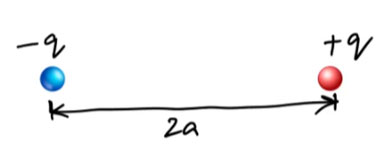
Its magnitude:
[
p = q(2a)
]
It is a vector quantity.
Electric Field of a Dipole (Derivations)
1. Electric Field on the Axial Line
Consider a point [P] at a distance [r] from the center of the dipole on the axial line.
Using Coulomb’s law and vector addition:
[E_{\text{axial}}] [= \dfrac{1}{4\pi\varepsilon_0} \dfrac{2p}{(r^3)}]
Direction: along the direction of dipole moment.
2. Electric Field on the Equatorial Line
Point [P] lies at distance [r] from center on the perpendicular bisector.
[E_{\text{equatorial}}] [= \dfrac{1}{4\pi\varepsilon_0} \dfrac{p}{(r^3)}]
Direction: opposite to dipole moment.
Dipole in an External Electric Field
A dipole experiences:
1. Torque
[
\tau = pE \sin\theta
]
Direction: tends to align the dipole with the field.
2. Potential Energy
[
U = -pE \cos\theta
]
3. Dimensions and Units
Dipole Moment
- Unit: Coulomb-meter (C·m)
- Dimensions: [A , T , L]
(Field and torque have their usual units.)
4. Key Features
- Consists of two opposite charges separated by a small distance.
- Characterized by its dipole moment [\vec{p} = q(2a)\hat{n}].
- Produces electric fields decreasing as [\dfrac{1}{r^3}].
- Experiences torque in an external electric field.
- Has lower potential energy when aligned with external field.
- Dipoles are fundamental models of molecules (e.g., HCl, H₂O).
5. Important Formulas to Remember
| Concept | Formula |
|---|---|
| Dipole moment | [ p = q(2a) ] |
| Axial line electric field | [ E_{\text{axial}}] [= \dfrac{1}{4\pi\varepsilon_0} \dfrac{2p}{r^3} ] |
| Equatorial line field | [ E_{\text{equatorial}}] [= \dfrac{1}{4\pi\varepsilon_0} \dfrac{p}{r^3} ] |
| Torque on dipole in uniform field | [ \tau = pE\sin\theta ] |
| Potential energy of dipole | [ U = -pE\cos\theta ] |
6. Conceptual Questions with Solutions
1. Why is an electric dipole considered a vector?
Because its dipole moment \[\vec{p}\] has magnitude and direction (from –q to +q).
2. Why is the dipole moment directed from –q to +q?
By mathematical convention, the direction of \[\vec{p}\] is always from negative to positive charge.
3. Why does the dipole field decrease as [1/r^3]?
Because fields of +q and –q partially cancel, leaving a field that falls off faster than a single charge (which decreases as \[1/r^2\]).
4. Why is the axial field stronger than the equatorial field?
Because on the axial line, the contributions of both charges add directly.
5. Why is the equatorial field opposite to dipole moment?
Due to vector subtraction of fields from +q and –q.
6. Does a dipole experience a net force in uniform electric field?
No. Only torque acts; the net force is zero because forces on +q and –q cancel.
7. Does a dipole experience a net force in non-uniform field?
Yes. Forces do not cancel fully, resulting in net force.
8. Why does a dipole align itself with an external electric field?
Because torque \[\tau = pE\sin\theta\] tries to reduce potential energy.
9. Why is potential energy minimum when dipole aligns with field?
Because \[U = -pE\cos\theta\] is minimum when \[\theta = 0^\circ\].
10. Why can’t a single charge form a dipole?
A dipole requires two opposite charges separated by a distance.
11. Why is dipole moment independent of coordinate system?
Because it depends only on charge magnitude and physical separation.
12. Why is there no field exactly at the midpoint of a dipole?
Fields from +q and –q are equal and opposite, so they cancel.
13. What happens if dipole length is reduced to zero?
It becomes a **point dipole**, still defined by finite \[p\].
14. How is molecular dipole moment useful?
It helps in understanding polarity, intermolecular forces, and behavior in electric fields.
15. Why does an electric dipole rotate but not translate in uniform field?
Equal and opposite forces produce torque but no net force.
7. FAQ / Common Misconceptions
1. Misconception: Dipole moment depends on external field.
No, it depends only on internal charge separation.
2. Misconception: A dipole must have large separation.
No. Even atoms and molecules act as dipoles with tiny separations.
3. Misconception: Dipole moment is from +q to –q.
Correct direction is from –q to +q.
4. Misconception: Dipole experiences force in uniform field.
No, it only experiences torque.
5. Misconception: Dipole fields decrease as [1/r^2].
Dipole fields decrease faster, i.e., \[1/r^3\].
6. Misconception: Midpoint of dipole always has field.
No, it always has **zero electric field**.
7. Misconception: Molecules cannot be dipoles.
Many molecules (like H₂O) behave as dipoles due to unequal charge distribution.
8. Misconception: Dipole moment changes with medium.
Dipole moment is intrinsic and does not depend on medium.
9. Misconception: Dipole in electric field always moves forward.
It rotates, but does not translate in a **uniform** field.
10. Misconception: Zero net force means zero effect.
No. Torque can still produce rotation.
8. Practice Questions (With Step-by-Step Solutions)
Q1. A dipole consists of charges [\pm 5 , \mu C] separated by [4 , cm]. Find its dipole moment.
Step 1: Convert units
[q = 5 \times 10^{-6} C], [\quad] [2a = 0.04 m]
Step 2: Apply formula
[
p = q(2a)
]
[p = 5 \times 10^{-6} \times 0.04] [= 2 \times 10^{-7} C\cdot m]
Q2. Find the axial electric field of a dipole of moment [p = 3 \times 10^{-8}, C\cdot m] at a distance [r = 20, cm].
Step 1: Convert units
[
r = 0.20, m
]
Step 2: Formula
[E_{\text{axial}}] [= \dfrac{1}{4\pi\varepsilon_0} \dfrac{2p}{r^3}]
Step 3: Substitute
[E] [= 9 \times 10^9 \cdot \dfrac{2 \cdot 3\times 10^{-8}}{(0.20)^3}]
[
E = 9 \times 10^9 \cdot \dfrac{6\times 10^{-8}}{0.008}
]
[
E = 6.75 \times 10^{5} , N/C
]
Q3. A dipole of moment [p] is placed in a uniform field [E] making angle [60^\circ]. Find torque.
[\tau = pE\sin 60^\circ] [= pE \cdot \dfrac{\sqrt{3}}{2}]
Done.
Q4. At what angle is the potential energy of a dipole maximum?
[
U = -pE\cos\theta
]
Maximum (\Rightarrow) (\cos\theta = -1)
[
\theta = 180^\circ
]
Q5. A dipole aligns itself along electric field. What is its potential energy?
[
\theta = 0^\circ
]
[
U = -pE\cos 0^\circ = -pE
]
Minimum potential energy.
 Sign in with Google