

1. Statement of the Concept / Overview
The electric field at a point in space is defined as the force experienced per unit positive test charge placed at that point, without disturbing the existing charge configuration.
[
\vec{E} = \dfrac{\vec{F}}{q_0}
]
It is a vector quantity and represents the influence a charge exerts on the surrounding space.
2. Clear Explanation and Mathematical Derivation
Electric Field Due to a Single Point Charge
Consider a point charge [Q]. Place a test charge [q_0] at distance [r], which experiences force:
[\vec{F} = k \dfrac{Q q_0}{r^2} \hat{r}]
Electric field:
[
\vec{E} = \dfrac{\vec{F}}{q_0}
]
Substituting:
[
\vec{E} = k \dfrac{Q}{r^2} \hat{r}
]
Thus:
- If [Q > 0], field is outward (radial).
- If [Q < 0], field is inward.
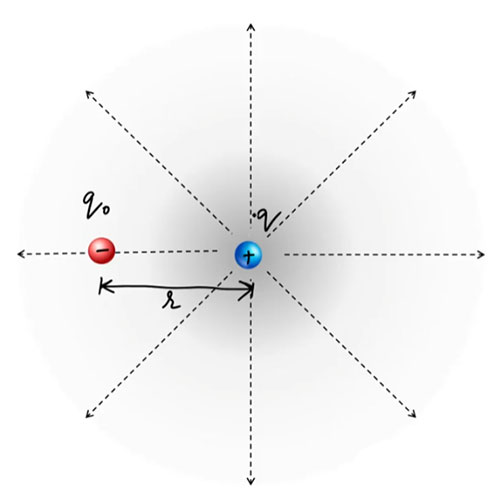
Principle of Superposition
For charges [Q_1, Q_2, \dots]:
[\vec{E}_{\text{net}}] [= \vec{E}_1 + \vec{E}_2 + \dots]
Because electric field is vectorial.
Electric Field Lines
- Start on positive charges, end on negative charges.
- Never intersect.
- Tangent at any point gives direction of [\vec{E}].
3. Dimensions and Units
| Quantity | Dimensions | SI Unit |
|---|---|---|
| Electric Field (E) | ([MLT^{-3}A^{-1}]) | Newton per Coulomb (N/C) or Volt per meter (V/m) |
4. Key Features
- Vector quantity
- Defined independent of test charge value
- Represents intensity of electric influence
- Obeys superposition principle
- Determines motion of charges
- Originates from positive charges, terminates on negative charges
- Infinite range (due to [1/r^2] law)
5. Important Formulas to Remember
| Situation | Electric Field Formula |
|---|---|
| Point charge | [\vec{E}] [= k \dfrac{Q}{r^2} \hat{r}] |
| Several point charges | [\vec{E}] [= \displaystyle \sum k\dfrac{Q_i}{r_i^2}\hat{r_i}] |
| Infinite line charge | [E] [= \dfrac{\lambda}{2\pi\epsilon_0 r}] |
| Infinite sheet | [E] [= \dfrac{\sigma}{2\epsilon_0}] |
| Ring on axis | [E] [= k \dfrac{Qx}{(R^2 + x^2)^{3/2}}] |
| Disc on axis | [E] [= \dfrac{\sigma}{2\epsilon_0}\left(1 – \dfrac{x}{\sqrt{x^2+R^2}} \right)] |
6. Conceptual Questions with Solutions
1. Why is electric field defined using a positive test charge?
Positive charge gives a consistent convention for field direction. Using a negative charge would reverse directions and create confusion.
2. Why should the test charge be very small?
A large test charge disturbs the existing field. A very small charge measures the field without affecting the arrangement.
3. Does a negative test charge change the value of E?
No. Field is defined as force per unit **positive** charge, independent of test-charge sign. Only the **direction of force** changes.
4. Can electric field be zero even if charges are present?
Yes, at points where fields from multiple charges cancel out via superposition.
5. Why do field lines never intersect?
If they intersected, two directions of E would exist at a point, which is impossible.
6. Does a positive charge always produce an outward field?
Yes. Field direction is defined as direction of force on a positive test charge.
7. Why does electric field decrease as \(1/r^2\)?
Because force between point charges follows Coulomb’s law, which has the \[\dfrac{1}{r^2}\] dependence.
8. Can electric field exist inside a charged conductor?
No. For electrostatic equilibrium, net internal field must be zero.
9. At what point between two like charges is electric field zero?
At a point along the line joining them, closer to the smaller charge.
10. Why is electric field tangential to field lines?
Field lines are constructed such that each line represents the direction of E at every point.
11. Can electric field be negative?
No. Magnitude is always positive; direction determines whether it points left/right or inward/outward.
12. Why do we use superposition for electric field?
Electric field is linear; effects from individual charges add vectorially without disturbing one another.
13. Is electric field unique for a given arrangement?
Yes. A charge distribution produces a single, well-defined vector field.
14. Why do electric field lines never form closed loops?
Because electric field begins and ends on charges. Magnetic field, not electric field, forms loops.
15. How can electric field be non-zero if force is zero?
If the test charge is zero (mathematically), field exists but force becomes zero: \[\vec{F} = q_0 \vec{E}\]
7. FAQ / Common Misconceptions
1. Misconception: Electric field depends on the test charge.
False. Field is defined independently of the test charge.
2. Misconception: Zero electric field means no charges nearby.
No. Fields from charges may cancel each other.
3. Misconception: Electric field lines represent actual physical paths.
No. They are conceptual visual tools.
4. Misconception: Field lines can cross.
Never. That would imply two directions of E at one point.
5. Misconception: A neutral body cannot have an electric field.
A neutral body can have **non-uniform charge distribution** on its surface → it creates fields.
6. Misconception: Only charges produce electric fields.
Changing magnetic fields also produce electric fields (Faraday’s law).
7. Misconception: Electric field and electric potential are the same.
No. Field: force per unit charge. Potential: energy per unit charge.
8. Misconception: Electric field is always radial.
Only point charges create radial fields. Lines, sheets, and surfaces do not.
9. Misconception: Test charge must always be positive.
Field is defined using a hypothetical positive charge; in calculations, sign of actual test charge doesn’t matter.
10. Misconception: If field is zero at a point, force on any charge is zero.
True only if **net field** is zero at that point. Otherwise, force depends on \[\vec{F} = q\vec{E}\].
8. Practice Questions (With Step-by-Step Solutions)
Question 1
Find the electric field due to a point charge [Q = 5,\text{μC}] at a distance of [0.2,\text{m}].
Step-by-step solution:
- Use
[
E = k\dfrac{Q}{r^2}
] - Substitute:
[
E = 9\times10^9 \cdot \dfrac{5\times10^{-6}}{(0.2)^2}
] - Compute denominator: [(0.2)^2 = 0.04]
[
E = 9\times10^9 \cdot \dfrac{5\times10^{-6}}{0.04}
]
5.
[
E = 9\times10^9 \cdot 1.25\times10^{-4}
]
6.
[
E = 1.125\times10^6\ \text{N/C}
]
Final Answer:
[
1.125\times10^6\ \text{N/C}
]
Question 2
Two charges [+4,\text{μC}] and [-2,\text{μC}] are placed 1 m apart. Find the field at the midpoint.
Solution:
- Distance from midpoint = [0.5] m
- Field due to [+4] μC is outward; due to [-2] μC is toward the charge.
- Both point in the same direction at midpoint.
[
E_1 = k\dfrac{4\times10^{-6}}{(0.5)^2}
]
[
E_2 = k\dfrac{2\times10^{-6}}{(0.5)^2}
]
[
E_{\text{net}} = (E_1 + E_2)
]
[
E_{\text{net}}] [= 9\times10^9 \left( \dfrac{6\times10^{-6}}{0.25} \right)
]
[
E_{\text{net}}] [= 9\times10^9 \times 24\times10^{-6}
]
[
E_{\text{net}} = 216000\ \text{N/C}
]
Final Answer:
[
2.16\times10^5\ \text{N/C}
]
Question 3
Find the direction of field at the midpoint between two equal positive charges.
Solution:
- Both charges push the test charge away.
- Directions are opposite at midpoint.
- Magnitudes equal → cancel.
Final Answer:
[
\vec{E}_{\text{mid}} = 0
]
Question 4
A charge of [-3,\text{μC}] is placed in a region where the electric field is [500,\text{N/C}] rightward. Find the force.
[
F = qE = (-3\times10^{-6})(500)
]
[
F = -1.5\times10^{-3}\ \text{N}
]
Direction: Leftward (opposite to field).
Question 5
Electric field at a point is [200,\text{N/C}]. What force acts on a charge [q = 0.01,\text{C}]?
[F = qE] [= 0.01 \times 200] [= 2\ \text{N}]
Answer:
[
2\ \text{N}
]
 Sign in with Google