

1. Statement of the Concept
The electric field intensity at a point in space due to a point charge is defined as the force experienced per unit positive test charge placed at that point.
2. Clear Explanation and Mathematical Derivation
Consider a point charge [Q] placed in free space.
Let a small positive test charge [q_0] be placed at a distance [r] from the charge [Q].
According to Coulomb’s law, the force on [q_0] due to [Q] is:
[F] [= \dfrac{1}{4\pi\varepsilon_0} \dfrac{Q q_0}{r^2}]
Electric field intensity is defined as:
[
E = \dfrac{F}{q_0}
]
Substituting the value of [F]:
[
E = \dfrac{1}{4\pi\varepsilon_0} \dfrac{Q}{r^2}
]
Thus, the electric field intensity produced by a point charge is:
[
E = \dfrac{1}{4\pi\varepsilon_0} \dfrac{Q}{r^2}
]
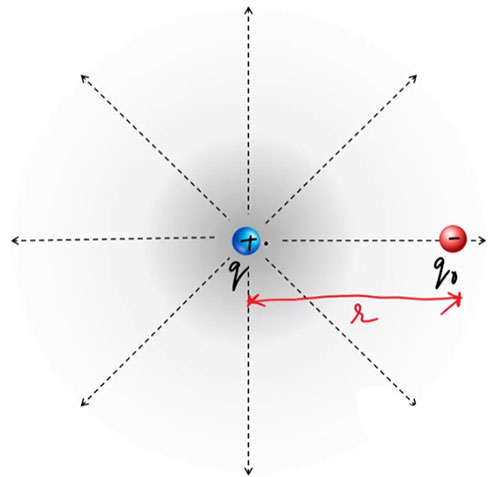
Direction of Electric Field
- For a positive point charge, the electric field is radially outward.
- For a negative point charge, the electric field is radially inward.
3. Dimensions and Units
Dimensions
[
[E] = [M L T^{-3} A^{-1}]
]
SI Unit
[\text{Newton per Coulomb (N/C)}] [\quad] [\text{or}] [\quad] [\text{Volt per meter (V/m)}]
4. Key Features
- Electric field is a vector quantity.
- It depends on:
- Magnitude of charge [Q]
- Distance [r] from the charge
- Nature of medium (via [\varepsilon])
- It decreases as [\dfrac{1}{r^2}].
- Points closer to the charge experience stronger fields.
5. Important Formulas to Remember
| Concept | Formula |
|---|---|
| Electric Field due to a point charge in vacuum | [E = \dfrac{1}{4\pi\varepsilon_0} \dfrac{Q}{r^2}] |
| Electric Field in a medium | [E = \dfrac{1}{4\pi\varepsilon} \dfrac{Q}{r^2}] |
| Relation in terms of dielectric constant | [E = \dfrac{1}{4\pi\varepsilon_0 k} \dfrac{Q}{r^2}] |
| Direction | Away from +Q, towards –Q |
6. Conceptual Questions with Solutions
1. Why does electric field decrease as distance increases?
Because the field lines spread out as distance increases. Mathematically, \[E \propto \dfrac{1}{r^2}\].
2. Why is a test charge chosen to be very small?
To ensure it does not disturb the original electric field created by charge \[Q\].
3. Why is electric field intensity a vector?
Because it has both magnitude and direction, defined by the direction of force on a positive test charge.
4. What happens if the test charge is negative?
The measured force reverses direction, but electric field is always defined using a **positive test charge**, so the field remains unchanged.
5. Why is the test charge always positive in definition?
To maintain consistency in defining direction of electric field.
6. Can two different charges produce equal electric fields?
Yes, if their ratio \[\dfrac{Q}{r^2}\] is the same.
7. Will electric field ever become zero for a single point charge?
No. It decreases but never reaches zero unless \[r \to \infty\].
8. Why is electric field undefined at the location of the charge?
Because \[r = 0\] makes \[\dfrac{1}{r^2}\] infinite.
9. Does electric field depend on test charge?
No. The expression for \[E\] does not contain \[q_0\].
10. Why do we not use a large test charge?
It alters the field by exerting a force on the source charge.
11. Will electric field intensity change inside a conductor?
Inside an ideal conductor, electric field is zero due to charge redistribution.
12. Why is the electric field stronger near a sharp point?
Field lines crowd more near sharp points, giving larger \[E\].
13. How does the medium affect electric field?
A medium with dielectric constant \[k > 1\] reduces electric field by factor \[k\].
14. Does electric field depend on mass of the test charge?
No. Electric field depends only on charge, not mass.
15. Why does direction of electric field reverse for negative charges?
Because force on a positive test charge is towards negative charges, making field lines inward.
7. FAQ / Common Misconceptions
1. Misconception: A negative test charge changes the electric field.
No. The definition always assumes a positive test charge, so the field remains unchanged.
2. Misconception: Electric field is same as force.
Electric field is force **per unit charge**, not the force itself.
3. Misconception: Electric field can be zero at any distance from a single charge.
No. It never becomes zero unless at infinite distance.
4. Misconception: Electric field depends on the test charge.
It does not. \[E\] is independent of \[q_0\].
5. Misconception: Bigger charge always produces larger electric field.
Not necessarily. A smaller charge at a smaller \[r\] can produce larger \[E\].
6. Misconception: Inside any material electric field is zero.
True only for **conductors**, not insulators.
7. Misconception: Electric field is always outward.
Outward for positive charges, inward for negative charges.
8. Misconception: If force is zero on a test charge, electric field is zero.
No. If test charge is zero, force becomes zero but field remains.
9. Misconception: Electric field at the charge is maximum.
It is actually undefined (approaches infinity).
10. Misconception: Electric field lines represent real physical paths.
They are conceptual tools, not physical entities.
8. Practice Questions (With Step-By-Step Solutions)
Q1. A point charge [+5 , \mu C] is placed in air. Find the electric field at a distance of [20 , cm].
Step 1: Convert units
[r = 0.20 m], [\quad] [Q = 5 \times 10^{-6} C]
Step 2: Apply formula
[
E = \dfrac{1}{4\pi\varepsilon_0}\dfrac{Q}{r^2}
]
[
E = 9 \times 10^{9} \dfrac{5 \times 10^{-6}}{(0.20)^2}
]
Step 3: Solve
[
E = 9 \times 10^{9} \times \dfrac{5 \times 10^{-6}}{0.04}
]
[
E = 1.125 \times 10^{6} , N/C
]
Q2. At what distance from a charge of [2, \mu C] is the electric field [1000 , N/C]?
[
E = \dfrac{1}{4\pi\varepsilon_0}\dfrac{Q}{r^2}
]
Rearranging:
[
r = \sqrt{\dfrac{1}{4\pi\varepsilon_0}\dfrac{Q}{E}}
]
[
r = \sqrt{9 \times 10^{9} \dfrac{2\times 10^{-6}}{1000}}
]
[
r = \sqrt{18}
\approx 4.24 , m
]
Q3. Find the electric field due to a charge of [-10, \mu C] at a distance of [50, cm] in a medium of dielectric constant [k = 4].
[
E = \dfrac{1}{4\pi\varepsilon_0 k}\dfrac{Q}{r^2}
]
[
E = \dfrac{9\times 10^{9}}{4} \dfrac{10 \times 10^{-6}}{(0.5)^2}
]
[
E = 2.25 \times 10^{9} \dfrac{10 \times 10^{-6}}{0.25}
]
[
E = 9 \times 10^{4} , N/C
]
Direction: towards the charge (because it is negative).
 Sign in with Google