

1. Concept Overview
A uniformly charged spherical shell is a hollow sphere whose entire charge [Q] is spread uniformly over its surface (radius [R]). We ask: What is the electric field at a point located at a distance [r] from the centre?
Gauss’s law gives a very simple, intuitive result:
- Outside the shell [(r \ge R)] the shell behaves exactly like a point charge located at the centre. The field falls off as [\dfrac{1}{r^2}].
- Inside the shell [(r < R)] the electric field is zero everywhere (electrostatic shielding).
Why this matters for a beginner: it shows how symmetry simplifies problems — a complicated distribution (all charge on a spherical surface) produces the same external field as a single point charge. It also explains shielding: a hollow conductor with static charges produces no internal electric field.
2. Clear Explanation and Mathematical Derivation
Use Gauss’s law:
[\oint \vec{E}\cdot d\vec{A}] [= \dfrac{Q_{\text{enc}}}{\varepsilon_0}]
Take a concentric spherical Gaussian surface of radius [r].
(A) Case 1: Outside the shell [(r \ge R)]
- Electric field is radial and same at every point on Gaussian sphere by symmetry.
- Area of Gaussian sphere: [4\pi r^2].
- Charge enclosed: whole charge [Q].
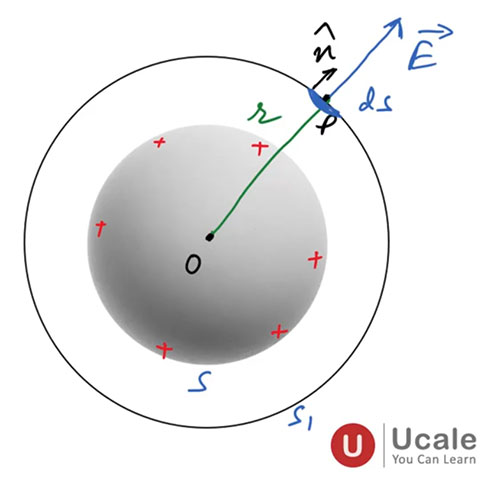
Apply Gauss’s law:
[E \cdot 4\pi r^2] [= \dfrac{Q}{\varepsilon_0}]
Hence:
[\boxed{E(r) = \dfrac{1}{4\pi\varepsilon_0}\dfrac{Q}{r^2}\quad\text{for } r \ge R}]
(This is identical to the field of a point charge [Q] at the centre.)
(B) Case 2: Inside the shell [(r < R)]
- Gaussian sphere of radius [r < R] encloses no charge (all charge lies on the shell at radius [R]).
- So [Q_{\text{enc}} = 0].
Gauss’s law:
[E \cdot 4\pi r^2 = 0] [\Rightarrow] [\boxed{E(r)=0\quad\text{for } r < R}]
At the surface [(r = R)], substitute [r=R] in outside expression:
[E(R)] [= \dfrac{1}{4\pi\varepsilon_0}\dfrac{Q}{R^2}]
3. Dimensions and Units
- Electric field [E]: SI unit = Newton per Coulomb (N/C) or Volt per metre (V/m).
- Dimensions: [[M L T^{-3} A^{-1}]].
4. Key Features
- Spherical symmetry → field is radial and depends only on [r].
- Outside: shell acts as point charge → [E \propto \dfrac{1}{r^2}].
- Inside: electric field is zero (electrostatic shielding).
- Field at surface: [E(R)=\dfrac{1}{4\pi\varepsilon_0}\dfrac{Q}{R^2}].
- Valid for any thin spherical shell with surface charge; also applies to conducting spherical shells in electrostatic equilibrium.
- If shell is a conductor, all charge moves to outer surface; result same.
- Useful in problems of shielding, capacitance (spherical capacitor), and gravitational analogies.
5. Important Formulas to Remember
| Situation | Formula |
|---|---|
| Outside the shell [(r \ge R)] | [E(r)] [=\dfrac{1}{4\pi\varepsilon_0}\dfrac{Q}{r^2}] |
| On the surface [(r=R)] | [E(R)] [=\dfrac{1}{4\pi\varepsilon_0}\dfrac{Q}{R^2}] |
| Inside the shell [(r<R)] | [E(r)=0] |
| Electric flux through Gaussian sphere | [\Phi] [= E\cdot 4\pi r^2] [= \dfrac{Q_{\text{enc}}}{\varepsilon_0}] |
(Recall: [\dfrac{1}{4\pi\varepsilon_0}] [= 9\times10^{9}\ \text{N·m}^2/\text{C}^2] in vacuum.)
6. Conceptual Questions with Solutions
1. Why does a spherical shell act like a point charge outside it?
Because of spherical symmetry—field contributions from all parts of the shell sum to the same as if the entire charge were concentrated at the centre; Gauss’s law shows this formally.
2. Why is the field zero inside?
Because a Gaussian surface inside the shell encloses no net charge, so by Gauss’s law the net flux and hence the field must be zero.
3. Does this result change if shell is non-conducting?
No. The result (E=0 inside, E~1/r^2 outside) holds for a thin spherical shell with charge on its surface whether conductor or insulating surface charge.
4. What if charge is distributed throughout a solid sphere (not shell)?
For a uniformly charged solid sphere, inside field is not zero — it increases linearly with r: [E \propto r\] for \[r<R]. That differs from hollow shell.
5. If two concentric shells have charges, how do fields add?
Use superposition: field at any r is sum of contributions from each shell using their outside/inside rules (treat each shell as point charge outside it).
6. Why can’t Gauss’s law be used for arbitrary shapes so easily?
It is always true, but only in high-symmetry cases (spherical, cylindrical, planar) does it give an easy algebraic result for E.
7. Is the potential inside the shell constant?
Yes. If field is zero inside, potential is constant throughout the interior (equal to the potential at the surface).
8. What is the direction of E outside a positively charged shell?
Radially outward from the centre.
9. Does the thickness of the shell matter?
If the shell is thin and charge is on outer surface, result holds. For thick shells with volume charge distribution, you must integrate or use appropriate Gauss rules.
10. If you place a charge inside a conducting shell, does the outer field change?
For a conductor, induced charges appear and field outside depends on total enclosed charge (including the placed charge); Gauss’s law still applies.
11. Why is the field continuous at the surface for a shell?
The radial field outside at [r=R] equals [\dfrac{Q}{4\pi\varepsilon_0 R^2}]; just inside it is zero — the normal component of E has a discontinuity equal to surface charge density/ϵ0, consistent with boundary conditions.
12. Can a test charge feel force inside the hollow shell?
No—if shell alone is present and static, interior E=0 so test charge feels no electrostatic force (neglecting its own interactions).
13. If the shell has negative charge, which way is E outside?
Radially inward (toward the centre).
14. How does replacing vacuum by dielectric affect results?
Replace [\varepsilon_0] by [\varepsilon]; magnitudes reduce by factor [\dfrac{\varepsilon_0}{\varepsilon}].
15. Is shielding perfect for any frequency/time variation?
Electrostatic shielding (E=0 inside) holds for static fields. Time-varying fields require additional considerations (Faraday induction).
7. FAQ / Common Misconceptions
1. “Zero field inside means zero potential inside.”
No—potential is constant inside but not necessarily zero. It equals the surface potential \[V(R)=\dfrac{1}{4\pi\varepsilon_0}\dfrac{Q}{R}\].
2. “All hollow objects are shielded regardless of material.”
Electrostatic shielding requires conductor or static equilibrium conditions; insulating hollow shells with fixed charges produce same field pattern but do not necessarily shield in presence of internal charges.
3. “Field must be continuous across the surface.”
Normal component of E can be discontinuous across a charged surface; inside it may be zero while immediately outside nonzero (surface charge causes jump).
4. “Spherical shell always creates zero field everywhere inside and outside.”
Incorrect. Outside field exists as if from a point charge; only interior is zero.
5. “Gauss’s law is only an approximation.”
No. Gauss’s law is exact (a Maxwell equation) — approximations enter only when assuming symmetry to simplify integrals.
6. “If shell is non-uniformly charged, interior is still zero.”
Not necessarily—if symmetry is broken (charge not uniformly on surface), interior field may not be zero.
7. “Field inside solid conductor is same as hollow shell.”
Inside a conductor at electrostatic equilibrium, E=0 as well; but distribution of charge (all on outer surface) follows from conductor property.
8. “Potential at infinity must be zero for shell problems.”
Setting potential zero at infinity is a convention used to write simple expressions; other references possible but results for differences remain same.
9. “If you drill a hole in the shell, interior field remains zero.”
Drilling breaks spherical symmetry; interior can get nonzero field depending on hole size and environment.
10. “A charged shell repels any object inside it.”
No. If alone and static, it produces no field inside so it exerts no Coulomb force on internal neutral/test charges.
8. Practice Questions (With Step-by-Step Solutions)
Q1. A thin spherical shell of radius [R=0.50\ \text{m}] carries total charge [Q = 8.0\times10^{-6}\ \text{C}]. Find the magnitude of electric field at [r=1.0\ \text{m}] and at [r=0.25\ \text{m}].
Solution (step-by-step):
Constants: [\dfrac{1}{4\pi\varepsilon_0}] [= 9.0\times10^{9}\ \text{N·m}^2!/!\text{C}^2.]
- For [r=1.0\ \text{m}] (outside):
[E(1.0)] [= 9.0\times10^{9} \cdot \dfrac{8.0\times10^{-6}}{(1.0)^2}.]
Compute numerator:
[9.0\times10^{9} \times 8.0\times10^{-6}] [= (9.0\times 8.0)\times 10^{9-6}] [= 72.0 \times 10^{3}.]
So:
[E(1.0)] [= 72.0 \times 10^{3}\ \text{N/C}] [= 7.2\times10^{4}\ \text{N/C}.]
- For [r=0.25\ \text{m}] (inside, since 0.25 < 0.50):
[E(0.25) = 0] [\ \text{N/C}] [\quad] [\text{(by Gauss’s law)}.]
Answers: [E(1.0)] [=7.2\times10^{4}\ \text{N/C}], [\quad] [E(0.25)=0.]
Q2. A spherical conducting shell of radius [R=0.2\ \text{m}] has charge [Q=1.0\times10^{-6}\ \text{C}]. What is the potential at the surface (taking zero at infinity)? Also, what is potential at a point 0.1 m from centre (inside)?
Solution:
Potential at surface:
[V(R)] [= \dfrac{1}{4\pi\varepsilon_0}\dfrac{Q}{R}] [= 9.0\times10^{9}\cdot \dfrac{1.0\times10^{-6}}{0.2}.]
Compute numerator:
[9.0\times10^{9}\times 1.0\times10^{-6}] [= 9.0\times10^{3}.]
Divide by 0.2:
[V(R)] [= \dfrac{9.0\times10^{3}}{0.2}] [= 45.0\times10^{3}\ \text{V}] [= 4.5\times10^{4}\ \text{V}.]
Potential inside (any point with r < R) is same as surface (constant):
[V(\text{inside})] [= V(R)] [= 4.5\times10^{4}\ \text{V}.]
Answers: Surface potential = [4.5\times10^{4}\ \text{V}]; inside potential = same [4.5\times10^{4}\ \text{V}].
Q3. A thin spherical shell radius [R=0.4\ \text{m}] carries surface charge density [\sigma = 2.0\times10^{-6}\ \text{C/m}^2]. Find total charge [Q] and field just outside the surface.
Solution:
- Total charge on shell:
Surface area: [A = 4\pi R^2] [= 4\pi (0.4)^2 = 4\pi \times 0.16] [= 0.64\pi\ \text{m}^2.]
Charge: [Q = \sigma A] [= 2.0\times10^{-6} \times 0.64\pi.]
Compute numeric:
[0.64 \times 2.0 = 1.28.]
So:
[
Q = 1.28\pi \times 10^{-6}\ \text{C}.
]
If numeric value desired, [\pi\approx 3.1416]:
[Q] [\approx 1.28 \times 3.1416 \times 10^{-6}] [= 4.021\ldots \times10^{-6}\ \text{C}] [\approx 4.02\times10^{-6}\ \text{C}.]
- Field just outside (at r = R^+):
[E(R)] [= \dfrac{1}{4\pi\varepsilon_0}\dfrac{Q}{R^2}] [= 9.0\times10^{9}\cdot \dfrac{4.02\times10^{-6}}{(0.4)^2}.]
Compute denominator: [(0.4)^2 = 0.16.]
Compute numerator:
[9.0\times10^{9} \times 4.02\times10^{-6}] [= 36.18 \times10^{3}.]
Divide:
[E(R)] [= \dfrac{36.18\times10^{3}}{0.16}] [= 226.125\times10^{3}\ \text{N/C}] [\approx 2.26\times10^{5}\ \text{N/C}.]
Answers: [Q \approx 4.02\times10^{-6}\ \text{C},] [\quad] [E(R)\approx 2.26\times10^{5}\ \text{N/C}.]
Q4. A thin spherical shell carries charge [Q]. A point charge [q] is placed at the centre. What is the field outside and inside the shell? (Assume conductor so charges redistribute.)
Solution (qualitative):
- Inside (r < R): Field due to centre charge and induced charges cancel inside conductor → if shell is a conductor in electrostatic equilibrium, field inside conducting material is zero. But in cavity at centre (if hollow), field due to q exists: for a point inside cavity (the hollow space) the field is that of point charge q (if spherical symmetry preserved).
- Outside (r ≥ R): Total enclosed charge = q + Q (where Q is net on shell including induced). Thus outside field behaves as point charge of magnitude q + Q located at centre:
[E_{\text{outside}}] [= \dfrac{1}{4\pi\varepsilon_0}\dfrac{q+Q}{r^2}.]
(Precise behaviour depends on conductor geometry; key idea: outside sees total net charge.)
Q5. Compare fields produced by (a) point charge Q at origin, (b) thin spherical shell with total charge Q and radius R, at a point r = 2R.
Solution:
Both produce the same field at r = 2R (outside shell):
[E(2R)] [= \dfrac{1}{4\pi\varepsilon_0}\dfrac{Q}{(2R)^2}] [= \dfrac{1}{4\pi\varepsilon_0}\dfrac{Q}{4R^2}.]
Hence identical.
 Sign in with Google