

1. Statement of the Concept
The electric field at a point located on the axis of a uniformly charged ring is directed along the axis and is given by:
[E] [= \dfrac{1}{4\pi \varepsilon_0} \dfrac{q x}{(x^2 + R^2)^{3/2}}]
where:
- [q] = total charge on the ring
- [R] = radius of the ring
- [x] = distance of the point from the center along the axis
2. Explanation and Complete Derivation
Consider a ring of radius [R] carrying a uniform charge [q].
Let [x] be the distance of point [P] on the axis of the ring.
Take a small charge element [dq] on the ring.
The electric field due to [dq] at point [P]:
[dE] [= \dfrac{1}{4\pi \varepsilon_0} \dfrac{dq}{r^2}]
where
[
r = \sqrt{x^2 + R^2}
]
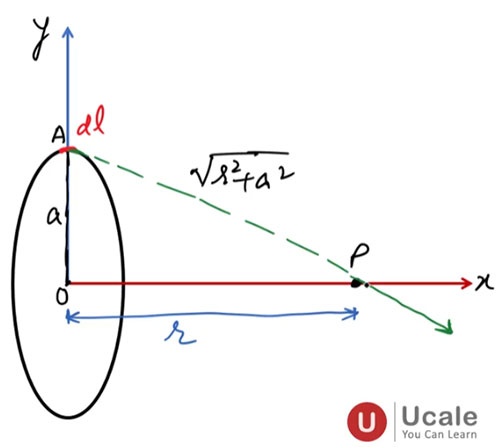
[R = a] and [r = x]
Resolving Components
Each element contributes electric field at angle [\theta]:
- Radial components cancel (symmetry).
- Only axial components add.
Axial component:
[
dE_x = dE \cos\theta
]
But:
[
\cos\theta = \dfrac{x}{r}
]
So,
[dE_x] [= \dfrac{1}{4\pi \varepsilon_0} \dfrac{dq}{r^2} \cdot \dfrac{x}{r}]
[dE_x] [= \dfrac{1}{4\pi \varepsilon_0} \dfrac{x,dq}{(x^2 + R^2)^{3/2}}]
Integrate over entire ring:
[E_x] [= \dfrac{1}{4\pi \varepsilon_0} \dfrac{x}{(x^2 + R^2)^{3/2}} \displaystyle \int dq]
But [\displaystyle \int dq = q].
Thus:
[E] [= \dfrac{1}{4\pi \varepsilon_0} \dfrac{q x}{(x^2 + R^2)^{3/2}}]
Direction:
- Along the axis
- Away from the ring if [q>0]
- Toward the ring if [q<0]
3. Dimensions and Units
- Electric field [E]
Dimensions: [[M L T^{-3} A^{-1}]]
SI Unit: [\text{N C}^{-1}] or [\text{V m}^{-1}]
4. Key Features
- Only axial field exists due to symmetry.
- Radial components cancel due to circular symmetry.
- At the center ([x=0]), field is zero.
- For large distances ([x \gg R]) the field behaves like a point charge:[
E \approx \dfrac{1}{4\pi \varepsilon_0} \dfrac{q}{x^2}
] - Field is maximum at:[
x = \dfrac{R}{\sqrt{2}}
]
5. Important Formulas to Remember
| Quantity | Formula |
|---|---|
| Distance from point to ring | [r = \sqrt{x^2 + R^2}] |
| Axial electric field | [E] [= \dfrac{1}{4\pi \varepsilon_0} \dfrac{q x}{(x^2 + R^2)^{3/2}}] |
| Condition for maximum field | [x] [= \dfrac{R}{\sqrt{2}}] |
| Maximum field | [E_{\text{max}}] [= \dfrac{1}{4\pi\varepsilon_0} \dfrac{2q}{3\sqrt{3} R^2}] |
6. Conceptual Questions with Solutions
1. Why does the radial component of electric field cancel out?
Because for every charge element on the ring, there is an opposite element producing an equal and opposite radial field component. Thus radial fields cancel due to symmetry.
2. Why is the field zero at the center of a uniformly charged ring?
At the center, all elements are at equal distance and produce symmetric field components that cancel each other in all directions.
3. Why does the field lie along the axis only?
Due to circular symmetry, horizontal components cancel. Only vertical (axial) components add up.
4. Does the direction of field change if charge is negative?
Yes. For negative charge, field is directed **toward** the ring instead of away from it.
5. At what point is the field maximum?
At \[x = \dfrac{R}{\sqrt{2}}\], where the expression for \[E\] becomes maximum.
6. Why does the field decrease for very large x?
Because the ring behaves like a point charge at large distances, giving \[E \propto \dfrac{1}{x^2}\].
7. Does the thickness of the ring matter?
No. Only total charge and radius matter, as long as charge distribution is uniform.
8. What happens if charge is not uniform?
Symmetry breaks, radial components no longer cancel, and field calculation becomes more complex.
9. Can the electric field at some point on axis be equal to zero besides the center?
No, only at the center: the formula shows \[E=0\] only if \[x=0\].
10. Do internal points (inside the ring but off-axis) have zero field?
No. Zero field occurs only at the center, not at all interior points.
11. Why does symmetry simplify the integration?
Symmetry ensures that radial components cancel, so we integrate only axial components.
12. Does the ring behave like a dipole?
No. It produces a field resembling a point charge at large distances, not a dipole.
13. What if the ring has zero radius (R → 0)?
The ring becomes a point charge, giving \[E = \dfrac{1}{4\pi\varepsilon_0} \dfrac{q}{x^2}\].
14. Why does field magnitude initially increase with x?
Because for small x, the axial contribution increases faster than the drop due to distance.
15. Why does field eventually decrease after reaching maximum?
At larger x, the denominator \[(x^2+R^2)^{3/2}\] grows faster, reducing the field.
7. FAQ / Common Misconceptions
1. Misconception: Field inside the ring is always zero.
No. Only at the center it is zero; elsewhere inside the ring, field is not zero.
2. Misconception: Field is uniform along the axis.
Wrong. It varies with x and has a maximum at \[x = \dfrac{R}{\sqrt{2}}\].
3. Misconception: Only charge magnitude affects field.
Radius also affects field through the term \[(x^2 + R^2)^{3/2}\].
4. Misconception: A non-uniform ring gives same result.
No. The derivation assumes uniform charge distribution.
5. Misconception: Field direction changes with distance.
No. It always points along the axis (toward or away depending on sign of charge).
6. Misconception: Ring behaves like a dipole at large distances.
No. It behaves like a point charge because net charge is non-zero.
7. Misconception: Electric field depends on the thickness of the ring.
No. Only charge and radius matter.
8. Misconception: Field is maximum at the center.
No. It’s zero at center and maximum at \[x=\dfrac{R}{\sqrt{2}}\].
9. Misconception: A positive test charge always moves toward the ring.
For positive ring, it moves away; direction depends on sign of charge.
10. Misconception: The formula is valid anywhere in space.
No. It is valid only **on the axis** of the ring.
8. Practice Questions (with Step-by-Step Solutions)
Q1. A ring of radius 0.2 m carries a charge of [5 \times 10^{-9},\text{C}]. Find the electric field on its axis at a point 0.1 m from the center.
Solution:
Given:
[R = 0.2\text{ m}]
[x = 0.1\text{ m}]
[q = 5 \times 10^{-9} \text{ C}]
[E] [= \dfrac{1}{4\pi\varepsilon_0} \dfrac{q x}{(x^2 + R^2)^{3/2}}]
Compute denominator:
[x^2 + R^2] [= 0.01 + 0.04] [= 0.05]
[(x^2 + R^2)^{3/2}] [= (0.05)^{3/2}] [= 0.01118]
[E] [= 9\times10^9 \cdot \dfrac{5\times10^{-9} \cdot 0.1}{0.01118}]
[
E = 4024 \text{ N/C}
]
Q2. At what distance from the center of a ring of radius 10 cm is the axial field maximum?
[x] [= \dfrac{R}{\sqrt{2}}] [= \dfrac{0.1}{\sqrt{2}}] [= 0.0707 \text{ m}]
Q3. A 2 nC ring produces an electric field of 1000 N/C on its axis at point P. If the radius is 0.05 m, find the distance x.
Use:
[E] [= \dfrac{1}{4\pi\varepsilon_0} \dfrac{q x}{(x^2 + R^2)^{3/2}}]
Substitute values and solve numerically:
[1000] [= 9\times10^9 \dfrac{2\times10^{-9} \cdot x}{(x^2 + 0.0025)^{3/2}}]
[1000] [= 18 \dfrac{x}{(x^2+0.0025)^{3/2}}]
Solve →
[
x \approx 0.031 \text{ m}
]
Q4. What is the electric field at large x compared to R?
[E \approx \dfrac{1}{4\pi\varepsilon_0} \dfrac{q}{x^2}]
So field behaves like a point charge.
Q5. A ring has charge 8 nC and radius 0.3 m. What is the electric field at its center?
Since [x = 0]:
[
E = 0
]
 Sign in with Google