

1. Statement of the Concept
Electric lines of force (or electric field lines) are imaginary curves whose tangent at any point gives the direction of the electric field at that point.
2. Clear Explanation
Electric field lines help us visually represent the electric field. They are drawn such that:
- Their direction at any point shows the direction of electric field [E].
- The density of lines represents the strength of E-field.
- They originate from positive charges and terminate on negative charges.
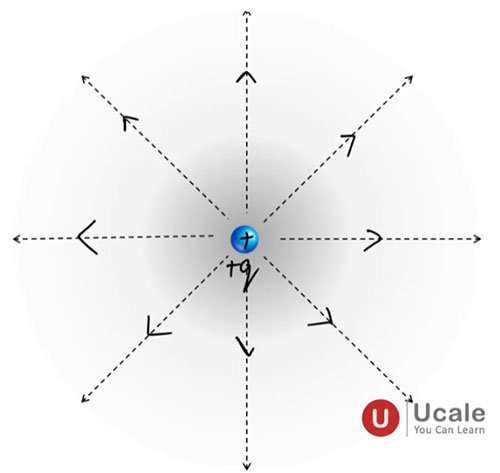

How Field Lines Are Constructed
Imagine a small positive test charge placed near a source charge. If it moves slightly under electrostatic force and you connect all such points, the path traced is called an electric field line.
Mathematical Relation
Even though field lines are imaginary, they follow strict rules that arise from the vector nature of the electric field.
For example, electric field magnitude is proportional to the number of lines per unit area:
[E] [\propto \dfrac{\text{Number of Lines}}{\text{Area}}]
This is why field lines crowd near strong fields and spread in weaker regions.
3. Dimensions and Units
Field lines are a conceptual representation, so they have no dimensions and no units.
However, they describe the electric field which has:
- SI Unit: [N/C] or [V/m]
- Dimensions: [M L T^{-3} A^{-1}]
4. Key Features
- Field lines start from positive charges and end on negative charges.
- They never intersect (because electric field has a unique direction at each point).
- Density of lines ∝ magnitude of electric field.
- Lines are perpendicular to the surface of a conductor.
- Lines are continuous curves that never break.
- For an isolated charge, field lines are radial.
- In a uniform field, lines are parallel and equally spaced.
5. Important Formulas to Remember
| Concept | Formula |
|---|---|
| Relation of magnitude of field with line density | [E \propto \dfrac{n}{A}] |
| Direction of field line | Tangent to the curve at a point |
| Origin/termination | +Q → outwards, −Q → inwards |
6. Conceptual Questions with Solutions
1. Why do electric field lines start from positive charges?
Because they represent the direction of force on a positive test charge, which is repelled by positive charges.
2. Why do field lines end on negative charges?
A positive test charge is attracted towards negative charges, so field line direction must end there.
3. Why can’t electric field lines intersect?
If they intersected, there would be two directions of electric field at the same point, which is impossible.
4. What does crowding of field lines indicate?
It indicates a region of strong electric field because \[E \propto\] line density.
5. Why are field lines absent inside a conductor?
Because electric field is zero inside a conductor in electrostatic equilibrium.
6. Why are field lines perpendicular to the surface of a conductor?
If not, charges would move along the surface, violating electrostatic equilibrium.
7. Why are field lines continuous curves?
Because electric field is defined at all points in space and varies smoothly.
8. What do parallel and equally spaced field lines represent?
A uniform electric field.
9. Why do field lines never form closed loops?
Because electric field is conservative and always starts/ends on charges.
10. Why is the number of field lines arbitrary?
Field lines are only a visual tool; their number isn’t fixed.
11. Why do field lines bend between two charges?
Because the net electric field is the vector sum of individual fields.
12. Why can’t electric field lines penetrate a conductor?
Because charges in a conductor rearrange to cancel the internal field.
13. Why do sharp edges have denser field lines?
Because charge density is higher at sharp edges, producing stronger electric fields.
14. Why do field lines spread out in a dielectric?
The dielectric weakens the electric field, so line density decreases.
15. Why are electric field lines imaginary and not real?
They are conceptual aids used to visualize the electric field, not physical objects.
7. FAQ / Common Misconceptions
1. Misconception: Field lines are real physical paths.
No. They are imaginary curves used for visualization.
2. Misconception: Field lines can start anywhere in space.
They must originate from charges or from infinity.
3. Misconception: Electric field lines can cross each other.
No, because the electric field has a unique direction at each point.
4. Misconception: Inside a conductor, field lines exist but are weak.
No. In electrostatic equilibrium, field is **exactly zero** inside a conductor.
5. Misconception: Curved field lines mean curved forces.
The charge experiences force **tangent** to the curve at each point, not along the whole curve at once.
6. Misconception: Density of lines is actual quantity.
It only represents field strength qualitatively.
7. Misconception: Field lines can form closed loops.
Never. They start/end on charges, unlike magnetic field lines.
8. Misconception: Direction of field line depends on test charge.
No, definition always assumes a positive test charge.
9. Misconception: Field lines curve between opposite charges due to attraction.
They curve because of **vector addition**, not attraction.
10. Misconception: More lines mean more charge.
Only relatively; number of lines is arbitrary.
8. Practice Questions (With Step-by-Step Solutions)
Q1. Draw the electric field lines for two equal positive charges. Explain why no line meets between them.
Step 1: Both charges repel the test charge.
Step 2: Field lines originate from both and bow outward.
Step 3: There is a point between the charges where fields cancel, so no line can exist there.
Step 4: Lines never intersect, so they diverge away from each other.
Q2. A region has parallel and equally spaced field lines. What type of field is it? Why?
Step 1: Parallel lines → same direction everywhere.
Step 2: Equal spacing → same magnitude everywhere.
Conclusion: It is a uniform electric field.
Q3. Why are electric field lines closer near the surface of a charged conductor?
Step 1: Surface charge density is higher near edges.
Step 2: Electric field is proportional to line density.
[
E \propto \sigma
]
Step 3: Therefore, lines crowd near the surface, showing strong field.
Q4. Explain with a diagram why field lines are perpendicular to the surface of a conductor.
Step 1: If field had a tangential component, charges on conductor would start moving.
Step 2: This violates electrostatic equilibrium.
Step 3: Therefore, only the normal component exists → lines must be perpendicular.
(You can add your own diagram on Ucale.)
Q5. What happens to electric field lines when a dielectric is inserted near a charge?
Step 1: Dielectric reduces electric field by factor [k].
Step 2: Since line density ∝ field strength, lines spread apart.
Step 3: Therefore, dielectric weakens the field, seen visually as fewer lines.
 Sign in with Google