

1. Statement of the Concept
The electric potential at any point due to a group of point charges is defined as the algebraic sum of the potentials produced by each charge individually at that point.
This follows directly from the principle of superposition, which states that fields and potentials simply add up.
2. Clear Explanation and Mathematical Derivation
Consider a system of n point charges:
[q_1, q_2, q_3, \dots , q_n] placed at different positions.
Let the distance of the point P from these charges be:
[r_1, r_2, r_3, \dots , r_n]
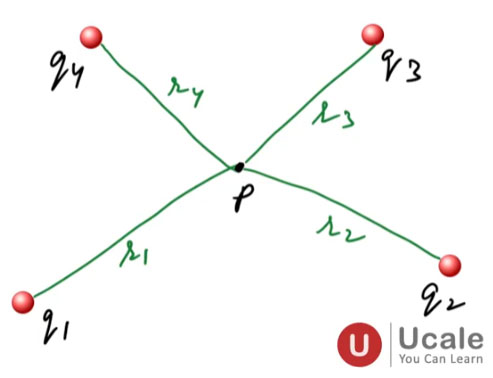
The potential due to a single point charge [q] at a distance [r] is:
[
V = \dfrac{1}{4\pi\varepsilon_0} \dfrac{q}{r}
]
Using the principle of superposition, the total potential at point P is:
[V_{\text{total}}] [= \sum_{i=1}^{n} \dfrac{1}{4\pi\varepsilon_0} \dfrac{q_i}{r_i}]
Thus,
[V_{\text{total}}] [= \dfrac{1}{4\pi\varepsilon_0} \left( \dfrac{q_1}{r_1} + \dfrac{q_2}{r_2} + \dfrac{q_3}{r_3} + \cdots + \dfrac{q_n}{r_n} \right)]
Important:
Electric potential is a scalar quantity, so we do not consider direction—only algebraic addition.
3. Dimensions and Units
- Dimensional Formula:
[V] = [M L^2 T^{-3} A^{-1}] - SI Unit: Volt (V)
- Other units:
- Kilovolt (kV)
- Millivolt (mV)
4. Key Features
- Electric potential is scalar, unlike the electric field which is vector.
- Potentials from multiple charges add algebraically, not vectorially.
- If signs of charges differ, their potential contributions may partially cancel.
- Potential can be positive or negative:
- Positive for +q
- Negative for –q
- Works even for large charge systems as long as distances are known.
- No integration needed since point charges produce simple expressions.
5. Important Formulas to Remember
| Situation | Formula |
|---|---|
| Potential due to a single point charge | [V] [= \dfrac{1}{4\pi\varepsilon_0} \dfrac{q}{r}] |
| Potential due to multiple point charges | [V] [= \dfrac{1}{4\pi\varepsilon_0} \displaystyle\sum_{i=1}^{n} \dfrac{q_i}{r_i}] |
| Potential at center of a square of side a with 4 identical charges q at corners | [V] [= \dfrac{4}{4\pi\varepsilon_0} \dfrac{q}{\left(\dfrac{a}{\sqrt{2}}\right)}] |
| Potential at midpoint between two equal charges q | [V] [= \dfrac{2}{4\pi\varepsilon_0} \dfrac{q}{r}] |
6. Conceptual Questions with Solutions
Q1. Why can potentials be added directly while electric fields cannot?
**Solution:** Because potential is a **scalar** quantity. Scalars add algebraically. Electric field is a **vector**, so direction matters and vector addition is required.
Q2. If two equal charges are placed at equal distances from a point, will their potentials cancel?
**Solution:** No. Potential is scalar and does not cancel unless charges are opposite in sign.
Q3. What happens to the total potential if all charges are doubled?
**Solution:** Potential becomes **twice** its original value because [V ∝ q].
Q4. Does electric potential become zero at infinity for a group of charges?
**Solution:** Yes. By convention, [V(\infty) = 0].
Q5. Can the potential at a point be negative even if multiple charges are present?
**Solution:** Yes. A negative charge contributes negative potential. If negative contributions dominate, total V becomes negative.
Q6. Why is superposition valid for potentials?
**Solution:** Because Coulomb’s force is linear, potentials follow linearity and can be added.
Q7. Is the potential infinite at the position of a point charge?
**Solution:** Yes. At [r = 0], [V = \infty].
Q8. If potential at a point is zero, does it mean no charge is present?
**Solution:** No. Zero potential does not imply absence of charges; it implies algebraic sum of potentials is zero.
Q9. Does a farther charge contribute less potential?
**Solution:** Yes. Potential is inversely proportional to distance: [V ∝ \dfrac{1}{r}].
Q10. What determines the sign of potential at a point?
**Solution:** The **sign of the charge** contributing to that potential.
Q11. Can potential be used to calculate electric field?
**Solution:** Yes. [\vec{E} = -\nabla V]
Q12. What if two charges produce potentials V₁ and V₂? What is total?
**Solution:** [V = V_1 + V_2], simply algebraic sum.
Q13. Can potential exist without electric field?
**Solution:** Yes. Potential can be constant in a region → field is zero. So V exists even if E = 0.
Q14. What if one charge is extremely far away?
**Solution:** Its contribution becomes negligible because [\dfrac{1}{r} → 0].
Q15. Do opposite charges always reduce total potential?
**Solution:** Yes, because negative potential reduces the positive one.
7. FAQ / Common Misconceptions
1. “Electric potential is a vector.”
No. It is purely scalar.
2. “If charges are different, superposition does not work.”
Superposition **always** works for potentials, regardless of signs.
3. “Potential zero means no electric field.”
Not always. Potential can be zero while field is non-zero.
4. “Only positive charges contribute to potential.”
Negative charges also contribute—just negative potential.
5. “Potential is always positive.”
Incorrect. It can be negative for negative charges.
6. “Closer charges always dominate potential.”
Usually yes, but very large distant charges may dominate.
7. “Potential due to a point charge depends on direction.”
No, it depends only on distance.
8. “Superposition means vector addition.”
Not for potential—only algebraic addition.
9. “Zero potential means zero potential energy.”
Only true if test charge is positive; sign matters.
10. “Potential is infinite everywhere near a charge.”
Only at [r = 0], not elsewhere.
8. Practice Questions (with step-by-step solutions)
Q1.
Three charges [q, 2q, 3q] are placed at distances [r, 2r, 3r] from a point P.
Find the total potential at P.
Solution:
[V] [= \dfrac{1}{4\pi\varepsilon_0} \left( \dfrac{q}{r} + \dfrac{2q}{2r} + \dfrac{3q}{3r} \right)]
Simplify:
[V] [= \dfrac{1}{4\pi\varepsilon_0} \left( \dfrac{q}{r} + \dfrac{q}{r} + \dfrac{q}{r} \right)] [= \dfrac{3q}{4\pi\varepsilon_0 r}]
Q2.
Two charges [+Q] and [−2Q] lie at distances [a] and [2a] from point P.
Find total potential.
Solution:
[V] [= \dfrac{1}{4\pi\varepsilon_0} \left( \dfrac{Q}{a} – \dfrac{2Q}{2a} \right)]
[V] [= \dfrac{1}{4\pi\varepsilon_0} \left( \dfrac{Q}{a} – \dfrac{Q}{a} \right) = 0]
Q3.
Four equal charges [q] are placed at four corners of a square of side [a].
Find V at the center.
Distance of each corner from center:
[
r = \dfrac{a}{\sqrt{2}}
]
Thus,
[V] [= 4 \times \dfrac{1}{4\pi\varepsilon_0} \dfrac{q}{\left(\dfrac{a}{\sqrt{2}}\right)}]
[V] [= \dfrac{4\sqrt{2}q}{4\pi\varepsilon_0 a}]
Q4.
Charges [q] and [q] are placed symmetrically about a point P at distance r.
Find the potential.
Solution:
[V] [= \dfrac{1}{4\pi\varepsilon_0} \left( \dfrac{q}{r} + \dfrac{q}{r} \right)] [= \dfrac{2q}{4\pi\varepsilon_0 r}]
Q5.
A point P is at distances [r_1, r_2, r_3] from charges [q_1, q_2, q_3].
Write general expression.
Solution:
[V] [= \dfrac{1}{4\pi\varepsilon_0}\left( \dfrac{q_1}{r_1} + \dfrac{q_2}{r_2} + \dfrac{q_3}{r_3} \right)]
 Sign in with Google