

1. Concept Overview
Every conductor can store electric charge. However, the amount of charge it can hold depends on how much electric potential develops on it when that charge is placed.
Electrical Capacitance is a measure of the ability of a conductor to store charge without becoming too highly charged (high potential).
- If a conductor gains charge [Q] and its potential becomes [V], then its capacitance is defined as:
[
\boxed{C = \dfrac{Q}{V}}
]
- Large capacitance means:
- the conductor can hold a large charge
- for a small rise in potential
- i.e., it is a “good charge-storer”
Capacitance depends only on the shape, size, and surroundings of the conductor, not on the charge stored.
This concept is foundational for understanding capacitors, energy storage, filters, and nearly all electronic circuits.
2. Clear Explanation and Mathematical Derivation
Consider an isolated conductor given a charge [Q]. The potential developed is [V].
Experimentally and from electrostatics:
- [V \propto Q]
- Or: [V = kQ]
where [k] depends on the geometry and environment.
Thus:
[C = \dfrac{Q}{V} = \dfrac{1}{k}]
Because [k] depends only on shape and medium, capacitance is purely a property of geometry.
Example: Capacitance of an isolated spherical conductor
For a sphere of radius [R]:
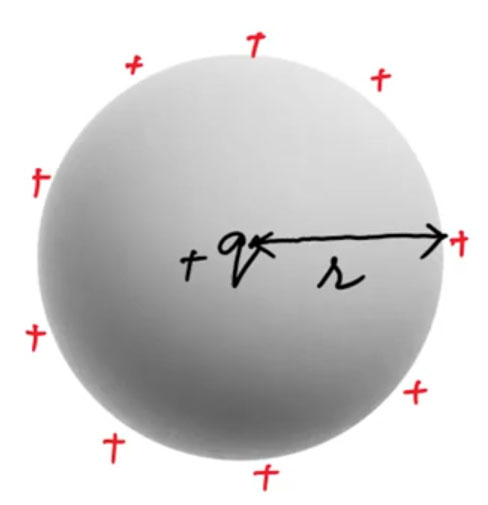
[V] [= \dfrac{1}{4\pi\varepsilon_0}\dfrac{Q}{R}]
Thus:
[C] [= \dfrac{Q}{V}] [= 4\pi\varepsilon_0 R]
This shows capacitance increases with size.
3. Dimensions and Units
- SI Unit of capacitance: Farad (F)
[
1\ \text{F} = 1\ \text{C V}^{-1}
] - Practical units:
- microfarad: [\mu\text{F} = 10^{-6}\ \text{F}]
- nanofarad: [\text{nF} = 10^{-9}\ \text{F}]
- picofarad: [\text{pF} = 10^{-12}\ \text{F}]
- Dimensions of capacitance:
[[M^{-1} L^{-2} T^{4} A^{2}]]
4. Key Features
- Capacitance depends on geometry, not on charge.
- Directly proportional to the ability to store charge.
- Medium affects capacitance through permittivity [\varepsilon].
- Larger conductor → larger capacitance.
- Capacitance increases when conductors are brought near others (basis of capacitors).
- Used in energy storage: [U = \dfrac{1}{2}CV^2].
- Determines how circuits respond to AC signals (filters, timing circuits).
5. Important Formulas to Remember
| Quantity | Formula |
|---|---|
| Definition of capacitance | [C] [= \dfrac{Q}{V}] |
| Potential of isolated spherical conductor | [V] [= \dfrac{1}{4\pi\varepsilon_0}\dfrac{Q}{R}] |
| Capacitance of isolated sphere | [C] [= 4\pi\varepsilon_0 R] |
| Energy stored in capacitor | [U] [= \dfrac{1}{2}CV^2 = \dfrac{Q^2}{2C} = \dfrac{1}{2}QV] |
| Relation between charge and electric field | [E] [= \dfrac{\sigma}{\varepsilon_0}] (for parallel plate capacitor) |
6. Conceptual Questions with Solutions
1. Why is capacitance independent of charge?
Because [C] depends on geometric constant [k] where [V = kQ]. Thus [C=\dfrac{1}{k}] depends only on shape and medium, not on Q.
2. Why is a larger sphere a better charge-storer?
Larger radius → smaller potential for same charge → higher capacitance.
3. Can capacitance ever be zero?
No. Any conductor in space has some finite capacitance due to its ability to hold charge.
4. Does bringing another conductor close affect capacitance?
Yes, it increases capacitance because potential for same charge decreases due to induced charges.
5. Why does a capacitor store energy?
Work is done in transferring charge onto the plates against electric forces; this work becomes electrostatic energy.
6. Why do we use capacitors instead of single conductors?
Two-conductor systems offer much higher capacitance → more charge storage for practical voltages.
7. Does changing charge change capacitance?
No. C remains the same; only Q and V change proportionally.
8. What happens to capacitance if medium is changed?
Capacitance increases by factor [\kappa = \dfrac{\varepsilon}{\varepsilon_0}].
9. Is capacitance affected by temperature?
Only indirectly—temperature affects permittivity of materials.
10. Can a neutral conductor have capacitance?
Yes. Capacitance exists regardless of stored charge.
11. Does potential become infinite for a conductor?
No physical conductor can have infinite potential because of charge leakage, breakdown, and air ionization.
12. Why isolated conductors in space have very small capacitance?
Space (vacuum) has low permittivity and far surroundings → small capacitance.
13. Why connecting two spheres by wire equalizes potentials?
Charge flows until both attain same potential, because electric field inside conductor must be zero.
14. Why is the capacitance of Earth very high?
Earth’s radius is large; using [C=4\pi\varepsilon_0R], Earth has ≈ 710 μF.
15. Does capacitance depend on distribution of charge on conductor?
No. Charge redistributes automatically; capacitance depends only on geometry.
7. FAQ / Common Misconceptions
1. “Capacitance increases when charge increases.”
Incorrect. Capacitance is independent of Q.
2. “Only two-plate systems have capacitance.”
No. Even a single isolated conductor has capacitance.
3. “Capacitance depends on material of conductor.”
Not significantly. Geometry matters more; material matters via permittivity if dielectric is used.
4. “Potential energy stored is QV.”
Correct formula is [\dfrac{1}{2}QV], not QV.
5. “Capacitors store charge permanently.”
No—they leak eventually; only store energy temporarily.
6. “Capacitance of a conductor is always the same.”
It changes with surroundings (distance to other conductors).
7. “Air gap has high permittivity.”
Air has low permittivity; dielectrics like mica increase capacitance greatly.
8. “Bigger charge means bigger voltage always.”
Voltage depends on capacitance too: [V=\dfrac{Q}{C}]. Large C → small V.
9. “Capacitors create current in DC circuits.”
They only transiently allow current during charging/discharging; steady-state DC current is zero.
10. “Capacitors store electrons on both plates.”
Net charge remains zero; each plate stores equal and opposite charges.
8. Practice Questions (With Step-by-Step Solutions)
Q1. A conductor develops a potential of [50\ \text{V}] when it holds a charge [2.5\times10^{-6}\ \text{C}]. What is its capacitance?
Solution:
[C] [= \dfrac{Q}{V}] [= \dfrac{2.5\times10^{-6}}{50}]
[C] [= 5.0\times10^{-8}\ \text{F}] [= 50\ \text{nF}]
Answer: [C = 50\ \text{nF}]
Q2. An isolated spherical conductor has radius [0.5\ \text{m}]. Find its capacitance.
Solution:
[C] [= 4\pi\varepsilon_0 R] [= 4\pi (8.85\times10^{-12})(0.5)]
[C] [= 4\pi \times 4.425\times10^{-12}] [\approx 55.6\times10^{-12}\ \text{F}]
[C] [\approx 5.6\times10^{-11}\ \text{F}] [= 56\ \text{pF}]
Q3. A conductor has capacitance [20\ \text{pF}]. What charge is required to raise potential by [200\ \text{V}]?
Solution:
[Q = CV] [= 20\times10^{-12} \times 200]
[Q = 4000\times10^{-12}] [= 4.0\times10^{-9}\ \text{C}]
Q4. A sphere of radius [R] has capacitance [C_1]. If its radius is doubled, what is new capacitance [C_2]?
Solution:
[
C = 4\pi\varepsilon_0 R
]
So if [R \rightarrow 2R]:
[C_2] [= 4\pi\varepsilon_0 (2R)] [= 2C_1]
Capacitance doubles.
Q5. A conductor requires [Q=5\times10^{-6}\ \text{C}] to raise its potential from [0\ \text{V}] to [100\ \text{V}]. How much work is done in charging it?
Solution:
Energy stored:
[U] [= \dfrac{1}{2}QV] [= \dfrac{1}{2}(5\times10^{-6})(100)]
[U] [= \dfrac{500\times10^{-6}}{2}] [= 250\times10^{-6}] [= 2.5\times10^{-4}\ \text{J}]
 Sign in with Google