

1. Concept Overview / Statement of the Law
Electrostatic Potential Difference (commonly called Voltage) tells us how much work is needed to move a unit positive charge from one point to another in an electric field.
It is one of the most important quantities in electrostatics because:
➡️ Charges move only when there is a potential difference.
➡️ It determines energy transfer, current flow, and stability of charges.
To understand it intuitively:
- Imagine two points A and B in an electric field.
- If point A has more potential energy per unit charge than point B, a positive charge will naturally “fall” from A to B—similar to how an object drops from a higher gravitational height to a lower height.
Thus:
Potential difference between two points A and B is the work done per unit charge by an external agent in moving a test charge from A to B slowly (without acceleration).
Mathematically,
[V_{AB}] [= V_A – V_B] [= \dfrac{W_{A \rightarrow B}}{q_0}]
This tells us:
- If [V_A > V_B], then work must be done to move a positive charge from B → A.
- If [V_A < V_B], positive charge naturally moves from A → B.
⚡ Potential difference, not absolute potential, determines physical effects.
This is why voltmeters measure difference, not individual potentials.
2. Explanation and Mathematical Derivation
Consider a small positive test charge [q_0] moving from point A to point B inside an electric field E.
The infinitesimal work done against the electric force is:
[dW] [= -\vec{F} \cdot d\vec{r}] [= -q_0 \vec{E} \cdot d\vec{r}]
Total external work from A to B:
[W_{A \rightarrow B}] [= -q_0 \int_{A}^{B} \vec{E} \cdot d\vec{r}]
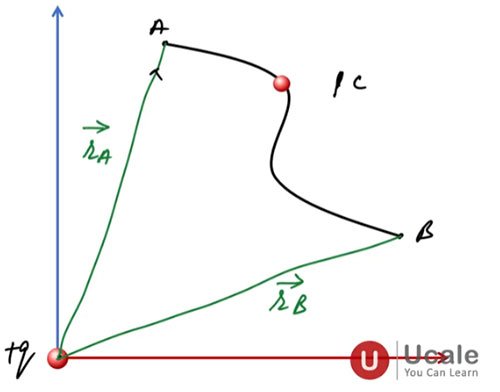
Potential difference is:
[
V_{AB} = \dfrac{W_{A \rightarrow B}}{q_0}
]
Thus:
[
V_{AB} = -\int_{A}^{B} \vec{E} \cdot d\vec{r}
]
Important: If the field is uniform:
[
\vec{E} = \text{constant}
]
Then:
[
V_{AB} = -E \cdot d
]
Where d is displacement along the direction of the field.
3. Dimensions and Units
- Unit: Volt (V)
[
1 \text{ V} = 1 \dfrac{\text{J}}{\text{C}}
]
- Dimensions:
[V] = [ML^2T^{-3}A^{-1}]
4. Key Features
- Potential difference is a scalar quantity.
- Charges move only when potential difference exists.
- It is path-independent (depends only on initial and final points).
- It determines how much energy each coulomb of charge gains or loses.
- Work done in moving a charge around a closed path is zero.
- Positive charge moves from higher to lower potential.
- Negative charge moves from lower to higher potential (opposite direction of field).
- In a uniform electric field, potential decreases linearly with distance.
- Potential difference is measurable, absolute potential often isn’t.
- Potential difference is zero when both points are at the same energy per unit charge.
5. Important Formulas (Table)
| Situation / Formula | Expression |
|---|---|
| Definition | [ V_{AB}] [= \dfrac{W_{A \rightarrow B}}{q_0} ] |
| Relation with field | [ V_{AB}] [= -\int_{A}^{B} \vec{E} \cdot d\vec{r} ] |
| Uniform field | [ V_{AB} = -Ed ] |
| Potential difference between two points due to point charge | [ V_{AB}] [= \dfrac{1}{4\pi\epsilon_0}Q \left( \dfrac{1}{r_A} – \dfrac{1}{r_B} \right) ] |
| Potential difference to move charge q | [ W = q V_{AB} ] |
| Electron energy (eV) | [ 1 \text{ eV} = 1.6 \times 10^{-19} \text{ J} ] |
6. Conceptual Questions with Solutions
1. Why do charges flow only when potential difference exists?
Because a difference in electric potential creates a difference in potential energy, resulting in a force that pushes charges.
2. Why does a positive charge move from higher potential to lower?
Because the electric field pushes it toward lower potential, reducing its potential energy.
3. Why does a negative charge move opposite to a positive charge?
Negative charge feels force opposite to electric field direction, so it moves from lower to higher potential.
4. Can potential difference be zero even if electric field exists?
Yes. If two points lie on the same equipotential surface, their potential difference is zero.
5. Can electric field be zero even when potential difference exists?
No. If potential difference exists, field cannot be zero between those points.
6. Why is potential difference independent of path?
Electrostatic forces are conservative; work depends only on the endpoints.
7. Why is work done around a closed path always zero?
Because you return to the same potential; net potential difference is zero.
8. If VA = 10 V and VB = 4 V, what does VAB represent?
[V_{AB} = V_A – V_B = 6 \text{ V}]. A positive test charge would naturally move from A to B.
9. How is potential difference related to energy?
[ W = q V_{AB} ]. Larger V means more energy change.
10. Why do electric fields point from high potential to low?
Because they show the direction in which a positive test charge would move naturally.
11. Why does potential difference decrease linearly in a uniform field?
Because [V = -Ed], where E is constant.
12. Can two points have different potentials but same potential energy?
No. Potential energy depends on charge × potential. Different potentials imply different energy per unit charge.
13. Why do we move charges slowly (without acceleration) while defining potential?
To prevent kinetic energy changes; only potential energy must change.
14. Why is potential difference measurable, but absolute potential often isn’t?
Because instruments compare two points; they cannot detect “zero level” at infinity.
15. Why doesn’t electric field do work on charges moving on an equipotential surface?
Because electric field is perpendicular to equipotential surfaces.
7. FAQ / Common Misconceptions
1. “If two points are equally distant from a charge, they must have zero potential difference.”
True for a single point charge, but false in general for unequal charge distributions.
2. “Voltage is the same as electric field.”
No. Voltage is energy per unit charge; field is force per unit charge.
3. “Zero potential difference means zero potential everywhere.”
No. Only the difference is zero; potentials can be nonzero.
4. “High potential difference always means strong electric field.”
Not always; strong field depends on potential gradient, not total V.
5. “Potential increases along the direction of electric field.”
False. Potential decreases along the field direction.
6. “If VA > VB, charge always moves from A to B.”
Only true for positive charges. Negative charges move opposite.
7. “Potential difference depends on how fast the charge moves.”
False. It depends only on positions, not velocity.
8. “Work done is zero only when potential difference is zero.”
False. Work done can be zero along certain paths even if V is not zero (e.g., equipotential paths).
9. “Potential difference can be measured at a single point.”
No. It is always between two points.
10. “Infinity always has zero potential.”
By convention only; not a physical necessity.
8. Practice Questions (With Step-by-Step Solutions)
Q1. Two points A and B have potentials 20 V and 5 V. What is VAB?
[V_{AB} = V_A – V_B] [= 20 – 5] [= 15 \text{ V}]
Q2. A 3 C charge moves between two points whose potential difference is 12 V. Find the work done.
[W = qV] [= 3 \times 12] [= 36 \text{ J}]
Q3. The electric field is uniform and has magnitude 5 N/C. What is the potential difference between two points 2 m apart along the field direction?
[V = -Ed] [= -5 \times 2] [= -10 \text{ V}]
Magnitude = 10 V.
Q4. What is the potential difference between two points at distances 0.2 m and 0.4 m from a 5 μC charge?
[V_{AB}] [= \dfrac{1}{4\pi\epsilon_0}Q \left( \dfrac{1}{r_A} – \dfrac{1}{r_B} \right)]
[V_{AB}] [= 9\times10^9 \times 5\times10^{-6} \left( \dfrac{1}{0.2} – \dfrac{1}{0.4} \right)]
[V_{AB}] [= 9\times10^9 \times 5\times10^{-6} \times (5 – 2.5)]
[V_{AB}] [= 112.5 \times 10^{3} \text{ V}]
Q5. A 2 C charge is moved from a point at 50 V to a point at 30 V. What is the change in potential energy?
[\Delta U = q \Delta V] [= 2 \times (30 – 50)]
[
\Delta U = -40 \text{ J}
]
Energy decreases.
 Sign in with Google