

1. Concept Overview / Statement of the Law
Electrostatic Potential (also called Electric Potential) is a measure of how much electric potential energy a unit positive test charge possesses at a point in an electric field.
It answers a simple but fundamental question:
“How difficult or easy is it to bring a positive charge from infinity to a point in the electric field?”
To bring a charge into an electric field, we must do work against or with electric forces.
Thus:
Electrostatic Potential at a point is defined as the amount of work done per unit positive test charge in bringing the charge from infinity to that point, slowly, without acceleration.
Mathematically,
[
V = \dfrac{W}{q_0}
]
A point at higher potential is where a positive charge has more electric potential energy.
A point at lower potential is where the charge has less electric potential energy.
Important: Potential is a scalar quantity, unlike electric field which is a vector.
2. Explanation and Mathematical Derivation
Consider an electric field E created by some charge distribution.
We want to bring a small unit positive test charge [q_0] from infinity to a point P.
Work done by an external agent in moving the charge over a small displacement d𝑟 is:
[dW] [= -\vec{F} \cdot d\vec{r}] [= -q_0 \vec{E} \cdot d\vec{r}]
(The negative sign indicates that external work is done against electric force.)
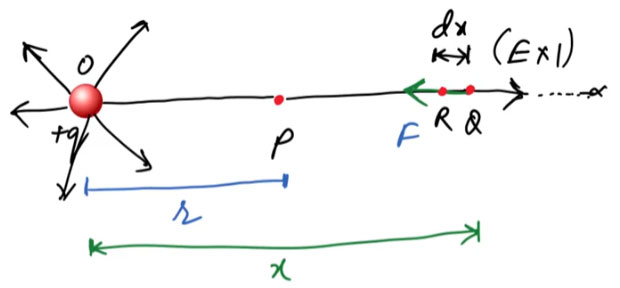
Total work done in bringing the test charge from infinity to P:
[W = -q_0 \int_{\infty}^{P} \vec{E} \cdot d\vec{r}]
Electrostatic potential is defined as:
[
V(P) = \dfrac{W}{q_0}
]
So,
[
V(P) = -\int_{\infty}^{P} \vec{E} \cdot d\vec{r}
]
This formula directly links electric field and electric potential.
For a point charge [Q]:
[
E = \dfrac{1}{4\pi\epsilon_0}\dfrac{Q}{r^2}
]
Using the above integral:
[
V = \dfrac{1}{4\pi\epsilon_0}\dfrac{Q}{r}
]
3. Dimensions and Units
- Unit: Volt (V)
[
1 \text{ Volt} = 1 \dfrac{\text{Joule}}{\text{Coulomb}}
] - Dimensions:
[
[V] = [ML^2T^{-3}A^{-1}]
]
4. Key Features
- Potential is a scalar quantity.
- Potential is defined relative to infinity (taken as zero potential).
- It describes the energy per unit charge, not the force.
- Potential is path-independent (electrostatic fields are conservative).
- Work done in a closed loop is zero.
- Higher potential means more energy for a positive charge.
- Negative potential means the point is below reference (infinity) in energy.
5. Important Formulas (Table)
| Situation | Electric Potential |
|---|---|
| Potential due to point charge [Q] at distance [r] | [ V = \dfrac{1}{4\pi\epsilon_0}\dfrac{Q}{r} ] |
| Potential difference | [ V_{AB} = W_{AB}/q_0 ] |
| Potential in terms of electric field | [ V = -\int \vec{E} \cdot d\vec{r} ] |
| Potential energy of two point charges | [ U = \dfrac{1}{4\pi\epsilon_0}\dfrac{Q_1 Q_2}{r} ] |
6. Conceptual Questions with Solutions (15)
1. Why is potential defined relative to infinity?
Because at infinity the electric field becomes negligible, so the electric potential energy becomes zero. It gives a consistent reference point.
2. Why is potential a scalar and field a vector?
Potential relates to work (energy), which has no direction. Electric field relates to force, which has direction.
3. What does a positive potential mean?
It means work must be done to bring a positive charge from infinity to that point.
4. What does a negative potential mean?
It means work is released when bringing a positive charge from infinity because the point attracts the charge.
5. Can potential be zero even if electric field is not zero?
Yes. On the perpendicular bisector of an electric dipole, potential is zero but field is not.
6. Can electric field be zero but potential nonzero?
Yes. Inside a charged spherical shell, field is zero but potential is constant and nonzero.
7. Why is potential difference more important than absolute potential?
Only differences in potential determine physical effects like current flow, not absolute values.
8. Why does potential decrease when moving against the field?
Because work must be done against the field, reducing the energy per unit charge.
9. What does infinite potential mean?
It means an infinite amount of work is needed to bring a charge extremely close to another point charge.
10. Why does potential vary as [1/r] for a point charge?
Because electric field varies as [1/r^2], and integration of [1/r^2] gives [1/r].
11. Do negative charges create negative potential?
Yes. A negative test charge lowers potential energy of a positive charge.
12. What does it mean when potential is constant in a region?
Electric field is zero (no change in potential with position).
13. Why is potential path-independent?
Electrostatic field is conservative, so work done depends only on initial and final points.
14. Is electrostatic potential energy same as potential?
No. Potential is work done per unit charge; energy is total work done for the actual charge.
15. Why is potential high near positive charges?
Because a positive test charge requires more work to approach another positive charge.
7. FAQ / Common Misconceptions (10)
1. “Zero potential means no charge is present.”
False. Zero potential can occur due to cancellation even when charges exist.
2. “Electric field and potential are the same.”
No. Field is vector (force/unit charge), potential is scalar (energy/unit charge).
3. “If potential is zero, field must be zero.”
Not true. Example: midpoint of dipole.
4. “Potential cannot be negative.”
It can be negative near negative charges.
5. “Potential depends on path taken.”
No. In conservative fields, work depends only on endpoints.
6. “Potential difference is not important.”
Actually, all physical effects (current flow, energy transfer) depend on potential difference.
7. “If field is zero, potential must be zero.”
No. Potential can be nonzero constant (e.g., inside spherical shell).
8. “Potential is force per unit charge.”
No. That is the definition of electric field.
9. “Potential at infinity is always zero.”
Only by convention. We choose it to simplify calculations.
10. “Higher potential means stronger electric field.”
Not always. Field depends on gradient (rate of change), not the magnitude of potential.
8. Practice Questions (With Step-by-Step Solutions)
Q1. What is the potential at a distance 20 cm from a point charge of +4 μC?
Solution:
[
V = \dfrac{1}{4\pi\epsilon_0}\dfrac{Q}{r}
]
[
V = 9 \times 10^9 \times \dfrac{4\times10^{-6}}{0.2}
]
[
V = 1.8 \times 10^5 \text{ V}
]
Q2. At what distance from a +2 μC charge is the potential 5 × 10⁴ V?
[
V = \dfrac{1}{4\pi\epsilon_0}\dfrac{Q}{r}
]
Rearranging:
[
r = \dfrac{1}{4\pi\epsilon_0}\dfrac{Q}{V}
]
[
r = 9\times10^9 \times \dfrac{2\times10^{-6}}{5\times10^4}
]
[
r = 0.36 \text{ m}
]
Q3. The potential difference between two points is 20 V. How much work is needed to move a 4 C charge between them?
[
W = qV
]
[W] [= 4 \times 20] [= 80 \text{ J}]
Q4. A point is at zero potential. A +3 μC charge placed there has potential energy 0 J. What is the potential energy of –3 μC charge?
[U = qV] [= -3\mu C \times 0] [= 0]
Both have zero potential energy.
Q5. What is the potential at the center of a uniformly charged spherical shell of radius R?
Inside the shell, potential is constant:
[
V = \dfrac{1}{4\pi\epsilon_0}\dfrac{Q}{R}
]
 Sign in with Google