

1. Concept Overview
A capacitor stores electrical energy in the form of an electric field between its plates when it is charged.
The total energy stored is equal to the work done in charging the capacitor from zero to a final charge [Q] at a potential difference [V].
The standard expression for energy stored in a capacitor is:
[U = \dfrac{1}{2} CV^{2}]
2. Clear Explanation and Mathematical Derivation
When a capacitor is being charged:
- The potential difference across it increases gradually from [0] to [V].
- At any instant, if the charge is [q], the potential is:
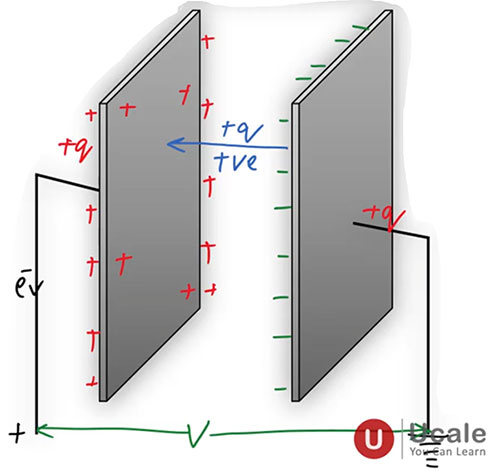
[V = \dfrac{q}{C}]
To add an infinitesimal charge [dq], the work done is:
[dW = V dq] [= \dfrac{q}{C}\ dq]
Total work done in charging from [0] to [Q]:
[W] [= \int_{0}^{Q} \dfrac{q}{C} \ dq]
[W] [= \dfrac{1}{C} \cdot \dfrac{Q^{2}}{2}]
[W = \dfrac{Q^{2}}{2C}]
Since [V = \dfrac{Q}{C}], substitute for [Q]:
[W = \dfrac{1}{2} C V^{2}]
Also:
[W = \dfrac{1}{2} Q V]
Thus, there are three equivalent forms:
[U] [= \dfrac{1}{2} C V^{2}] [= \dfrac{Q^{2}}{2C}] [= \dfrac{1}{2} Q V]
3. Dimensions and Units
| Quantity | Expression | Dimensions | SI Unit |
|---|---|---|---|
| Energy Stored | [U = \dfrac{1}{2} C V^{2}] | [ML^{2}T^{-2}] | Joule (J) |
4. Key Features
- Energy is stored in the electric field, not in the plates.
- Energy stored increases with:
- higher capacitance
- higher potential difference
- For a given charge [Q], a capacitor with higher capacitance stores less energy.
- For a given voltage [V], a capacitor with higher capacitance stores more energy.
- Dielectrics increase energy storage since they increase C.
5. Important Formulas to Remember
| Formula | Description |
|---|---|
| [U = \dfrac{1}{2} C V^{2}] | Energy in terms of capacitance and voltage |
| [U = \dfrac{Q^{2}}{2C}] | Energy in terms of charge and capacitance |
| [U = \dfrac{1}{2} Q V] | Work done in charging the capacitor |
| [u = \dfrac{1}{2} \epsilon E^{2}] | Energy density of electric field |
6. Conceptual Questions with Solutions
1. Where is energy actually stored in a capacitor?
Energy is stored in the electric field between the plates, not in the plates themselves. The dielectric region contains the electric potential energy.
2. Why does charging a capacitor require work?
Work must be done to move charges onto the plates against the electric field created by previously deposited charges. This work becomes the stored energy.
3. Does a capacitor with a dielectric store more energy?
Yes. A dielectric increases capacitance, and for the same voltage, stored energy [U = \dfrac{1}{2} C V^{2}] increases.
4. If voltage doubles, how does energy change?
Energy becomes four times because [U \propto V^{2}].
5. Does a capacitor always lose energy if discharged?
No. In ideal circuits, energy can be recovered. But in real circuits, some energy is lost as heat in resistance.
6. Why is only half of the supplied electrical energy stored?
Because the other half is dissipated as heat in the circuit resistance during charging.
7. Can a capacitor store energy without a dielectric?
Yes, an air-filled capacitor also stores energy, but less than one with a dielectric.
8. What happens to stored energy if we insert a dielectric after charging?
Capacitance increases, voltage decreases, and stored energy reduces.
9. If Q = 0, is energy zero?
Yes, because all formulas show that energy depends on either Q or V, both of which must be non-zero.
10. Why is the energy always positive?
Energy represents work done; work cannot be negative in charging a capacitor.
7. FAQ / Common Misconceptions
1. “Energy is stored on the plates.”
No. Energy is stored in the electric field between the plates.
2. “Energy is lost if a dielectric is inserted.”
Not always. If the capacitor is isolated, energy decreases; if connected to a battery, energy can increase.
3. “A capacitor stores charge.”
A capacitor stores equal and opposite charges on the plates but the actual stored physical quantity is energy.
4. “Energy stored is proportional to V.”
No. It is proportional to V².
5. “Larger voltage always means more energy.”
Only if capacitance remains the same.
6. “Capacitors always waste energy when charging.”
In ideal circuits, no. Loss occurs due to resistance in real circuits.
7. “Capacitor energy depends only on C.”
No. It depends on the combination of C, V, or Q.
8. “If C increases, energy must increase.”
Only if voltage is constant. Under constant charge, energy decreases.
9. “If a capacitor is shorted, all energy disappears.”
Energy is released rapidly as heat or spark.
10. “A charged capacitor weighs more.”
Yes — but extremely tiny. Energy contributes to mass via [E = mc^{2}].
8. Practice Questions (with Step-by-Step Solutions)
Q1. A capacitor of 10 μF is connected to a 200 V supply. Find the energy stored.
Solution:
[U = \dfrac{1}{2} C V^{2}]
[U] [= \dfrac{1}{2} \times 10 \times 10^{-6} \times (200)^{2}]
[U = 0.2\ \text{J}]
Q2. A capacitor stores 0.5 J of energy at 100 V. Find its capacitance.
[U = \dfrac{1}{2} C V^{2}]
[C] [= \dfrac{2U}{V^{2}}] [= \dfrac{1}{10000}] [= 100\ \mu F]
Q3. A 20 μF capacitor carries a charge of 200 μC. Find the stored energy.
[U = \dfrac{Q^{2}}{2C}]
[U] [= \dfrac{(200 \times 10^{-6})^{2}}{2 \times 20 \times 10^{-6}}]
[U = 1\ \text{J}]
Q4. A capacitor has C = 5 μF and stores 0.1 J. Find V.
[U = \dfrac{1}{2} C V^{2}]
[V] [= \sqrt{\dfrac{2U}{C}}] [= \sqrt{\dfrac{0.2}{5 \times 10^{-6}}}]
[V = 200\ \text{V}]
Q5. What happens to stored energy if C is doubled while V is kept constant?
[U = \dfrac{1}{2} C V^{2}]
If C doubles, U doubles.
 Sign in with Google