

1. Concept Overview
The point–slope form of a straight line is used when:
- The slope of the line is known, and
- One point on the line is given.
Statement:
The equation of a straight line passing through a point [(x_1, y_1)] and having slope [m] is:
[\boxed{y − y_1 = m(x − x_1)}]
2. Mathematical Derivation
Understanding the Idea
Let:
- [(x_1, y_1)] be a fixed point on the line
- [(x, y)] be any general point on the same line
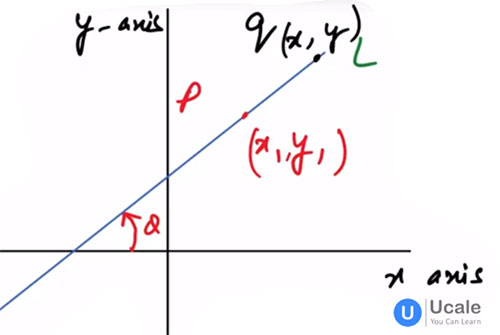
By definition of slope:
[m = \dfrac{y − y_1}{x − x_1}]
Multiply both sides by [(x − x_1)]:
[y − y_1 = m(x − x_1)]
This is the point–slope form of the equation of a straight line.
3. Key Features
- Requires only one point and slope
- Most fundamental form of line equation
- Basis for deriving other forms:
- Slope–intercept form
- Two point form
- Applicable to all non-vertical lines
4. Important Formulas to Remember
| Description | Formula |
|---|---|
| Point–slope form | [y − y_1 = m(x − x_1)] |
| Slope | [m = \dfrac{y − y_1}{x − x_1}] |
| Vertical line | [x = x_1] |
5. Conceptual Questions with Detailed Solutions
1. Why is this form called point–slope form?
Because it uses one known point and the slope of the line.
2. Can this form represent vertical lines?
No. Vertical lines have undefined slope.
3. What happens if the point is the origin?
The equation reduces to [y = mx].
4. Is this form unique for a given line?
Yes. For fixed slope and point, only one line exists.
5. Can any point on the line be used?
Yes. Using any point gives the same final equation.
6. How is this form related to two point form?
Two point form is derived by first finding slope, then using point–slope form.
7. Does the equation change if another point is chosen?
The form may look different, but represents the same line.
8. Is this form useful in physics?
Yes. Motion graphs often use it.
9. Can parameters appear in this form?
Yes. [m], [x_1], and [y_1] can be parameters.
10. Why is this form considered fundamental?
Because it directly follows from the definition of slope.
11. What if m = 0?
The equation reduces to [y = y_1], a horizontal line.
12. Does this form depend on the coordinate axes?
No. It is independent of axis orientation.
13. Is it easy to convert this into general form?
Yes. Expand and rearrange terms.
14. Can this form handle fractional slopes?
Yes. It works for all real slopes.
15. Is this form in Class 11 syllabus?
Yes. It is a core concept.
6. FAQ / Common Misconceptions
1. Point–slope form works for all lines.
False. It does not work for vertical lines.
2. The point must be the intercept.
False. Any point on the line can be used.
3. This form is difficult to use.
False. It is straightforward.
4. It cannot be converted to other forms.
False. It is the base of all other forms.
5. m must be positive.
False. It can be positive, negative, or zero.
6. Horizontal lines need special handling.
False. They naturally appear when [m = 0].
7. Using different points gives different lines.
False. It gives the same line.
8. This form is not useful graphically.
False. It is useful for plotting.
9. Coordinates must be integers.
False. They can be any real numbers.
10. This form is not examinable.
False. It is examinable and important.
7. Practice Questions with Step-by-Step Solutions
Question 1. Find the equation of the line passing through (2, 3) with slope 4.
Step-by-Step Solution:
Given point [(x_1, y_1) = (2, 3)]
Given slope [m = 4]
Use point–slope form:
[y − 3 = 4(x − 2)]
Simplify:
[y − 3 = 4x − 8]
[y = 4x − 5]
Conclusion:
Equation of the line is [y = 4x − 5].
Question 2. Find the equation of the line passing through (−1, 2) with slope −3.
Step-by-Step Solution:
[(x_1, y_1) = (−1, 2)]
[m = −3]
Point–slope form:
[y − 2 = −3(x + 1)]
Simplify:
[y − 2 = −3x − 3]
[y = −3x − 1]
Conclusion:
Equation is [y = −3x − 1].
Question 3. Find the equation of the line passing through (0, −4) with slope 5.
Step-by-Step Solution:
[(x_1, y_1) = (0, −4)]
[m = 5]
Point–slope form:
[y + 4 = 5(x − 0)]
Simplify:
[y = 5x − 4]
Conclusion:
Equation is [y = 5x − 4].
Question 4. Find the equation of the line passing through (3, −2) with slope 0.
Step-by-Step Solution:
[(x_1, y_1) = (3, −2)]
[m = 0]
Point–slope form:
[y + 2 = 0(x − 3)]
Simplify:
[y = −2]
Conclusion:
Equation of the line is [y = −2].
Question 5. Find the equation of the line passing through (a, b) with slope m.
Step-by-Step Solution:
Given [(x_1, y_1) = (a, b)]
Given slope [m]
Point–slope form:
[y − b = m(x − a)]
Conclusion:
Required equation is [y − b = m(x − a)].
Question 6. Find the equation of the line passing through (4, −1) and having slope 2.
Step-by-Step Solution:
Given point [(x_1, y_1) = (4, −1)]
Given slope [m = 2]
Use point–slope form:
[y − (−1) = 2(x − 4)]
Simplify:
[y + 1 = 2x − 8]
[y = 2x − 9]
Conclusion:
Equation of the line is [y = 2x − 9].
Question 7. Find the equation of the line passing through (−2, 5) with slope −1.
Step-by-Step Solution:
[(x_1, y_1) = (−2, 5)]
[m = −1]
Point–slope form:
[y − 5 = −1(x + 2)]
Simplify:
[y − 5 = −x − 2]
[y = −x + 3]
Conclusion:
Equation of the line is [y = −x + 3].
Question 8. Find the equation of the line passing through (1, −3) and having slope 0.
Step-by-Step Solution:
Given [(x_1, y_1) = (1, −3)]
Given slope [m = 0]
Point–slope form:
[y + 3 = 0(x − 1)]
Simplify:
[y = −3]
Conclusion:
Equation of the line is [y = −3].
Question 9. Find the equation of the line passing through (0, 6) and having slope −4.
Step-by-Step Solution:
[(x_1, y_1) = (0, 6)]
[m = −4]
Point–slope form:
[y − 6 = −4(x − 0)]
Simplify:
[y = −4x + 6]
Conclusion:
Equation of the line is [y = −4x + 6].
Question 10. Find the equation of the line passing through (p, q) and having slope 3.
Step-by-Step Solution:
Given point [(x_1, y_1) = (p, q)]
Given slope [m = 3]
Use point–slope form:
[y − q = 3(x − p)]
Conclusion:
Required equation is [y − q = 3(x − p)].
 Sign in with Google