

1. Concept Overview
The slope–intercept form of a straight line is used when:
- The slope of the line and
- The y-intercept of the line
are known.
Statement:
The equation of a straight line with slope [m] and y-intercept [c] is:
[\boxed{y = mx + c}]
2. Mathematical Derivation
Meaning of Terms
- Slope [m]:
Measures the steepness of the line
[m = \dfrac{\text{change in y}}{\text{change in x}}] - y-intercept [c]:
The point where the line cuts the y-axis
At y-axis, [x = 0], so [y = c]
Derivation
Let a straight line:
- Have slope [m]
- Cut the y-axis at point [(0, c)]
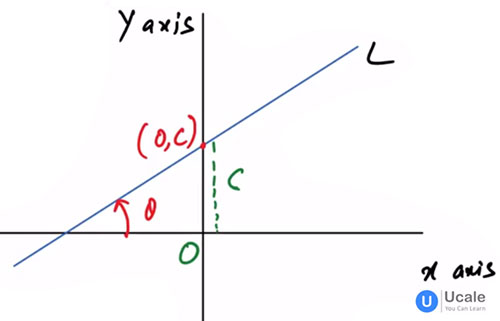
Using point–slope form:
[y − y_1 = m(x − x_1)]
Substitute [(x_1, y_1) = (0, c)]:
[y − c = m(x − 0)]
Simplifying:
[
\boxed{y = mx + c}
]
This is the slope–intercept form.
3. Key Features
- Simplest and most commonly used form
- Directly shows:
- Slope of the line
- Position where the line cuts the y-axis
- Easy to plot graphs
- Widely used in physics (e.g., motion graphs)
4. Important Formulas to Remember
| Description | Formula |
|---|---|
| Slope–intercept form | [y = mx + c] |
| y-intercept | [c = y] when [x = 0] |
| Slope | [m = \dfrac{\Delta y}{\Delta x}] |
5. Conceptual Questions with Detailed Solutions
1. Why is this form called slope–intercept form?
Because it directly shows the slope [m] and the y-intercept [c] of the line.
2. What happens if c = 0?
The line passes through the origin and the equation becomes [y = mx].
3. Can vertical lines be written in this form?
No. Vertical lines have undefined slope, so this form is not applicable.
4. What does a positive value of m indicate?
The line rises from left to right.
5. What does a negative value of m indicate?
The line falls from left to right.
6. What does c represent graphically?
It is the point where the line cuts the y-axis.
7. Can horizontal lines be represented?
Yes. For horizontal lines, [m = 0] and equation becomes [y = c].
8. Is slope–intercept form unique?
Yes. For a given straight line, values of [m] and [c] are fixed.
9. Why is this form preferred for graph plotting?
Because intercept and slope are immediately visible.
10. Can this form be converted into other forms?
Yes. It can be converted into general, intercept, or point–slope form.
11. What if m = 0 and c = 0?
The equation reduces to [y = 0], which is the x-axis.
12. Does changing c change the slope?
No. It only shifts the line up or down.
13. Does changing m affect intercept?
Not necessarily. It changes the steepness.
14. Is this form used in real-life problems?
Yes. Motion graphs and cost functions use this form.
15. Can parameters appear in this form?
Yes. [m] and [c] can both be constants or parameters.
6. FAQ / Common Misconceptions
1. All straight lines can be written in slope–intercept form.
False. Vertical lines cannot be written in this form.
2. c is the x-intercept.
False. [c] is the y-intercept.
3. m depends on origin.
False. Slope is independent of origin.
4. m is always positive.
False. It can be positive, negative, or zero.
5. Horizontal lines cannot be written.
False. They are written as [y = c].
6. c tells how steep the line is.
False. Steepness depends on [m].
7. If c is large, slope is large.
False. They are independent.
8. The graph always cuts y-axis.
True for non-vertical lines.
9. This form is only theoretical.
False. It is widely used in applications.
10. Slope–intercept form is not in syllabus.
False. It is a core Class 11 topic.
7. Practice Questions with Full Step-by-Step Solutions
Question 1. Find the equation of the line with slope 3 and y-intercept −2.
Step-by-Step Solution:
Given slope [m = 3]
Given y-intercept [c = −2]
Use slope–intercept form:
[y = mx + c]
Substitute values:
[y = 3x − 2]
Conclusion:
Equation of the line is [y = 3x − 2].
Question 2. Write the equation of the line with slope −1 and y-intercept 4.
Step-by-Step Solution:
[m = −1], [c = 4]
Substitute in formula:
[y = −x + 4]
Conclusion:
Required equation is [y = −x + 4].
Question 3. Find the equation of the line passing through the origin and having slope 5.
Step-by-Step Solution:
Slope [m = 5]
Passing through origin ⇒ [c = 0]
Equation:
[y = 5x]
Conclusion:
Equation is [y = 5x].
Question 4. Find the equation of the horizontal line with y-intercept −3.
Step-by-Step Solution:
Horizontal line ⇒ [m = 0]
[c = −3]
Equation:
[y = −3]
Conclusion:
Equation of the line is [y = −3].
Question 5. Write the equation of the line whose slope is 0 and y-intercept is 7.
Step-by-Step Solution:
[m = 0], [c = 7]
Equation:
[y = 7]
Conclusion:
Equation of the line is [y = 7].
Question 6. Find the equation of the line whose slope is 2 and which cuts the y-axis at (0, 5).
Step-by-Step Solution:
Given slope [m = 2]
Given y-intercept point [(0, 5)] ⇒ [c = 5]
Use slope–intercept form:
[y = mx + c]
Substitute values:
[y = 2x + 5]
Conclusion:
Equation of the line is [y = 2x + 5].
Question 7. Write the equation of the straight line whose slope is −3 and y-intercept is −1.
Step-by-Step Solution:
Given slope [m = −3]
Given y-intercept [c = −1]
Substitute in [y = mx + c]:
[y = −3x − 1]
Conclusion:
Required equation is [y = −3x − 1].
Question 8. Find the equation of the line passing through (0, −4) and having slope 1.
Step-by-Step Solution:
Slope given: [m = 1]
Point [(0, −4)] lies on y-axis ⇒ [c = −4]
Use slope–intercept form:
[y = mx + c]
Substitute values:
[y = x − 4]
Conclusion:
Equation of the line is [y = x − 4].
Question 9. Write the equation of the straight line whose slope is 0 and which passes through (0, −6).
Step-by-Step Solution:
Slope [m = 0] ⇒ horizontal line
Point on y-axis: [(0, −6)] ⇒ [c = −6]
Equation using slope–intercept form:
[y = 0·x − 6]
Simplify:
[y = −6]
Conclusion:
Equation of the line is [y = −6].
Question 10. Find the equation of the line whose slope is m and y-intercept is c.
Step-by-Step Solution:
Given slope [m]
Given y-intercept [c]
Use slope–intercept form:
[y = mx + c]
Conclusion:
Required equation is [y = mx + c].
 Sign in with Google