


1. Concept Overview
When two distinct points on a straight line are known, we can uniquely determine the equation of that straight line.
This form of the equation is called the Two Point Form of the equation of a straight line.
Statement:
The equation of a straight line passing through two points
[P(x_1, y_1)] and [Q(x_2, y_2)] is given by the two point form.
2. Mathematical Derivation
Step 1: Find the Slope of the Line
Let the given two points be:
- [P(x_1, y_1)]
- [Q(x_2, y_2)]
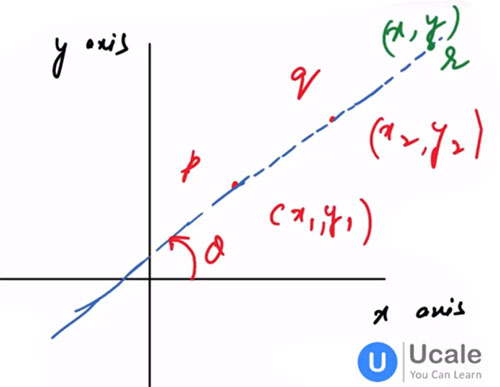
Slope of the line joining these two points is:
[m = \dfrac{y_2 − y_1}{x_2 − x_1}], provided [x_2 \neq x_1]
Step 2: Use Point–Slope Form
The point–slope form of the equation of a straight line is:
[y − y_1 = m(x − x_1)]
Substitute the value of [m]:
[y − y_1 = \dfrac{y_2 − y_1}{x_2 − x_1} (x − x_1)]
This is the Two Point Form of the equation of a straight line.
Final Two Point Form
[\boxed{y − y_1 = \dfrac{y_2 − y_1}{x_2 − x_1} (x − x_1)}]
Important Notes
- This form works only when the line is not vertical
- If [x_1 = x_2], the line is vertical and its equation is:
[x = x_1]
3. Key Features
- Requires two known points
- Gives a unique straight line
- Useful when intercepts are not known
- Easily convertible into other forms:
- Slope–intercept form
- General form
4. Important Formulas to Remember
| Description | Formula |
|---|---|
| Slope between two points | [m = \dfrac{y_2 − y_1}{x_2 − x_1}] |
| Two point form | [y − y_1 = \dfrac{y_2 − y_1}{x_2 − x_1} (x − x_1)] |
| Vertical line | [x = x_1] |
5. Conceptual Questions with Detailed Solutions
1. Why are two points sufficient to determine a straight line?
Because exactly one straight line can be drawn through any two distinct points.
2. What happens if the two given points are the same?
Then infinitely many lines pass through that point, so the equation cannot be uniquely determined.
3. Why does the two point form fail for vertical lines?
Because slope becomes undefined when [x_1 = x_2], leading to division by zero.
4. Can the two point form be converted to slope–intercept form?
Yes. By simplifying and rearranging, it can be written as [y = mx + c].
5. Is the order of points important?
No. Interchanging the points does not change the final equation.
6. Can this form represent horizontal lines?
Yes. If [y_1 = y_2], slope becomes zero and the equation reduces to [y = constant].
7. Does the equation depend on origin?
No. Shifting the origin does not change the straight-line nature.
8. Is two point form used in higher mathematics?
Yes. It is fundamental in coordinate geometry and vector geometry.
9. Can fractional slopes be handled easily?
Yes. Fractions do not cause any difficulty in this form.
10. Why is this form useful in numerical problems?
Because it directly uses given data without finding intercepts.
11. Can this form be used to check collinearity?
Yes. If the third point satisfies the equation, the points are collinear.
12. Is two point form symmetric?
Yes. It treats both given points equally.
13. Does this form give a unique equation?
Yes, provided the two points are distinct.
14. Can constants appear in the equation?
Yes. Coordinates may contain parameters.
15. Is this form applicable in analytic geometry only?
No. It is widely used in physics and engineering as well.
6. FAQ / Common Misconceptions
1. Two point form works for all straight lines.
False. It does not work for vertical lines.
2. Order of points changes the equation.
False. The final equation remains the same.
3. Slope must be calculated separately.
False. It is already built into the formula.
4. This form is difficult to use.
False. It is one of the most direct forms.
5. Vertical lines have no equation.
False. Their equation is [x = constant].
6. Two point form cannot give intercepts.
False. Intercepts can be found by simplifying.
7. Two point form is not examinable.
False. It is a core Class 11 topic.
8. Horizontal lines need special treatment.
False. They are automatically handled.
9. Parameters cannot be used.
False. Parameters are often used in problems.
10. This form cannot be converted to general form.
False. It can always be rearranged.
7. Practice Questions with Full Step-by-Step Solutions
Question 1. Find the equation of the line passing through (1, 2) and (3, 6).
Step-by-Step Solution:
Given points: [A(1, 2)], [B(3, 6)]
Find slope:
[m = \dfrac{6 − 2}{3 − 1} = \dfrac{4}{2} = 2]
Use two point form:
[y − 2 = 2(x − 1)]
Simplify:
[y − 2 = 2x − 2]
[y = 2x]
Conclusion:
Equation of the line is [y = 2x].
Question 2. Find the equation of the line passing through (−2, 3) and (4, −3).
Step-by-Step Solution:
Points: [A(−2, 3)], [B(4, −3)]
Slope:
[m = \dfrac{−3 − 3}{4 − (−2)} = \dfrac{−6}{6} = −1]
Two point form:
[y − 3 = −1(x + 2)]
Simplify:
[y − 3 = −x − 2]
[y = −x + 1]
Conclusion:
Equation of the line is [y = −x + 1].
Question 3. Find the equation of the line passing through (3, 5) and (3, −1).
Step-by-Step Solution:
Both points have same x-coordinate.
Line is vertical.
Conclusion:
Equation of the line is [x = 3].
Question 4. Find the equation of the line passing through (0, −2) and (4, 2).
Step-by-Step Solution:
Slope:
[m = \dfrac{2 − (−2)}{4 − 0} = 1]
Two point form using (0, −2):
[y + 2 = 1(x − 0)]
Simplify:
[y = x − 2]
Conclusion:
Equation is [y = x − 2].
Question 5. Find the equation of the line passing through (a, b) and (a + 1, b + 2).
Step-by-Step Solution:
Slope:
[m = \dfrac{(b + 2) − b}{(a + 1) − a} = 2]
Two point form:
[y − b = 2(x − a)]
Conclusion:
Required equation is [y − b = 2(x − a)].
Question 6. Find the equation of the line passing through (2, −1) and (6, 7).
Step-by-Step Solution:
Given points:
[A(2, −1)], [B(6, 7)]
Find the slope:
[m = \dfrac{7 − (−1)}{6 − 2} = \dfrac{8}{4} = 2]
Use two point form with point [A(2, −1)]:
[y − (−1) = 2(x − 2)]
Simplify:
[y + 1 = 2x − 4]
[y = 2x − 5]
Conclusion:
Equation of the line is [y = 2x − 5].
Question 7. Find the equation of the straight line joining the points (−3, 4) and (1, 4).
Step-by-Step Solution:
Given points:
[A(−3, 4)], [B(1, 4)]
Find the slope:
[m = \dfrac{4 − 4}{1 − (−3)} = \dfrac{0}{4} = 0]
Use two point form:
[y − 4 = 0(x + 3)]
Simplify:
[y − 4 = 0]
[y = 4]
Conclusion:
Equation of the line is [y = 4] (horizontal line).
Question 8. Find the equation of the line passing through (−1, −2) and (2, 1).
Step-by-Step Solution:
Points given:
[A(−1, −2)], [B(2, 1)]
Find the slope:
[m = \dfrac{1 − (−2)}{2 − (−1)} = \dfrac{3}{3} = 1]
Use two point form with point [A(−1, −2)]:
[y − (−2) = 1(x + 1)]
Simplify:
[y + 2 = x + 1]
[y = x − 1]
Conclusion:
Equation of the line is [y = x − 1].
Question 9. Find the equation of the line passing through (5, −3) and (5, 4).
Step-by-Step Solution:
Given points:
[A(5, −3)], [B(5, 4)]
Since [x_1 = x_2 = 5], the line is vertical.
Conclusion:
Equation of the line is [x = 5].
Question 10. Find the equation of the line passing through (p, q) and (p + 2, q − 2).
Step-by-Step Solution:
Given points:
[A(p, q)], [B(p + 2, q − 2)]
Find the slope:
[m = \dfrac{(q − 2) − q}{(p + 2) − p} = \dfrac{−2}{2} = −1]
Use two point form with point [A(p, q)]:
[y − q = −1(x − p)]
Simplify:
[y − q = −x + p]
Conclusion:
Equation of the required line is [y − q = −(x − p)].
 Sign in with Google